Journalism as rambling might make sense. Chances of interviews decrease all the time. I did phone Heidelberg about Total Print Expo and the answer is they don't know yet. Long ago I sent some questions to the Guardian for Alan Rusbridger. No reply though he has replied to comments on his blog so this is the sort of thing that is more likely. At the time I followed ABC numbers but it became clear that there is no model for how news organisations move online and no integrated ABC figures to show how titles do as print and Web.
Recently I notice that the print Guardian seems to carry on in a print sort of way. Attacks on bloggers are quite frequent. News about digital developments sometimes missing. The new Amazon Kindle has not turned up in my print Guardian. Announced Wednesday, this is Friday. However online there was a blog from Bobbie Johnson on Tuesday and a story updated yesterday though I only found it through Google.
Kindle DX heralded as "saviour of newspapers" apparently. So what do they mean? Can't be paper as such, it must be about news organisations. So far New York Times, Washington Post and Boston Globe are signed up for the new device with possible cheap hardware with a subscription. So would the Guardian do something similar in the UK? PDF can display on the larger screen without reflow. The PDF version of the Guardian is more or less a secret in the UK but could do with a relaunch.
Maybe it is just that different people make different decisions but the effect is that the print version of the Guardian seems to ignore a lot of actual news. Do they think the print audience is just going to stay loyal as a source of income and has no idea what they do online? If they have a coherent plan, why not tell people about it? I could be wrong about the lack of Kindle stories but this blog is one way of checking. Chances of the book aspects turning up on Saturday? Quite low I would think.
Also today Printweek hard copy version has a story about magazines that makes no mention of the Web either as a cause of declining advertising revenues or as a publishing option. Yet Haymarket as such seems to be moving online quite rapidly. Marketing Direct is now mostly a website. Print organisations can offer web design and digital communication. Printweek could do more to report what other magazines are thinking about and new devices such as the Amazon Kindle.
I will try a few emails but my guess is that new information will come about mostly through search and blog comments.
This IPEX blog is mostly about the UK. Meanwhile new developments may be included in the drupa blog where the memory of the innovation parc is still fresh.
Tuesday, May 05, 2009
Thinking about imagining IPEX is already happening. Not much will happen in the meantime as far as I can tell. The Printweek printed report on Northprint includes a statement that Total Print Expo is still "on the cards" following a significant drop in numbers for Northprint. So my guess is that there is a 70% chance of it happening and a 50% chance of Heidelberg being there. But this still may not be a very useful test on what is possible for book production. Jo Francis from Printweek has made a note to check out the Espresso in about six months time. This could be as significant an event. A lot of these tests are mostly spin, or culture. If digital book production is gaining attention, some way could be found for Blackwell to appear positive.
Monday, May 04, 2009
Printing and bookselling could fit together in various ways. For a long time there ahave been bookshops as an extension of a print operation. Cambridge University Press has a shop mostly with stock from their own titles. Most printers have had to get in stock from other sources if they wanted a shop to continue. So far there has not been much of a welcome for the Espresso and the development that Blackwell offer instant print on Charing Cross Road. I think printers could look at this again and use the publicity to investigate other possible combinations of online content and digital printing. Recent blog post by Jo Francis on the Printweek community site refers to reports that the Espresso binding may fall apart. She plans to visit Charing Cross Road within six months and check whether interest continues. I saw the final products at the London Book Fair and briefly at the Blackwell shop and I think the binding problem can be solved if it exists on any scale. Several people seemed well pleased with the result.
Looking at the detail on the reports of binding problems, it was only the first effort that fell apart on the visit by Valentine Low reported in the Times. The second one was ok so the process took 13 minutes. Paul Manning lists several problems in comment on anearlier Printweek report, but he also states that the problems could be resolved in a year or so.
The print industry has better binding equipment and suitable kit for short runs. It is still unclear what the Espresso runs will be like, especially for the originals people are asking for. There may be opportunities for print organisations to work with bookshops. Maybe there is space for more instant print on Charing Cross Road.
Looking at the detail on the reports of binding problems, it was only the first effort that fell apart on the visit by Valentine Low reported in the Times. The second one was ok so the process took 13 minutes. Paul Manning lists several problems in comment on anearlier Printweek report, but he also states that the problems could be resolved in a year or so.
The print industry has better binding equipment and suitable kit for short runs. It is still unclear what the Espresso runs will be like, especially for the originals people are asking for. There may be opportunities for print organisations to work with bookshops. Maybe there is space for more instant print on Charing Cross Road.
Tuesday, April 07, 2009
Redtie will talk about Web2Print at Northprint.
At the drupa Innovation Parc it was said that 2008 was the Web To Print drupa.
Perhaps this was not noticed enough at the time, given the interest in machinery.
But at Northprint there is no Heidelberg.
At the drupa Innovation Parc it was said that 2008 was the Web To Print drupa.
Perhaps this was not noticed enough at the time, given the interest in machinery.
But at Northprint there is no Heidelberg.
Monday, April 06, 2009
Could there be a Total Print Expo without Heidelberg?
An interesting interview in Printweek included (content quoted in full for purposes of review and comment)
So if Heidelberg is not at Northprint, will they be at Total Print Expo in October? This is not supposed to be "Southprint" but a continuation of Digital Print World with added litho or whatever meets the requirement. In 2008 Heidelberg showed how Anicolor coped with short runs. I thought this was exactly what a trade show is supposed to be about. Nearby Fuji showed a video about inkjet. Whatever run length you had in mind the Heidelberg stand showed actual production. See my story for OhmyNews. (The editors switched the headline to e-books, I thought the Heidelberg arrival at a digital show was the main news.)
Unless they see Total Print World as a niche show they may value, it will probably revert back to appearing to be a digital show. So what would that mean? It could mean that this was a show about "short runs" and only digital is still worth promoting. I used to think that Heidelberg would continue to attend as the comparison with inkjet would make more sense. the kit announced at drupa is expected to be better known later this year and leading up to IPEX 2010. What is a "short run"? 2,000 would cover quite a lot of print. People I spoke to in 2008 could not make much sense of the Heidelberg claims that Anicolor was suitable for runs less than 50. Just my impression, this is just a blog. But in future the case for litho comparisons will be more compelling as a topic.
Debate will wait for IPEX or even drupa but things change meanwhile. The London Bookfair will include a digital area with a stand for Easypress Technologies. The current interest is in ePUB but the Atomik Dynamic Publisher also supplies print ready PDF. So this relates to the drupa Innovation Parc and web-to-print. Life would be easier if the bookfair used all of the upstairs at Earl's Court and left some space in Earl's Court 2 for a print show such as Total Print Expo. The software companies could all be upstairs whatever they suggested as output. A major gain could be that the London College of Communications Futures Conference would still be upstairs but with a direct link to Total Print Expo. The arrangement where you have to walk round the whole building to find the stairs makes no sense at all. Easy to imagine on a blog. Expect more travel in time and space.
An interesting interview in Printweek included (content quoted in full for purposes of review and comment)
Daniel Danielli, Editor, Printweek - On a different topic, Heidelberg UK is not exhibiting at Northprint and you didn’t exhibit at Grafitalia – have you reviewed your exhibitions strategy?
Jürgen Rautert, Heidelberg Sales - Yes. To put it bluntly, I hate the amount of money we have been spending at exhibitions, it is too much. Drupa is something very special, so it’s hard to reduce our spend there, but we have drastically cut back on shows in the US and we will reduce at Ipex, but we will be there. We will reduce the number of minor shows we attend around the world, as we would rather use our showrooms to demonstrate our products. I don’t think it’s fair any more to spend the kind of money we were spending 10 years ago, because in the end the customer pays. It is the same for exhibitions as it is in every other field of business – the minor players in the niches will continue and a few of the bigger ones will continue, but the medium-sized fairs will disappear from the industry. That’s my prediction.
So if Heidelberg is not at Northprint, will they be at Total Print Expo in October? This is not supposed to be "Southprint" but a continuation of Digital Print World with added litho or whatever meets the requirement. In 2008 Heidelberg showed how Anicolor coped with short runs. I thought this was exactly what a trade show is supposed to be about. Nearby Fuji showed a video about inkjet. Whatever run length you had in mind the Heidelberg stand showed actual production. See my story for OhmyNews. (The editors switched the headline to e-books, I thought the Heidelberg arrival at a digital show was the main news.)
Unless they see Total Print World as a niche show they may value, it will probably revert back to appearing to be a digital show. So what would that mean? It could mean that this was a show about "short runs" and only digital is still worth promoting. I used to think that Heidelberg would continue to attend as the comparison with inkjet would make more sense. the kit announced at drupa is expected to be better known later this year and leading up to IPEX 2010. What is a "short run"? 2,000 would cover quite a lot of print. People I spoke to in 2008 could not make much sense of the Heidelberg claims that Anicolor was suitable for runs less than 50. Just my impression, this is just a blog. But in future the case for litho comparisons will be more compelling as a topic.
Debate will wait for IPEX or even drupa but things change meanwhile. The London Bookfair will include a digital area with a stand for Easypress Technologies. The current interest is in ePUB but the Atomik Dynamic Publisher also supplies print ready PDF. So this relates to the drupa Innovation Parc and web-to-print. Life would be easier if the bookfair used all of the upstairs at Earl's Court and left some space in Earl's Court 2 for a print show such as Total Print Expo. The software companies could all be upstairs whatever they suggested as output. A major gain could be that the London College of Communications Futures Conference would still be upstairs but with a direct link to Total Print Expo. The arrangement where you have to walk round the whole building to find the stairs makes no sense at all. Easy to imagine on a blog. Expect more travel in time and space.
Saturday, March 07, 2009
This blog will continue as IPEX 2002 even though 2010 is not far away. It is mostly about the UK, including the world of books and newspapers. The drupa2008 blog is more about global technology developments. This may turn out to be confusing but I have decided to avoid starting another blog when possible. More cross reference may help. There may be shifting opinions and quite a lot off topic, but coherence may appear in a later version.
This is a blog so it seems ok to borrow material from other sources and then add a comment. This week in Printweek Andrew Tribute has suggested that print companies may switch to Open Source Software and avoid the upgrade costs from Adobe and Microsoft. He mentions Scribus, as well as Xclamation and Passeportout. It is a significant event that Printweek can publish such an opinion. Perhaps Adobe is not seen as being central to the print industry as was once the case. I cannot find a stand booked at IPEX for example. Since buying Macromedia the promotion energy has been around Flash, what I call Adobe (FLSH). this move away from Adobe Classic could suggest that the products around Postscript and PDF are becoming commoditised or easily replicated. So Andrew Tribute is probably right to claim that most of page layout and PDF workflow could be managed with Open Source Software.
However, what I also think is that there is an implication for publishing that may be less comforting for the printing industry. Andrew Tribute wrote for WhatTheyThink in November 2008 about the E-Reader such as from Amazon or Sony - "I’m afraid at this time I am hardly impressed with these e-readers. I think the success they are having is more for the computer geek area where people want the latest technology." A PDF is available from Attributes download page. The Sony Reader has support for the ePUB format, also supported by many publishers and the Adobe Digital Editions Reader. A surprising development has been the scale of downloads of the Stanza Reader for i-Phone and i-Pod, much larger numbers than sales of the Kindle. So the ePUB format is already easy to access for a fairly large audience. It is based on open standards, starting with XHTML. Andrew Tribute observes that "Today there is awide availability of expert low-cost programmers who have skills to customise OSS and build it into an integrated network. (By the way, "low-cost" programmers relates to the total cost of the project compared to some license fees, open source supporters do charge a reasonable rate for a day's work) Main point, starting with an Open Document in Open Office, a print ready PDF is not the only option.
I think the print industry should also be more public in support for the Job Definition Format (JDF) another XML-friendly set of standards. Sean Smyth earlier reported in Printweek on Hunkeler Innovation that "I did not hear the word JDF in two days". JDF is not too technical to explain in general terms. Perhaps "web-to-print" is more exciting and the JDF version can come later in the flow. But there are going to be some fast publishing methods online. Print needs a workflow that compares, and ways to present it.
This is a blog so it seems ok to borrow material from other sources and then add a comment. This week in Printweek Andrew Tribute has suggested that print companies may switch to Open Source Software and avoid the upgrade costs from Adobe and Microsoft. He mentions Scribus, as well as Xclamation and Passeportout. It is a significant event that Printweek can publish such an opinion. Perhaps Adobe is not seen as being central to the print industry as was once the case. I cannot find a stand booked at IPEX for example. Since buying Macromedia the promotion energy has been around Flash, what I call Adobe (FLSH). this move away from Adobe Classic could suggest that the products around Postscript and PDF are becoming commoditised or easily replicated. So Andrew Tribute is probably right to claim that most of page layout and PDF workflow could be managed with Open Source Software.
However, what I also think is that there is an implication for publishing that may be less comforting for the printing industry. Andrew Tribute wrote for WhatTheyThink in November 2008 about the E-Reader such as from Amazon or Sony - "I’m afraid at this time I am hardly impressed with these e-readers. I think the success they are having is more for the computer geek area where people want the latest technology." A PDF is available from Attributes download page. The Sony Reader has support for the ePUB format, also supported by many publishers and the Adobe Digital Editions Reader. A surprising development has been the scale of downloads of the Stanza Reader for i-Phone and i-Pod, much larger numbers than sales of the Kindle. So the ePUB format is already easy to access for a fairly large audience. It is based on open standards, starting with XHTML. Andrew Tribute observes that "Today there is awide availability of expert low-cost programmers who have skills to customise OSS and build it into an integrated network. (By the way, "low-cost" programmers relates to the total cost of the project compared to some license fees, open source supporters do charge a reasonable rate for a day's work) Main point, starting with an Open Document in Open Office, a print ready PDF is not the only option.
I think the print industry should also be more public in support for the Job Definition Format (JDF) another XML-friendly set of standards. Sean Smyth earlier reported in Printweek on Hunkeler Innovation that "I did not hear the word JDF in two days". JDF is not too technical to explain in general terms. Perhaps "web-to-print" is more exciting and the JDF version can come later in the flow. But there are going to be some fast publishing methods online. Print needs a workflow that compares, and ways to present it.
Monday, December 15, 2008
Giving up now.
Disappointing to say the least. There should be something later if only slides.
I may have not done something I should have done. Refreshed a few times and logged on again once. My information at the moment is that nothing happened after the welcome screen.
My basic take remains the same. It is interesting that Printweek are prepared to try this. The Web is part of the mix, according to UK print journalists. That is a development.
Disappointing to say the least. There should be something later if only slides.
I may have not done something I should have done. Refreshed a few times and logged on again once. My information at the moment is that nothing happened after the welcome screen.
My basic take remains the same. It is interesting that Printweek are prepared to try this. The Web is part of the mix, according to UK print journalists. That is a development.
Friday, October 24, 2008
Scope for websites. The blogs started to take over around or after 2002 when they got so much easier to update. The websites became stuck as claims of some possibility or other. Forget the homepage said Jeff Jarvis at some point but I kept updating it to hang on to credibility. There should have been a database of stories, not just a constant rewrite. Still, they all exist somewhere so an archive should be possible. Stuff comes around. Next month Personal Computer World is promising a guide to databases.
The Total Print event has confirmed in my mind that print is now part of a digital scene. I tried to make litho interesting as news but this only worked to an extent. The editors of OhmyNews have switched the headlines on my story so that the e-book aspect is the priority. Seems reasonable for their audience.
So let us assume that WWWatford has arrived. It was intended as a destination for the UK print industry, like Cairo for Windows. The Heidelberg presentation was as good as this could get. Prinect and computer to plate. Litho could not be much more available. Web-to-print was all over the show. What the speed is for the UK industry to implement this sort of thing, that is another question. There may be more consolidation before there is much investment. Recent Printweek editorials have been frank about the level of investment that would make much sense, for example in capacity for magazines. The WWWatford site will continue to look at UK print with the global context getting easier to link in as attention turns to IPEX. Assume next year's Total Print much the same as this. The LCC conference was mostly about games and the Web so there is a discussion possible about how this fits with the display area.
The Acrobat Services sites are complicated by the Adobe introduction to Acrobat of all things Flash. It is no longer just about PDF. On balance I think most people are still mostly interested in PDF when they think about Acrobat but this is not the marketing view from Adobe. They seem to be giving up on Adobe Classic as if it is getting too easy for others to supply Postscript clones or PDF creation. Adobe Max is expected to be much more future proof. I think the UK is not really ready for much of this, partly because of bandwidth. So I intend to keep the UK site pretty much to Adobe Classic in themes, - flat pages, hard copy, documents as organisations are used to them. Also the Digital Editions Reader and ePUB. The PDFXML approach will be included but there is almost no support from Adobe in promoting this. At least with ePUB there is a group of people with an interest in reaching a wider audience.
The dotcom site is best thought of "in a cloud". That is where Adobe seem to be heading. It already includes some news about Google. Docs can save PDF and I also like Scribd. Their design makes good use of Flash but they seem to be interested in text as well. there may even be mention of Microsoft. The cloud beckons.
Remaining aspects of Flash will turn up as part of animX, a site about digital animation. I am interested in such content, just slow to believe it is a priority for people who are used to PDF.
The Total Print event has confirmed in my mind that print is now part of a digital scene. I tried to make litho interesting as news but this only worked to an extent. The editors of OhmyNews have switched the headlines on my story so that the e-book aspect is the priority. Seems reasonable for their audience.
So let us assume that WWWatford has arrived. It was intended as a destination for the UK print industry, like Cairo for Windows. The Heidelberg presentation was as good as this could get. Prinect and computer to plate. Litho could not be much more available. Web-to-print was all over the show. What the speed is for the UK industry to implement this sort of thing, that is another question. There may be more consolidation before there is much investment. Recent Printweek editorials have been frank about the level of investment that would make much sense, for example in capacity for magazines. The WWWatford site will continue to look at UK print with the global context getting easier to link in as attention turns to IPEX. Assume next year's Total Print much the same as this. The LCC conference was mostly about games and the Web so there is a discussion possible about how this fits with the display area.
The Acrobat Services sites are complicated by the Adobe introduction to Acrobat of all things Flash. It is no longer just about PDF. On balance I think most people are still mostly interested in PDF when they think about Acrobat but this is not the marketing view from Adobe. They seem to be giving up on Adobe Classic as if it is getting too easy for others to supply Postscript clones or PDF creation. Adobe Max is expected to be much more future proof. I think the UK is not really ready for much of this, partly because of bandwidth. So I intend to keep the UK site pretty much to Adobe Classic in themes, - flat pages, hard copy, documents as organisations are used to them. Also the Digital Editions Reader and ePUB. The PDFXML approach will be included but there is almost no support from Adobe in promoting this. At least with ePUB there is a group of people with an interest in reaching a wider audience.
The dotcom site is best thought of "in a cloud". That is where Adobe seem to be heading. It already includes some news about Google. Docs can save PDF and I also like Scribd. Their design makes good use of Flash but they seem to be interested in text as well. there may even be mention of Microsoft. The cloud beckons.
Remaining aspects of Flash will turn up as part of animX, a site about digital animation. I am interested in such content, just slow to believe it is a priority for people who are used to PDF.
Tuesday, October 07, 2008
"Earls Court in Outer Space", possible title for a future episode of Dr Who. I have been thinking about forms of fiction as a way to make more sense of things. Also time travel is unavoidable. This blog is about 2002 after all and the issues for UK print and publishing seem not to have changed very much. Also travel in actual space would be interesting as the Frankfurt bookfair is the same week as Total Print! So my first plot premise is that in the future there will be an integrated kind of show in London, "total communication" perhaps when the LCC gets used to not being LCP. This is some way off of course.


Diagrams show Earl's Court with a print and publishing event at the same time. Ground floor for anything heavy, print kit in Earl's Court 2 but connected to the books in Earl's Court 1. Upstairs for the agents near the Conference Centre, and pre-media, software any equipment that is fairly light. The LCC Futures Conference is in some other space at the back. Yes, there had to be a point to all this. the escalator will go straight to the LCC conference with a direct walking route from Earl's Court 2. Think about it. Next week you may find yourself walking all the way round Earl's Court to go up a level and walk back almost as far as where you started.
Anyway, back to the fiction. UK authors have started to vanish, but then reappear. Terry Pratchett is back again but still no sign of Doris Lessing. Then new texts appear on the Web in similar styles such as they may have written. The website is traced to Canada and there appears to be a connection with a Toronto agent played by Dan Ackroyd. Believe me, he will take the part. All he has to do is to explain that he is in contact with aliens and they have a method of producing books. Terry Pratchett was easy to clone but Doris Lessing is a bit more difficult.
Enter Doctor Who, played by Christopher Eccleston. He manages to negotiate a deal with Dan Ackroyd so that Doris Lessing returns to the UK and several authors agree to let the aliens have all digital rights while they keep hard copy rights for the UK. Also the entire building of Earl's Court and anyone in it during the show gets a trip round the planet earth. Only Christopher Eccleston can manage the confident grin as he hurries off to the next adventure. There could be a sequel depending on how the deal turns out.
Link to Doctor Who show and gif (animated)


Diagrams show Earl's Court with a print and publishing event at the same time. Ground floor for anything heavy, print kit in Earl's Court 2 but connected to the books in Earl's Court 1. Upstairs for the agents near the Conference Centre, and pre-media, software any equipment that is fairly light. The LCC Futures Conference is in some other space at the back. Yes, there had to be a point to all this. the escalator will go straight to the LCC conference with a direct walking route from Earl's Court 2. Think about it. Next week you may find yourself walking all the way round Earl's Court to go up a level and walk back almost as far as where you started.
Anyway, back to the fiction. UK authors have started to vanish, but then reappear. Terry Pratchett is back again but still no sign of Doris Lessing. Then new texts appear on the Web in similar styles such as they may have written. The website is traced to Canada and there appears to be a connection with a Toronto agent played by Dan Ackroyd. Believe me, he will take the part. All he has to do is to explain that he is in contact with aliens and they have a method of producing books. Terry Pratchett was easy to clone but Doris Lessing is a bit more difficult.
Enter Doctor Who, played by Christopher Eccleston. He manages to negotiate a deal with Dan Ackroyd so that Doris Lessing returns to the UK and several authors agree to let the aliens have all digital rights while they keep hard copy rights for the UK. Also the entire building of Earl's Court and anyone in it during the show gets a trip round the planet earth. Only Christopher Eccleston can manage the confident grin as he hurries off to the next adventure. There could be a sequel depending on how the deal turns out.
Link to Doctor Who show and gif (animated)

Sunday, March 02, 2008
Not sure about Adobe having reached a new stage with the release of AIR. It could be a significant date but this can only be clear later. I have found some evidence that Postscript is not promoted that often. The webpage still refers to Acrobat 6 so may not have been changed that often. The industry quotes about the PDF Print Engine are from 2006, maybe around the time of IPEX. There could well be an update during drupa but my impression is that most of the time this phase is more or less over.
Wednesday, February 27, 2008
I am just restarting to post to the PDF and print blogs. Yesterday I found out that Adobe have issued AIR as version 1 so it is not just an idea. My impression is that Adobe has actually turned into Macromedia. Adobe Classic is hard to find. Maybe Max is a better word than Macromedia, still used for an event. Acrobat is not just PDF, not even PDF in terms of what they will tell you about.
This blog from 2002 is probably going to be speculative and open to revision, based on guesswork and memory. The drupa2008 blog will appear to be more considered and based on reliable information. Not that Adobe explain much till the products are released. Digital Editions Reader? A complete mystery. That is why Scribd makes a lot of sense. I have done a test page.
The Scribd design gives the impression that they actually like documents. The Adobe site currently has so much animated production numbers that on low bandwidth such as we have in most of the UK everything grinds to a halt. All I want to do is get off the home page to somewhere with some information in a text format I can copy out. The medium is so much the message and always about how engaging Flash is. Enough already.
This blog from 2002 is probably going to be speculative and open to revision, based on guesswork and memory. The drupa2008 blog will appear to be more considered and based on reliable information. Not that Adobe explain much till the products are released. Digital Editions Reader? A complete mystery. That is why Scribd makes a lot of sense. I have done a test page.
The Scribd design gives the impression that they actually like documents. The Adobe site currently has so much animated production numbers that on low bandwidth such as we have in most of the UK everything grinds to a halt. All I want to do is get off the home page to somewhere with some information in a text format I can copy out. The medium is so much the message and always about how engaging Flash is. Enough already.
Tuesday, October 30, 2007
Every so often something happens that suggests 2002 IPEX is still a suitable place for some things. I remember towards the end of IPEX the BT speakers had aday off ill from the presentation theatre and the Adobe people got into a stride. One of their guests spoke about Acrobat for comment and markup. There was some additional programming involved. Later I discovered this was not widely taken up because the costs revolved copies of Acrobat on every desktop. Apparently the architiects found the prices ok when approving a large builing and Pfizer could afford any number of copies to speed up approval by the relevant authorities, but somehow the print industry was mostly left behind.

No sign of Adobe at Digital Print World. Artwork Systems were there though, with a Web based approval system. They charge for the server software but the browser level requires nothing but Java. Maybe 20 or 30 copies of Acrobat could be had for the same sort of price but this model makes a lot more sense if a large number of print customers are involved.
More on Digital Print World in a story for OhmyNews.

No sign of Adobe at Digital Print World. Artwork Systems were there though, with a Web based approval system. They charge for the server software but the browser level requires nothing but Java. Maybe 20 or 30 copies of Acrobat could be had for the same sort of price but this model makes a lot more sense if a large number of print customers are involved.
More on Digital Print World in a story for OhmyNews.
Sunday, August 12, 2007
it has happened again
the swicki is taking over more space
so some padding is needed
these US companies! Who needs them?
they just put themselves forward
install something and something else pops up
we just changed the code so it looks even bigger
that's because it is bigger
still, i'm sure there is a way round it
the swicki is taking over more space
so some padding is needed
these US companies! Who needs them?
they just put themselves forward
install something and something else pops up
we just changed the code so it looks even bigger
that's because it is bigger
still, i'm sure there is a way round it
Printweek has reported that NewsTec is cancelled.
This has been for newspapers. My guess is that few expect many new presses to be bought. In December 2005, Jeff Jarvis wrote about "the last presses" in his blog and for the Guardian.
You know what? Maybe he has got a point. There, value added blogging. Not just repeating a link.
So if the newspaper discussion has been moved from 2009 to 2010 it is reasonable to assume technology scope will include blogs, video etc for "news organisations" as Jeff Jarvis describes them.
Printweek has a new and improved website where the comments relate to the news. The previous Printing World site was a bit sketchy as a discussion board. I have added a comment to the report on the latest ABC figures for UK newspaper circulation. The report seems more aware of the issues than some stories in magazines about print. What is the general take on media within Haymarket?, I wonder. They seem still dedicated to hard copy. Only time will tell.
This has been for newspapers. My guess is that few expect many new presses to be bought. In December 2005, Jeff Jarvis wrote about "the last presses" in his blog and for the Guardian.
You know what? Maybe he has got a point. There, value added blogging. Not just repeating a link.
So if the newspaper discussion has been moved from 2009 to 2010 it is reasonable to assume technology scope will include blogs, video etc for "news organisations" as Jeff Jarvis describes them.
Printweek has a new and improved website where the comments relate to the news. The previous Printing World site was a bit sketchy as a discussion board. I have added a comment to the report on the latest ABC figures for UK newspaper circulation. The report seems more aware of the issues than some stories in magazines about print. What is the general take on media within Haymarket?, I wonder. They seem still dedicated to hard copy. Only time will tell.
Thursday, July 19, 2007
A new blog has been started for drupa 2008
http://drupa2008.blogspot.com
Very similar to this one, but convincingly forward looking.
http://drupa2008.blogspot.com
Very similar to this one, but convincingly forward looking.
Friday, November 17, 2006
I have put a new page on the WWWatford website. Since I started blogging the websites have been updated less frequently but they have become more like a blog or sequence of opinion. The page added is a draft for drupa in 2008 and quotes an article in Printing World about JDF being accepted over the next couple of years.
This kind of time travel is a way to try to keep up with the Adobe approach to pushing Acrobat online and towards Flash. the UK print industry is not going quite as quickly and this may also be true in other places.
This kind of time travel is a way to try to keep up with the Adobe approach to pushing Acrobat online and towards Flash. the UK print industry is not going quite as quickly and this may also be true in other places.
Tuesday, November 07, 2006
A relevant comment from 'Good Morning Silicon Valley', on the news that Google will now be selling small ads for US newspapers-
For the newspaper industry, which failed to understand where its future lay back before Craigslist had a CEO and Google was still run out of a Stanford dorm room, and has been suffering miserably for it ever since, the program is a way to make some money off inventory that would typically be filled with worthless house ads. But it also proffers a dubious bargain: it will bolster the newspapers' flagging advertising revenues, but it may undercut their existing advertising relationships and, more importantly, rates in the process. Says Publishing 2.0: "Handing the reins over to Google’s efficient direct response advertising machine will only hasten the realization that the Web is much more efficient than print at driving action and response."
Will this sort of thing work in the UK? Probably sometime soon. Though the official moment will only be recognised when you read it in a newspaper.
For the newspaper industry, which failed to understand where its future lay back before Craigslist had a CEO and Google was still run out of a Stanford dorm room, and has been suffering miserably for it ever since, the program is a way to make some money off inventory that would typically be filled with worthless house ads. But it also proffers a dubious bargain: it will bolster the newspapers' flagging advertising revenues, but it may undercut their existing advertising relationships and, more importantly, rates in the process. Says Publishing 2.0: "Handing the reins over to Google’s efficient direct response advertising machine will only hasten the realization that the Web is much more efficient than print at driving action and response."
Will this sort of thing work in the UK? Probably sometime soon. Though the official moment will only be recognised when you read it in a newspaper.
The Guardian Review on Saturday included a few paragraphs from the Bookseller on the inside back cover about the prospects for e-books, or an 'e-reading device'. Joel Rickett remembers the mistaken hopes for the CD-Rom in the '90s and suggests that publishers are now very cautious. There is no mention of Google or Google Books as such but news that Random House and Harper Collins are investing in digital versions of their titles. This may be to ensure the text can be found by search engines in a manner the publisher controls. Probably Joel Rickett reflects industry opinion in suggesting that although all publishers "are frantically planning for the tipping point when an e-reading device really takes off, predictions for the book's trade's 'iPod moment' range from two to five years."
In my view the process has already gone some way. Many people find text online that may or may not be regarded as a book equivalent. Last week I had a look at the new version of Acrobat from Adobe. Most of their presentation is about the benefits of Acrobat Connect for collaboration beyond the limits of the document. This conferencing suite used to be known as Breeze from Macromedia and is mostly based on Flash. Lots of video and animated Powerpoint etc. I am still in shock about this as I am used to editing text or adding comments to a fixed page. Maybe this is something I will get used to eventually but it is a point of departure for Acrobat as a PDF product. Over the last ten years or so PDF has represented on screen the layout of a printed page. Adobe seem to think we should be moving away from this. I will try to keep an open mind but the arrival of Acrobat 8 is for me a defining moment in realising what I liked about all the previous versions. Apparently the new version of a Reader will be in Flash but can accept PDF as an input. I have had a look at the beta. Maybe some people will prefer this. A small download if you already have Flash, but there is no way to copy out text to combine with something else. An engagement platform? I don't think so.
Have a look at this ad c/o YouTube
This strikes me as mostly an ad for Flash. The type is all over the place. With previous versions of Adobe there was often a White Paper or something similar in a PDF format. This sort of thing is now harder to find.
Enough on where Adobe might be going. The main point is that an 'iPod moment' for books has already happened.
In my view the process has already gone some way. Many people find text online that may or may not be regarded as a book equivalent. Last week I had a look at the new version of Acrobat from Adobe. Most of their presentation is about the benefits of Acrobat Connect for collaboration beyond the limits of the document. This conferencing suite used to be known as Breeze from Macromedia and is mostly based on Flash. Lots of video and animated Powerpoint etc. I am still in shock about this as I am used to editing text or adding comments to a fixed page. Maybe this is something I will get used to eventually but it is a point of departure for Acrobat as a PDF product. Over the last ten years or so PDF has represented on screen the layout of a printed page. Adobe seem to think we should be moving away from this. I will try to keep an open mind but the arrival of Acrobat 8 is for me a defining moment in realising what I liked about all the previous versions. Apparently the new version of a Reader will be in Flash but can accept PDF as an input. I have had a look at the beta. Maybe some people will prefer this. A small download if you already have Flash, but there is no way to copy out text to combine with something else. An engagement platform? I don't think so.
Have a look at this ad c/o YouTube
This strikes me as mostly an ad for Flash. The type is all over the place. With previous versions of Adobe there was often a White Paper or something similar in a PDF format. This sort of thing is now harder to find.
Enough on where Adobe might be going. The main point is that an 'iPod moment' for books has already happened.
Monday, October 30, 2006
I have now done a Google custom search engine for JDF, the Job Definition Format.
I thought about changing the current balance, PDF-ISO9000-quality-learning , but I don't think JDF is yet as interesting in terms of people looking for it. So the JDF one will stay as a side project for a while. The stats show at least 10 time as many searches on PDF as JDF.
I thought about changing the current balance, PDF-ISO9000-quality-learning , but I don't think JDF is yet as interesting in terms of people looking for it. So the JDF one will stay as a side project for a while. The stats show at least 10 time as many searches on PDF as JDF.
Thursday, October 26, 2006
Google have started a sort of social software version of a search engine. I am not sure it is as networked as the Eurekster Swicki idea. I have tried to start with it and it seems to me intended to have a fairly sharp focus. There is no word cloud for example. These are great to show that there are different aspects to a collection and the relative sizes show how much each is used. I will still work on the Eurekster Swickis and I expect the Google move to strengthen this concept. There is a page showing mine at Learn9.net, Hello Spiders.
The 'learn9' one is important for me as it shows links between quality and learning. I don't find this much in academic sources where learning is studied.
The Google ones are focused just on PDF, ISO 9000, quality and learning. You can put the same query into each if you like. The ISO 9000 one assumes an 'objective' model is possible for any system. The 'quality' one includes 'critique' and all other options. That's the design intention anyway.
And now a graphic for the PDF Search Engine. The Google idea of a graphic is not very flash, but it probably loads fairly quickly.

The 'learn9' one is important for me as it shows links between quality and learning. I don't find this much in academic sources where learning is studied.
The Google ones are focused just on PDF, ISO 9000, quality and learning. You can put the same query into each if you like. The ISO 9000 one assumes an 'objective' model is possible for any system. The 'quality' one includes 'critique' and all other options. That's the design intention anyway.
And now a graphic for the PDF Search Engine. The Google idea of a graphic is not very flash, but it probably loads fairly quickly.

OhmyNews have published my story about last week's Digital Print World and the Acrobat 8 launch in the UK.
Maybe I lack a bit of balance, but I still think the main news about Digital Print World was that Adobe were not there. Maybe they are right if they think print is more or less over. It certainly needs to change fairly rapidly to keep up with the web as an option.
Maybe I lack a bit of balance, but I still think the main news about Digital Print World was that Adobe were not there. Maybe they are right if they think print is more or less over. It certainly needs to change fairly rapidly to keep up with the web as an option.
Tuesday, October 24, 2006
A lot happened last week but I did not update this blog. For one thing the last entry more or less stands. At the three dome Regent's Park two hour special on Acrobat 8 there was no time at all for JDF. This was a special version intended for 'creatives'. Not general knowledge workers or engineers or some other group that might not need print. I honestly got the impression that Adobe now believe that 'creatives' are only interested in video for mobile phones or whatever else is interesting at the moment. Press and magazine advertising is in decline but is probably still at least half of what London agencies are turning over. Just a bit about JDF would not have been out of place.
Reviewing Acrobat 8 for Digital Printer, Nessan Cleary wrote that there is more on JDF "though none of the Adobe staff at the press launch seemed to be too clued up on JDF, and Adobe doesn't appear to have tested its JDF with any of the MIS or workflow systems that one would expect it to be used with." Later he writes that PDF1.7 supports PDFX/-4 and native transparency. "We will now start to see workflow vendors upgrading their RIPs with the new PDF Print Engine." Now this may be based on some guidance from the press launch. My impression as a blogger is that there is an absolute disconnect between the press release out of Chicago and the experience in the UK and other places. Unless the JDF aspect is explained the benefits of the PDF Print Engine will not result in a rush to upgrade current RIPs.
Explained that is from end to end. Desktop to RIP as a consistent story.
By the way, most executives in enormous companies realise that they face a cost in a print bill. Even today the web cannot cope with all communication. The assumed Adobe target audience for Acrobat 8 might be slightly interested in the benefits of JDF for costs and schedules.
The reality as, however, that Adobe probably think they did enough for print at IPEX and will do something else at drupa in 2008. I have done a slideshow from previous photos and the official drupa song. About 12 meg. Other video etc. will appear later.
The slideshow PDF was created in Adobe Album. This never seems to heve been developed much in Acrobat. I got the impression that there was not much emphasis on any of the multimedia features in the presentation of Acrobat 8. Web capture of pages with Flash has always been a bit dodgy and there is no news of any improvement. Perhaps corporates don't like external files that may contain a virus. Or maybe they don't like Flash anyway. So what will they make of Breeze?
Reviewing Acrobat 8 for Digital Printer, Nessan Cleary wrote that there is more on JDF "though none of the Adobe staff at the press launch seemed to be too clued up on JDF, and Adobe doesn't appear to have tested its JDF with any of the MIS or workflow systems that one would expect it to be used with." Later he writes that PDF1.7 supports PDFX/-4 and native transparency. "We will now start to see workflow vendors upgrading their RIPs with the new PDF Print Engine." Now this may be based on some guidance from the press launch. My impression as a blogger is that there is an absolute disconnect between the press release out of Chicago and the experience in the UK and other places. Unless the JDF aspect is explained the benefits of the PDF Print Engine will not result in a rush to upgrade current RIPs.
Explained that is from end to end. Desktop to RIP as a consistent story.
By the way, most executives in enormous companies realise that they face a cost in a print bill. Even today the web cannot cope with all communication. The assumed Adobe target audience for Acrobat 8 might be slightly interested in the benefits of JDF for costs and schedules.
The reality as, however, that Adobe probably think they did enough for print at IPEX and will do something else at drupa in 2008. I have done a slideshow from previous photos and the official drupa song. About 12 meg. Other video etc. will appear later.
The slideshow PDF was created in Adobe Album. This never seems to heve been developed much in Acrobat. I got the impression that there was not much emphasis on any of the multimedia features in the presentation of Acrobat 8. Web capture of pages with Flash has always been a bit dodgy and there is no news of any improvement. Perhaps corporates don't like external files that may contain a virus. Or maybe they don't like Flash anyway. So what will they make of Breeze?
Monday, October 16, 2006
Adobe have announced a "1.1" version of the PDF Print Engine as it now works with PDF 1.7 and Mac OSX.
I still think an "end-to-end" workflow will not happen unless the JDF creation in Acrobat is explained just a little.
I still think an "end-to-end" workflow will not happen unless the JDF creation in Acrobat is explained just a little.
Tuesday, October 10, 2006
I have set up two topics on the 'Comment Requested' blog.
It is not an invention that I can't get the comments to work on this IPEX 2002 blog.
One is about the urgency of the print industry getting momentum for JDF as a marketing opportunity. Print customers could be aware that JDF is useful for them.
I have set up a poll on a JDF lens at Squidoo. Keep scrolling down.
The second topic is about the way Adobe is moving away from PDF, at least just for hard copy. Acrobat 8 is a further move into the office. Connect is Flash, not PDF. I am still in shock about this. I may get used to it by the time 8 is released. It still should be a concern for printers though. Maybe PDF will depend on a wider range of support.
It is not an invention that I can't get the comments to work on this IPEX 2002 blog.
One is about the urgency of the print industry getting momentum for JDF as a marketing opportunity. Print customers could be aware that JDF is useful for them.
I have set up a poll on a JDF lens at Squidoo. Keep scrolling down.
The second topic is about the way Adobe is moving away from PDF, at least just for hard copy. Acrobat 8 is a further move into the office. Connect is Flash, not PDF. I am still in shock about this. I may get used to it by the time 8 is released. It still should be a concern for printers though. Maybe PDF will depend on a wider range of support.
Saturday, September 30, 2006
I am now even more convinced that AdTech marked a new phase for the acceptance of online publishing in the UK. Maybe it had happened already and I missed it. I have now had a look at the new Haymarket directory site - BlueBoomerang. This is comprehensive in market sectors including print and direct mail. The focus is shifting towards digital, however slowly in some cases. At Digital Print World there will be software that could be used for direct mail in hard copy or email. Printweek covers this to some extent.
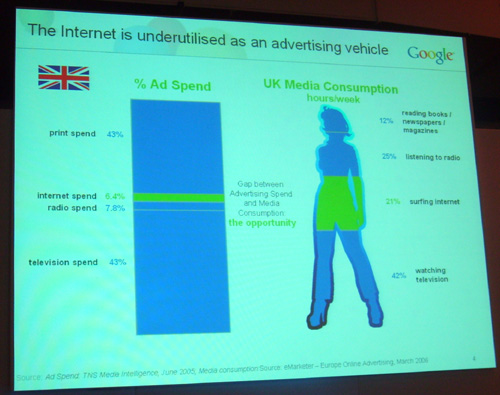
Meanwhile here are some photos of slides from Google University. Other numbers are available but the overall picture seems clear enough. This is based on current UK, so the growth of broadband will move it further. A stand for Brand Republic at a future AdTech is a strong probability.


Meanwhile here are some photos of slides from Google University. Other numbers are available but the overall picture seems clear enough. This is based on current UK, so the growth of broadband will move it further. A stand for Brand Republic at a future AdTech is a strong probability.


Friday, September 29, 2006

Here is a photo of the stand on next year's dates for AdTech London, outside Pizza Express. Notice the 'Revolution' logo bottom right. My question remains why Haymarket have not decided to promote Brand Republic instead. A website could be more interesting for this audience than a printed magazine. In my opinion it is highly likely something will change in time for the next AdTech.
Wednesday, September 27, 2006
Off to AdTech tomorrow. Like a direct mail show, but online.
Haymarket are a media partner and last year were in the basement with a hospitality area. Strangely they promoted their print magazines - Marketing etc. Revolution got included - covering online - but I don't remember much about Brand Republic - the website version of their advertising media publishing. Not sure why this should be. the Haymarket policy may be to recognise the web but it is not coming over in their promotion. At least that was what I thought last year.
Still no news on a Lawrence Wallis blog. Maybe Brand Republic could offer him some space.
To comment, please switch to commentrequest.
Haymarket are a media partner and last year were in the basement with a hospitality area. Strangely they promoted their print magazines - Marketing etc. Revolution got included - covering online - but I don't remember much about Brand Republic - the website version of their advertising media publishing. Not sure why this should be. the Haymarket policy may be to recognise the web but it is not coming over in their promotion. At least that was what I thought last year.
Still no news on a Lawrence Wallis blog. Maybe Brand Republic could offer him some space.
To comment, please switch to commentrequest.
Saturday, September 23, 2006
I have now started another blog, comments allowed
http://commentrequest.blogspot.com/
So please go to item on Lawrence Wallis if you know where his adventures on the blogosphere may be found.
This new blog may have a wider scope. I have tended to start a new blog when in doubt so this one could be a way to integrate some ideas, even if only just as questions.
http://commentrequest.blogspot.com/
So please go to item on Lawrence Wallis if you know where his adventures on the blogosphere may be found.
This new blog may have a wider scope. I have tended to start a new blog when in doubt so this one could be a way to integrate some ideas, even if only just as questions.
I have now visited Life Bytes , opposite the Odeon in Sidwell Street Exeter, for a full discussion on this Breeze as Acrobat situation. I am told that "it may not be a bad thing".
So ok, I am trying to get my head round it. Starting with my own experience that I don't find Flash content as 'engaging' as PDF or text. It is like being hit over the head with a Powerpoint presentation as designed sometime ago. There is no record of it, it cannot be edited or combined with other sources. I think Powerpoint has become much better or at least I have got used to it enough to copy out the bits I need.
Acrobat Connect may be improved on the current Breeze or maybe things will improve later. I would like an option to save the presentations as PDF and also to save the chat as PDF or text. These can be posted later apparently but the people in the audience have no option to do it for themselves. Maybe this is the attraction of Flash, that it is easier to keep control of content, but this is not the same as an engaging platform. Before the recent presentation of Acrobat 8, Adobe used to offer video plus PDF download. I found that much easier to follow or study later. The crazed load of Flash touring Acrobat 8 is impossible to follow if you want to get past the supposed benefits towards the actual features. What I want is a PDF file with a carefully structured set of bookmarks on the left.
I have not found any reference to improvements in PDF as a container for Flash, Quicktime or other media. Acrobat 7 is able to capture web pages with Flash, but it tends to come and go. You have to reload occasionally. I don't understand why and maybe this is not a problem for everyone but I notice PDF is rarely used for multimedia. Is it a technical limitation, or has Adobe just stopped explaining the option? At LifeBytes I was told there is another problem in controlling how Quicktime is displayed when designing a PDF from scratch. Apparently it pops out of the page and finds a new size. Maybe this is ok with a screen culture and some people I know are just hanging on to the idea of a page.
Meanwhile I am enjoying the video on Youtube so I don't mind Flash as such. The next couple of months could be a time for revision on PDF so far and maybe for looking at Breeze potential.
So ok, I am trying to get my head round it. Starting with my own experience that I don't find Flash content as 'engaging' as PDF or text. It is like being hit over the head with a Powerpoint presentation as designed sometime ago. There is no record of it, it cannot be edited or combined with other sources. I think Powerpoint has become much better or at least I have got used to it enough to copy out the bits I need.
Acrobat Connect may be improved on the current Breeze or maybe things will improve later. I would like an option to save the presentations as PDF and also to save the chat as PDF or text. These can be posted later apparently but the people in the audience have no option to do it for themselves. Maybe this is the attraction of Flash, that it is easier to keep control of content, but this is not the same as an engaging platform. Before the recent presentation of Acrobat 8, Adobe used to offer video plus PDF download. I found that much easier to follow or study later. The crazed load of Flash touring Acrobat 8 is impossible to follow if you want to get past the supposed benefits towards the actual features. What I want is a PDF file with a carefully structured set of bookmarks on the left.
I have not found any reference to improvements in PDF as a container for Flash, Quicktime or other media. Acrobat 7 is able to capture web pages with Flash, but it tends to come and go. You have to reload occasionally. I don't understand why and maybe this is not a problem for everyone but I notice PDF is rarely used for multimedia. Is it a technical limitation, or has Adobe just stopped explaining the option? At LifeBytes I was told there is another problem in controlling how Quicktime is displayed when designing a PDF from scratch. Apparently it pops out of the page and finds a new size. Maybe this is ok with a screen culture and some people I know are just hanging on to the idea of a page.
Meanwhile I am enjoying the video on Youtube so I don't mind Flash as such. The next couple of months could be a time for revision on PDF so far and maybe for looking at Breeze potential.
It is possible that Lawrence Wallis has joined in with the blogging scene. His words in Printweek are about the 'blook'. Surprisingly for me he makes no objection to the word 'blook' although he sometimes has a problem with variations on established language. His major complaint this week is about the standardised and restricted stock of most bookshops. Maybe he is finding that the web offers the variety and serendipity that browsing in bookshops offered in days gone by.
Mysteriously, he adds that "loyal readers ( rumour suggests one might exist ) may have noticed that I spent some time in the blogosphere to escape the bleak scene in bookselling". Well, sadly I can find no trace of this. Try the link, things may have been updated,
Please let me know if a link to a Lawrence Wallios blog turns up. Sorry, I can't find a way to turn on comments.
By the way, he is crestfallen that the Blooker Prize has been won by yet another cookery book. You know what? He has got a point.
Mysteriously, he adds that "loyal readers ( rumour suggests one might exist ) may have noticed that I spent some time in the blogosphere to escape the bleak scene in bookselling". Well, sadly I can find no trace of this. Try the link, things may have been updated,
Please let me know if a link to a Lawrence Wallios blog turns up. Sorry, I can't find a way to turn on comments.
By the way, he is crestfallen that the Blooker Prize has been won by yet another cookery book. You know what? He has got a point.
Thursday, September 21, 2006
I am still in shock after trying to take in the new information about Acrobat 8. The striking feature is that Acrobat is now based on Flash as well as PDF. What was Breeze is now Acrobat Connect, a conferencing system with a big advert button in the middle of the PDF oriented menu.
Kevin Lynch, previously with Macromedia, is Adobe vice president of product marketing for the Knowledge Worker Business Unit (KWBU) with responsibility for Acrobat and the Flash Media Server. He recently told Kurt Foss - "One of my visions at Macromedia has always been about the combination of asynchronous and synchronous communication. At Macromedia, with Breeze we were heavily involved with the synchronous real time—including the use of persistent meeting rooms. We also realized people want to get information that isn't always in real time. The document format from Acrobat is a perfect fit for that vision. Now we really have documents and people."
So the Breeze approach - a mix of chat, video and Powerpoint - is seen as closer to people than hard copy documents. Previously Adobe has not really promoted the PDF as slideshow option and the collaboration features have required really expensive server support. Acrobat Professional 7 did allow comments to be enabled in a PDF but effectively this was a secret. Flash now is the top priority for collaboration and it looks as if this will be promoted.
The presentation to the Acrobat Users did advertise a section on JDF but this did not happen. All the features are for knowledge workers - combining documents, exchanging comments, making sure text has been deleted (radaction), especially useful for the legal market.
What strikes me is that print is not really in there as a priority or even a mention in the background. More on this later after a look at a recent 'zeitgeist' article in Image Reports. This looks at how to compare Quark and InDesign, one of the big questions of the day. The picture that comes over of the approach to budgets and resources in pre-press or pre-media is a bit disturbing. Apparently many large users known to the editors of Image Reports are still using Xpress 4, introduced in 1998. Recent Mac operating systems may require new equipment. However "old Mac 9 Macs die eventually so even the most skinflint publishers are finally having to upgrade."
The article has a fairly relaxed acceptance of the current state of pre-press integration with data. "Xpress 7 introduces powerful XML/JDF based collaboration support though it is too early to see if real world users will actually take advantage of it." The option of using Job Jackets to ensure customers create PDF as required is explained but on InDesign there is no mention of the Acrobat features to initiate a JDF file.
Two problems. Pre-press is not rushing into new technology. Maybe if designers want to start up a JDF intent file they will form an orderly queue and make a joint request. Secondly Adobe are not going to promote the JDF aspects in Acrobat if they can better spend their time reaching knowledge workers directly. Maybe knowledge workers need print occasionally and would like to specify their requirements, but this has been allocated to a different marketing budget.
Although I am still in shock, the conclusion I'm reaching is that it is time again for people in print to have a close look at what Adobe is doing. The Breeze idea may not work. After the free trials it looks as if a hosted service could cost more than a cable movie subscription for each user. Google Groups is free. But it could be a sound idea to use video and speech as well as text and graphics.
In the same issue of Image Reports Gee Ranasinha writes about AJAX on the web, based on XML and other strange stuff. People wanting to communicate have many options so print may need to move a bit faster on JDF etc. to be part of the mix.
Which was the better record label, Motown or Atlantic?
Kevin Lynch, previously with Macromedia, is Adobe vice president of product marketing for the Knowledge Worker Business Unit (KWBU) with responsibility for Acrobat and the Flash Media Server. He recently told Kurt Foss - "One of my visions at Macromedia has always been about the combination of asynchronous and synchronous communication. At Macromedia, with Breeze we were heavily involved with the synchronous real time—including the use of persistent meeting rooms. We also realized people want to get information that isn't always in real time. The document format from Acrobat is a perfect fit for that vision. Now we really have documents and people."
So the Breeze approach - a mix of chat, video and Powerpoint - is seen as closer to people than hard copy documents. Previously Adobe has not really promoted the PDF as slideshow option and the collaboration features have required really expensive server support. Acrobat Professional 7 did allow comments to be enabled in a PDF but effectively this was a secret. Flash now is the top priority for collaboration and it looks as if this will be promoted.
The presentation to the Acrobat Users did advertise a section on JDF but this did not happen. All the features are for knowledge workers - combining documents, exchanging comments, making sure text has been deleted (radaction), especially useful for the legal market.
What strikes me is that print is not really in there as a priority or even a mention in the background. More on this later after a look at a recent 'zeitgeist' article in Image Reports. This looks at how to compare Quark and InDesign, one of the big questions of the day. The picture that comes over of the approach to budgets and resources in pre-press or pre-media is a bit disturbing. Apparently many large users known to the editors of Image Reports are still using Xpress 4, introduced in 1998. Recent Mac operating systems may require new equipment. However "old Mac 9 Macs die eventually so even the most skinflint publishers are finally having to upgrade."
The article has a fairly relaxed acceptance of the current state of pre-press integration with data. "Xpress 7 introduces powerful XML/JDF based collaboration support though it is too early to see if real world users will actually take advantage of it." The option of using Job Jackets to ensure customers create PDF as required is explained but on InDesign there is no mention of the Acrobat features to initiate a JDF file.
Two problems. Pre-press is not rushing into new technology. Maybe if designers want to start up a JDF intent file they will form an orderly queue and make a joint request. Secondly Adobe are not going to promote the JDF aspects in Acrobat if they can better spend their time reaching knowledge workers directly. Maybe knowledge workers need print occasionally and would like to specify their requirements, but this has been allocated to a different marketing budget.
Although I am still in shock, the conclusion I'm reaching is that it is time again for people in print to have a close look at what Adobe is doing. The Breeze idea may not work. After the free trials it looks as if a hosted service could cost more than a cable movie subscription for each user. Google Groups is free. But it could be a sound idea to use video and speech as well as text and graphics.
In the same issue of Image Reports Gee Ranasinha writes about AJAX on the web, based on XML and other strange stuff. People wanting to communicate have many options so print may need to move a bit faster on JDF etc. to be part of the mix.
Which was the better record label, Motown or Atlantic?
Wednesday, September 13, 2006
Evidence from Printweek that a new view of print as part of something else is gaining strength. Lauretta Roberts writes in an editorial headlined "newspapers not on the extinction list just yet" that "publishers have to face up to the pesky internet issue." She recognises that online can add to print, with blogs, wikis, and "citizen journalism", ( her quote marks, standard for proper journalists like Emily Bell for example).
There is also a mention for the Google offer of a PDF of out of copyright books. This is seen as a possible challenge for publishers but a great opportunity for printers equipped for short print runs and specialised binding. The conclusion is that "for printers there's a new market opening up."
The London College of Printing became the London College of Communications so maybe "Communications" is a term to cover the expanded world of online and on-off editions. I am still thinking about the 'Knowledge Based Economy' and where print fits. KBE may not be the right term and it may not be that new. A one-off copy on request is back to scribe technology so maybe the KBE started then.
There is also a mention for the Google offer of a PDF of out of copyright books. This is seen as a possible challenge for publishers but a great opportunity for printers equipped for short print runs and specialised binding. The conclusion is that "for printers there's a new market opening up."
The London College of Printing became the London College of Communications so maybe "Communications" is a term to cover the expanded world of online and on-off editions. I am still thinking about the 'Knowledge Based Economy' and where print fits. KBE may not be the right term and it may not be that new. A one-off copy on request is back to scribe technology so maybe the KBE started then.
Thursday, August 31, 2006
I am writing a blog from the IAS conference on the Knowledge Based Economy. It is at the learn9 blog.
The connection with print will show up more clearly later. Apparently the knowledge economy started long ago, way before the steam powered printing press. There was industrial espionage on navigation technology involving Portugal and Spain. So I was told over coffee. More detail later.
The connection with print will show up more clearly later. Apparently the knowledge economy started long ago, way before the steam powered printing press. There was industrial espionage on navigation technology involving Portugal and Spain. So I was told over coffee. More detail later.
Friday, August 11, 2006
This report for instance on Trinity Mirror in Printweek has no mention of the Mirror website or how advertising income splits or trends. Haymarket have other marketing titles where such issues do crop up. Surely the print industry need to know a bit more about this?
There it is in a headline.
Young people turn off TV and discard newspapers to surf the net
In black and white, on the business page of a newspaper. I saw it there myself only this morning.
Also on the Guardian award winning website.
At this time a news organisation such as the Guardian is ready to face the facts. In my opinion the yound people are not alone. There are probably others using the web more and print less.
Previously analysis by Roy Greenslade has often skipped over this web trend as an explanation of declining print circulations. There is still not much detail ABCstyle on web and print numbers. Still, at least the business pages are now fairly clear as to what is happening.
Young people turn off TV and discard newspapers to surf the net
In black and white, on the business page of a newspaper. I saw it there myself only this morning.
Also on the Guardian award winning website.
At this time a news organisation such as the Guardian is ready to face the facts. In my opinion the yound people are not alone. There are probably others using the web more and print less.
Previously analysis by Roy Greenslade has often skipped over this web trend as an explanation of declining print circulations. There is still not much detail ABCstyle on web and print numbers. Still, at least the business pages are now fairly clear as to what is happening.
Wednesday, August 02, 2006
I think the UK newspapers have definitely switched to an online policy. I have updated the UK Acrobat Services site with news on the Guardian free PDF offer and the FT recovery and web growth. In both cases there is a lack of info on a clear business model. The FT reports advertising growth but no info on what proportion was online. There is circulation info with the UK fully paid only a few thousand more than the web subscribers. So the FT is close to being a news organisation with an online base.
Richard Wray in The Guardian reports
"Pearson's chief executive, Marjorie Scardino, admitted yesterday that the ability of its flagship Financial Times title to take part in the growing online debate was being hampered by the subscription fees charged for access to its FT.com site.
But announcing better-than-expected first-half profits for Pearson, which includes Penguin books and educational publishing, Ms Scardino stopped short of suggesting that the paper's website, which is nearly 11 years old, should dump subscriptions altogether and rely on advertising revenues."
This is pushing the Guardian approach which seems to have more or less given up on subscriptions. There is very little promotion for the 'digital editions' and the new PDF free download is based on the web updates round 24 hours, not a copy of a previous print edition.
Unfortunately most of the potential benefits of PDF have got lost along the way. The new A4 G24 is designed to be printed out apparently. It can be read on screen but there are no links from the content page. The photos are sometimes fairly low res, maybe intended for web a bit smaller. The 'digital edition' has no navigation use of PDF as a document. It is not like a magazine where PDF has been used to offer the complete experience of print.
There may have been a chance that Guardian readers would have paid for a PDF with graphics. But this has not been promoted so the G24 may be the format that will continue. Lots of text but small photos and no illustration.
The FT subscription model has some benefits. It includes some PDF pages complete.
Richard Wray in The Guardian reports
"Pearson's chief executive, Marjorie Scardino, admitted yesterday that the ability of its flagship Financial Times title to take part in the growing online debate was being hampered by the subscription fees charged for access to its FT.com site.
But announcing better-than-expected first-half profits for Pearson, which includes Penguin books and educational publishing, Ms Scardino stopped short of suggesting that the paper's website, which is nearly 11 years old, should dump subscriptions altogether and rely on advertising revenues."
This is pushing the Guardian approach which seems to have more or less given up on subscriptions. There is very little promotion for the 'digital editions' and the new PDF free download is based on the web updates round 24 hours, not a copy of a previous print edition.
Unfortunately most of the potential benefits of PDF have got lost along the way. The new A4 G24 is designed to be printed out apparently. It can be read on screen but there are no links from the content page. The photos are sometimes fairly low res, maybe intended for web a bit smaller. The 'digital edition' has no navigation use of PDF as a document. It is not like a magazine where PDF has been used to offer the complete experience of print.
There may have been a chance that Guardian readers would have paid for a PDF with graphics. But this has not been promoted so the G24 may be the format that will continue. Lots of text but small photos and no illustration.
The FT subscription model has some benefits. It includes some PDF pages complete.
Wednesday, July 12, 2006
I had flu last week so am just catching up with things.
Printweek (6 July) had a news item about the Microsoft response to discussion with Adobe on PDF and XPS. Quite strange this as Jack Schofield for one commented on this news in the Guardian June 8th.
The reason for sudden interest could be a technical comment from Simon Eccles, based around the story. "XPS is designed to allow decent typography and real ICC-based colour management. Hooray. No more ghastly customer-supplied Word docs with bizarrecolour palettes and random line endings."
In brief, any way to get from desktop to plate with mimimum hassle is to be welcomed.
Stangely however, Simon Eccles concludes by stating that although service bureaus may start to receive XPS files in about six months time, "whether they'll be able to output them is another question."
Surely the print industry will see this one coming? When has pre-press held back just because the customers have yet to form an orderly queue and reach agreement amongst themselves on exactly what they are demanding?
Could it be as easy as 'place as XPS' on a menu somewhere? Is there a plug-in company looking at this?
The Simon Eccles article makes no mention of Global Graphics although they developed XPS for Microsoft. Presumably they have some ideas on how to connect with a RIP.
Whatever happens with Adobe and Microsoft, my impression is that for the bulk of documents coming out of Offices it should be more or less an open standard to store a pge edescription and get it printed. Adobe can't expect to sell full Acrobat to everyone just to create PDF. Sometime next year things may be a bit clearer.
Let us hope Printweek reports on a lot more detail. There could be some developments.
Printweek (6 July) had a news item about the Microsoft response to discussion with Adobe on PDF and XPS. Quite strange this as Jack Schofield for one commented on this news in the Guardian June 8th.
The reason for sudden interest could be a technical comment from Simon Eccles, based around the story. "XPS is designed to allow decent typography and real ICC-based colour management. Hooray. No more ghastly customer-supplied Word docs with bizarrecolour palettes and random line endings."
In brief, any way to get from desktop to plate with mimimum hassle is to be welcomed.
Stangely however, Simon Eccles concludes by stating that although service bureaus may start to receive XPS files in about six months time, "whether they'll be able to output them is another question."
Surely the print industry will see this one coming? When has pre-press held back just because the customers have yet to form an orderly queue and reach agreement amongst themselves on exactly what they are demanding?
Could it be as easy as 'place as XPS' on a menu somewhere? Is there a plug-in company looking at this?
The Simon Eccles article makes no mention of Global Graphics although they developed XPS for Microsoft. Presumably they have some ideas on how to connect with a RIP.
Whatever happens with Adobe and Microsoft, my impression is that for the bulk of documents coming out of Offices it should be more or less an open standard to store a pge edescription and get it printed. Adobe can't expect to sell full Acrobat to everyone just to create PDF. Sometime next year things may be a bit clearer.
Let us hope Printweek reports on a lot more detail. There could be some developments.
There has been a really helpful response on Adobe blogs from Mike Potter.
This is the best explanation I have found so far on how LiveCycle and FLEX compare in the Adobe scheme of things.
However, my conclusion is that LiveCycle is now intended for a very niche approach where document control is mandated or the look or print is a legal requirement. the energy is with FLEX. Comments from Jeff on the blog seem fair enough -
Jeff — 04:45 PM on July 10, 2006
I don't understand the need for pdf forms at all. To me, pdf is good, very good infact, for one thing, and one thing only, output.
It also appears that 'Apollo' is mostly about making offline work possible with Flash applications. It may not have much to do with developments in the PDF format.
So what is new with Acrobat 8 ? Time will tell.
This is the best explanation I have found so far on how LiveCycle and FLEX compare in the Adobe scheme of things.
However, my conclusion is that LiveCycle is now intended for a very niche approach where document control is mandated or the look or print is a legal requirement. the energy is with FLEX. Comments from Jeff on the blog seem fair enough -
Jeff — 04:45 PM on July 10, 2006
I don't understand the need for pdf forms at all. To me, pdf is good, very good infact, for one thing, and one thing only, output.
It also appears that 'Apollo' is mostly about making offline work possible with Flash applications. It may not have much to do with developments in the PDF format.
So what is new with Acrobat 8 ? Time will tell.
Sunday, July 02, 2006
I am still none the wiser about Flx or apollo as either appear in the Acrobat 8 story.
However I have found some helpful messages from the Flex end of the discussion.
Am I being a bit rude in suggesting that Adobe believes in segmented marketing and targeted messages? Maybe the confusion is just in my own head, but I can't help thinking that some guidance on Flex and LiveCycle would be helpful. If the LiveCycle prices are not adjusted soon there needs to be some good reason not to move along with Flash. OK you used to like paper based design.
Sorry, put that last sentence down to my current confusion. Of course there is a case for server based PDF software. One day Adobe will explain where this fits with Flex.
At Life Bytes (local web access point) on Friday I happened to see an example of an invoice generating webpage using PHP and FPDF. Fairly simple design but it worked really well. A4 PDF from a text file of data. At a time when the Flex SDK is free and I think one CPU is free as well something like that, anything to hold some attention for server PDF is worth promoting. Surprising really that the Adobe blogs don't promote FPDF.
However I have found some helpful messages from the Flex end of the discussion.
Am I being a bit rude in suggesting that Adobe believes in segmented marketing and targeted messages? Maybe the confusion is just in my own head, but I can't help thinking that some guidance on Flex and LiveCycle would be helpful. If the LiveCycle prices are not adjusted soon there needs to be some good reason not to move along with Flash. OK you used to like paper based design.
Sorry, put that last sentence down to my current confusion. Of course there is a case for server based PDF software. One day Adobe will explain where this fits with Flex.
At Life Bytes (local web access point) on Friday I happened to see an example of an invoice generating webpage using PHP and FPDF. Fairly simple design but it worked really well. A4 PDF from a text file of data. At a time when the Flex SDK is free and I think one CPU is free as well something like that, anything to hold some attention for server PDF is worth promoting. Surprising really that the Adobe blogs don't promote FPDF.
Thursday, June 29, 2006
Lawrence Wallis in today's Printweek is realistic about change and the headline even finds a welcome for changes in technology. It is suggested that moving upmarket to higher quality is only a short term remedy when new techniques become possible. Two examples are given. "Most seismic was the onset of desktop publishing (DTP) in 1985 that rocked and destabilised the prevailing pre-press establishment." There, that is enough direct quoting. You can't just copy stuff out of Printweek as if it was something from the blog of Roy Greenslade.
The second example given is colour repro on personal computers sometime later. Once described as "good enough" this is now apparently widely accepted.
There is still professional pre-press of course but at IPEX the term most widely used was "pre-media". There is still some video editing kit that is not available at Currys Digital.
But for DTP it is now possible to imagine that the technology available at home is good enough for most purposes. Amazon probaly stock most of what anyone would need.
The second example given is colour repro on personal computers sometime later. Once described as "good enough" this is now apparently widely accepted.
There is still professional pre-press of course but at IPEX the term most widely used was "pre-media". There is still some video editing kit that is not available at Currys Digital.
But for DTP it is now possible to imagine that the technology available at home is good enough for most purposes. Amazon probaly stock most of what anyone would need.
Adobe have announced Flex 2 alongside an updated Flash. This is for 'rich internet applications' and links to XML data on the server. I don't understand when or why to prefer it to LiveCycle and PDF. I am getting more and more confused about Adobe. I have written a sort of report on Acrobat Services dotcom but it is pretty clear this is not based on any info about wher LiveCycle may be going.
Roy Greenslade has responded to my earlier post about his new blog. Briefly my request is that he should find some way to do an updated version of the circulation studies he used to do in the print version of the Guardian media pages.
For one thing he is fairly well placed to guess at what a business model might be like in the minds of people at the Guardian or Telegraph. Sometime later ABC will be allowed to publish some joined up figures.
Below is a complete cut and paste from his blog and my comment
-----
One final noteworthy comment came from ipex2002 who offered me a "big welcome as a blogger" and said I showed "much understanding for the blogosphere". Then he added:
"Unfortunately I find the blog is made up of too many short items. I was hoping for something like the analysis Roy Greenslade used to do of circulation figures for newspapers. The ABC numbers could be compared over the years and made some sense of where each newspaper was going."
I'm happy to say, ipex2002, that I plan to do just that in future. As soon as the monthly figures are released I'll run an analysis. Some might feel this to be a bit "old media", but print newspapers remain influential and, anyway, charting their sales decline is more than a nod to new media's growing importance. I've also been pushing for a coherent and authoritative monthly audit of newspapers' online hits and quantity of users. There's a lot going on on that front and the council of the Audit Bureau of Circulations (ABC) is trying to work out a way of providing a regular chart.
--------
my comment
Roy,
Thanks for responding to the request in the IPEX2002 blog. What I would really like is some industry agreed business model that showed how a news organisation was doing in each context, print circulation and online stats. I realise this is asking a lot. If there is a business model nobody is too open on what it is. ABC seem to find it hard to get agreement on what to publish. The 'digital editions' were I thought ok to add to print circulation figures, but no newspaper seems to have done this.
Still, I think this is the way your blog is going and the fact that you now concentrate online says something about trends.
I don't read all of your blog, but Technorati seems effective enough to find mentions of IPEX2002...
Best
Will
Will Pollard (will787 on Guardian talk)
For one thing he is fairly well placed to guess at what a business model might be like in the minds of people at the Guardian or Telegraph. Sometime later ABC will be allowed to publish some joined up figures.
Below is a complete cut and paste from his blog and my comment
-----
One final noteworthy comment came from ipex2002 who offered me a "big welcome as a blogger" and said I showed "much understanding for the blogosphere". Then he added:
"Unfortunately I find the blog is made up of too many short items. I was hoping for something like the analysis Roy Greenslade used to do of circulation figures for newspapers. The ABC numbers could be compared over the years and made some sense of where each newspaper was going."
I'm happy to say, ipex2002, that I plan to do just that in future. As soon as the monthly figures are released I'll run an analysis. Some might feel this to be a bit "old media", but print newspapers remain influential and, anyway, charting their sales decline is more than a nod to new media's growing importance. I've also been pushing for a coherent and authoritative monthly audit of newspapers' online hits and quantity of users. There's a lot going on on that front and the council of the Audit Bureau of Circulations (ABC) is trying to work out a way of providing a regular chart.
--------
my comment
Roy,
Thanks for responding to the request in the IPEX2002 blog. What I would really like is some industry agreed business model that showed how a news organisation was doing in each context, print circulation and online stats. I realise this is asking a lot. If there is a business model nobody is too open on what it is. ABC seem to find it hard to get agreement on what to publish. The 'digital editions' were I thought ok to add to print circulation figures, but no newspaper seems to have done this.
Still, I think this is the way your blog is going and the fact that you now concentrate online says something about trends.
I don't read all of your blog, but Technorati seems effective enough to find mentions of IPEX2002...
Best
Will
Will Pollard (will787 on Guardian talk)
Monday, June 26, 2006
I suppose proper journalists report actual news as they have sources. In a blog it is ok to just ask a question and confess to ignorance.
What is supposed to be good about Acrobat 8.0 ? Apparently it will appear in the fourth quarter of this year. This is June, the summer drift has started, at least for me, but still as memory serves on the previous seven occasions there was some kind of rumor as to what to expect.
Having listened to a webcast of the recent briefings for financial analysts I can say that I have some idea of where Flash is going and what to expect from the next Creative Suite. But the only information on Acrobat 8.0 is that the upgrades will be a boost to income.
Just had a look at Google blogsearch and this seems to still be the main aspect.
According to Sundar Mudaliyar for PDF Converting, "Cowen and Company said investors worried over Adobe's disappointing guidance for the fourth quarter should take comfort in the launch of Adobe's new Acrobat 8.0 product, set for launch in November.
Analyst Walter Pritchard said the launch of Acrobat 8.0 in the fall could boost revenue by 29% sequentially."
The question is though "what are the features that will encourage the upgrade?", at least that seems a reasonable question at some point.
Sundar Mudaliyar has only limited information- "Acrobat 8.0 will offer users enhanced interactivity features to counter Microsoft's Vista operating system, which is slated for launch in early 2007 and could include PDF conversion tools."
OK, "enhanced interactivity", what can this mean? There is some information coming out from the Flash end of Adobe around 'Apollo' which seems to be a way to work offline with a web environment. Currently I find that Acrobat can capture web pages with Flash but the result can disappear when you save it. Maybe a future PDF will work better as a Flash container. Is that it?
Acrobat is now part of a 'knowledge worker' business unit that also works with Breeze. I find Breeze ok except that I miss having a record later as you do with a PDF set of slides. Maybe Acrobat 8 will include a Breeze plugin.
Whatever the guessing might be about Flash, has PDF development come to an end? This could be the real worry around the Microsoft issues. Creating PDF for static office documents and litho pages is pretty well sorted out and may not remain the sort of function that can be charged at a premium.
So information on what Acrobat 8 actually offers would be interesting.
What is supposed to be good about Acrobat 8.0 ? Apparently it will appear in the fourth quarter of this year. This is June, the summer drift has started, at least for me, but still as memory serves on the previous seven occasions there was some kind of rumor as to what to expect.
Having listened to a webcast of the recent briefings for financial analysts I can say that I have some idea of where Flash is going and what to expect from the next Creative Suite. But the only information on Acrobat 8.0 is that the upgrades will be a boost to income.
Just had a look at Google blogsearch and this seems to still be the main aspect.
According to Sundar Mudaliyar for PDF Converting, "Cowen and Company said investors worried over Adobe's disappointing guidance for the fourth quarter should take comfort in the launch of Adobe's new Acrobat 8.0 product, set for launch in November.
Analyst Walter Pritchard said the launch of Acrobat 8.0 in the fall could boost revenue by 29% sequentially."
The question is though "what are the features that will encourage the upgrade?", at least that seems a reasonable question at some point.
Sundar Mudaliyar has only limited information- "Acrobat 8.0 will offer users enhanced interactivity features to counter Microsoft's Vista operating system, which is slated for launch in early 2007 and could include PDF conversion tools."
OK, "enhanced interactivity", what can this mean? There is some information coming out from the Flash end of Adobe around 'Apollo' which seems to be a way to work offline with a web environment. Currently I find that Acrobat can capture web pages with Flash but the result can disappear when you save it. Maybe a future PDF will work better as a Flash container. Is that it?
Acrobat is now part of a 'knowledge worker' business unit that also works with Breeze. I find Breeze ok except that I miss having a record later as you do with a PDF set of slides. Maybe Acrobat 8 will include a Breeze plugin.
Whatever the guessing might be about Flash, has PDF development come to an end? This could be the real worry around the Microsoft issues. Creating PDF for static office documents and litho pages is pretty well sorted out and may not remain the sort of function that can be charged at a premium.
So information on what Acrobat 8 actually offers would be interesting.
Jeff Jarvis is well in touch with the UK at this time. He has a lot on the BBC and repeats some views on the Guardian. I have added a comment there.
Briefly, I find I am reaching a limit on accepting the way the Guardian is reporting the shift to online and participatory. Their own moves are ok but they seem to knock anything else. After a while it stops making much sense.
Briefly, I find I am reaching a limit on accepting the way the Guardian is reporting the shift to online and participatory. Their own moves are ok but they seem to knock anything else. After a while it stops making much sense.
Sunday, June 25, 2006
The Guardian and Observer are still confusing when it comes to blogs and the web. They seem to be moving that way but still raise questions about anything on the scene other than themselves.
Today Peter Preston suggests we should 'beware false prophets of the internet age', a reference to Sir Martin Sorrell. Preston shows how the structures of advertising agencies are challenged by the web just as much as print media. "We're all in this together." What is supposed to follow from this? The facts of the trends remain the same. Group M forecast that internet advertisement spend will overtake national press spend by the end of 2006.
The Group M figures are just about the UK. Preston also mentions Omynews with 21,000 'citizen reporters', quote marks as appearing in the Observer. First, a few correction on detail. There is an 'h' in OhmyNews. The founder is Oh Yeon-ho. There are currently about 41,000 citizen reporters for the Korean site and approaching 1000 for the English language site.
More disturbing is the continued use of quote marks around the term "citizen journalism". Why is it that professional print journalists have difficulty in using these words directly with the same meaning as on the OhmyNews site and other places? At least Emily Bell had been direct enough to state that she thinks the term is "horrible" but she has yet to explain why. Is it something about the UK, where we are all supposed to be subjects?
Is it because citizen journalism is seen as too close to blogging? The 'Comment is Free' approach seems to me to combine an attempt to take on the format of a blog while continuing to criticise most of the blogs that previously existed. Preston recently wrote that "Most Guardian journalists....are still in the throes of blogging adjustment. Don't pronounce from on high, or polish too hard. Get down there on the ground in the democracy pit, rubbing shoulders with the southern California wing of Blogosphere Inc. Be one of the boys, like one of your readers. Cultivate a folksy, conversational voice." This was in a comment claiming that search engines now determined a style of writing that can be easily understood and has destroyed the fine traditions of puns in headlines.
As one of many reasons for print journalists not to be too alarmed, Preston points out that "what works in Korea may not work anywhere else". There is no reporting on the English language version of OhmyNews though the number of citizen reporters is up from 300 at the time of the first conference last year. Next month the conference will include information on the new Japanese site. Maybe Preston will come back to this later.
To my mind the most significant recent news is not even mentioned, unless it was included last week and I missed it. The Guardian will offer a free PDF version of online news for readers to print out and carry about. It is assumed that such free offers will help the future audience for web sites. Maybe the Times has a similar idea in publishing print in the USA, where the growth is seen for London online titles.
Round about now, the net is closing in. The web is the main news medium. Print is peripheral. It is all over for the Sunday newspapers.
And finally, Preston takes a very cheap shot at John Simpson just because Simpson links UK tabloids with "false stories" and "interferance in people's private lives". Researching Simpson's autobiography Preston finds dialogue between Simpson's parents from the time that Simpson was little more than a year old. Preston raises the question of how there can have been a shorthand note.
In the comment about search engines, Preston has a few positive things to say about blogging as the scene is not threatening to some traditions of journalism. "I started in journalism because of Thomas Nash and the pamphleteers of London's coffee houses more than 400 years back - because, with no press, let alone a Commentisfree one, society functioned by superlative samizdat and the semi-private phrasemaker was king."
Was he there at the time? Can he show us the notebook?
Today Peter Preston suggests we should 'beware false prophets of the internet age', a reference to Sir Martin Sorrell. Preston shows how the structures of advertising agencies are challenged by the web just as much as print media. "We're all in this together." What is supposed to follow from this? The facts of the trends remain the same. Group M forecast that internet advertisement spend will overtake national press spend by the end of 2006.
The Group M figures are just about the UK. Preston also mentions Omynews with 21,000 'citizen reporters', quote marks as appearing in the Observer. First, a few correction on detail. There is an 'h' in OhmyNews. The founder is Oh Yeon-ho. There are currently about 41,000 citizen reporters for the Korean site and approaching 1000 for the English language site.
More disturbing is the continued use of quote marks around the term "citizen journalism". Why is it that professional print journalists have difficulty in using these words directly with the same meaning as on the OhmyNews site and other places? At least Emily Bell had been direct enough to state that she thinks the term is "horrible" but she has yet to explain why. Is it something about the UK, where we are all supposed to be subjects?
Is it because citizen journalism is seen as too close to blogging? The 'Comment is Free' approach seems to me to combine an attempt to take on the format of a blog while continuing to criticise most of the blogs that previously existed. Preston recently wrote that "Most Guardian journalists....are still in the throes of blogging adjustment. Don't pronounce from on high, or polish too hard. Get down there on the ground in the democracy pit, rubbing shoulders with the southern California wing of Blogosphere Inc. Be one of the boys, like one of your readers. Cultivate a folksy, conversational voice." This was in a comment claiming that search engines now determined a style of writing that can be easily understood and has destroyed the fine traditions of puns in headlines.
As one of many reasons for print journalists not to be too alarmed, Preston points out that "what works in Korea may not work anywhere else". There is no reporting on the English language version of OhmyNews though the number of citizen reporters is up from 300 at the time of the first conference last year. Next month the conference will include information on the new Japanese site. Maybe Preston will come back to this later.
To my mind the most significant recent news is not even mentioned, unless it was included last week and I missed it. The Guardian will offer a free PDF version of online news for readers to print out and carry about. It is assumed that such free offers will help the future audience for web sites. Maybe the Times has a similar idea in publishing print in the USA, where the growth is seen for London online titles.
Round about now, the net is closing in. The web is the main news medium. Print is peripheral. It is all over for the Sunday newspapers.
And finally, Preston takes a very cheap shot at John Simpson just because Simpson links UK tabloids with "false stories" and "interferance in people's private lives". Researching Simpson's autobiography Preston finds dialogue between Simpson's parents from the time that Simpson was little more than a year old. Preston raises the question of how there can have been a shorthand note.
In the comment about search engines, Preston has a few positive things to say about blogging as the scene is not threatening to some traditions of journalism. "I started in journalism because of Thomas Nash and the pamphleteers of London's coffee houses more than 400 years back - because, with no press, let alone a Commentisfree one, society functioned by superlative samizdat and the semi-private phrasemaker was king."
Was he there at the time? Can he show us the notebook?
Thursday, June 22, 2006
Lawrence Wallis writes in Printweek that memory is a variable so far as relying on it is concerned. Looking through the Printweek list of 100 movers and shakers I was surprised not to find Martin Bailey, even on the list of those who had slipped away. Then I searched this blog to find he was missing last year. What can this mean? Has JDF become so well established there is no influence to be recognised in going on about it? Maybe Global Graphics is now concentrating on work for Microsoft so are not seen as part of the print industry. This fate has overtaken anyone from Adobe. They go on so much about mobile video that nobody notices anything to do with Postscript.
Monday, June 12, 2006
I may be a bit unfair about the Guardian but then again I genuinely find it hard to understand what they are going on about. I still think there are some muddled messages somewhere.
Today the Reader's Editor, that is the representative for people like you and me, has been lucky enough to get a direct quote from the actual editor on the occasion of the decision not to hold back news from the web just because there is still a print deadline to come.
"I love the paper. I continue to believe in it."
Yeah, right. This is like Jeff Jarvis writing "I have nothing against books".
Such statements are a starting point for something else.
Meanwhile just to show how contrary people can be I am somewaht miffed at a book of coupons sent to me by a kind friend who visited London. The coupons entitle me to reductions on the Guardian and Observer during the world cup. I don't get out much but I think this offer has not turned up in Exeter. In today's media section there is a report that the Manchester Evening News is charged for in the suburbs but now given away in the centre where a new readership is assumed to exist. Maybe the Guardian coupons are intended for people in the south east, assumed to be young and impressionable while the paper version is subsidised by payments from people in the south west and other regions, assumed to be old and slow to change their ways. Anyway, the free web site anywhere is still welcome.
The coupons are accepted in Exeter, by the way.
Today the Reader's Editor, that is the representative for people like you and me, has been lucky enough to get a direct quote from the actual editor on the occasion of the decision not to hold back news from the web just because there is still a print deadline to come.
"I love the paper. I continue to believe in it."
Yeah, right. This is like Jeff Jarvis writing "I have nothing against books".
Such statements are a starting point for something else.
Meanwhile just to show how contrary people can be I am somewaht miffed at a book of coupons sent to me by a kind friend who visited London. The coupons entitle me to reductions on the Guardian and Observer during the world cup. I don't get out much but I think this offer has not turned up in Exeter. In today's media section there is a report that the Manchester Evening News is charged for in the suburbs but now given away in the centre where a new readership is assumed to exist. Maybe the Guardian coupons are intended for people in the south east, assumed to be young and impressionable while the paper version is subsidised by payments from people in the south west and other regions, assumed to be old and slow to change their ways. Anyway, the free web site anywhere is still welcome.
The coupons are accepted in Exeter, by the way.
Saturday, June 10, 2006
A big welcome for Roy Greenslade as a blogger. Today in the print version of the Guardian he shows much understanding for the blogosphere, as the Guardian comment machine describes it. "Professional journalists" ( his quote marks ) must "step down from the pulpit and move among the congrgation"...."we have to admit to ourselves that we don't know everything"..more like this, it feels wrong to copy too much out of a print medium. Links from 'Comment is Free' so you can add to it as well.
Unfortunately I find the blog is made up of too many short items. I was hoping for something like the analysis Roy Greenslade used to do of circulation figures for newspapers. The ABC numbers could be compared over the years and made some sense of where each newspaper was going. One problem with this was that as the web became more significant the numbers for print only made less and less sense. The FT for example is fairly close to having more paid subscription online than print sales in the UK. What this means for the finances of the FT is a mystery, as is the financial situation of any of the news websites linked to print operations. There are some new terms, 'news organisation' used by Jeff Jarvis about newspapers with websites, 'media organisation' used by Emily Bell about newspapers with podcasts. But there is no published business model. If there is a business plan then very few people know anything about it. At least that is as far as I know.
But presumably Roy Greenslade is in a position to know a lot more along these sort of lines. If he is not allowed to state all he knows about the Guardian numbers, at least he could make a guess about the FT and then maybe the FT would estimate something on the Guardian. It needs someone like Roy Greenslade to make a start on this. At the 'We Media' event it was suggested that the transition for news organisations could be difficult for existing media and that some would not make it. So how is this to be measured? What progress is being made?
Roy Greenslade links to a report by Julia Day of a speech by Alan Rusbridger that as reported appears to ignore some aspects of citizen journalism. I am afraid I have to agree with the suggestion that "some people may detect an inconsistency" with other speeches expressing enthusiasm for new media. Actually I think the editorial policy of the Guardian is as hard to assess as the business model. There seems to be one version leaked through Jeff Jarvis to a web audience and then another version as in this recent speech presumably meant for a print audience in Oxford. A point of view about citizen journalism comes over either through ambivalent reporting or attempts to incorporate related techniques into the web site. This year "citizen journalism" has been a hype bubble about to burst, as rarely seen as the beast of Bodmin Moor, or else a horrible term in need of a replacement.
To be fair to Roy Greenslade he realises what the issues are around citizen journalism. In the UK the awards approach may turn out not to add very much except for another night out for "professional journalists".
Meanwhile in South Korea, OhmyNews are organising a conference on 'best practices in citizen journalism'. This will be based on a wide range of contributions and has already started with online text and links.
As reported, the latest view from Alan Rusbridger has no mention for the citizen journalism approach of having professional editors supporting a large number of reporters who may also be bloggers or have a similar method of working. He describes blogging as "wonderfully enabling, intoxicatingly democratic, exhilaratingly anarchic" but also states that "no internet start-up on earth would even consider matching the investment in people made by newspapers".
Sometimes a different picture appears through the news pages. On May 31st the Media Business section (not the Monday supplement) reported that OhmyNews would exchange material with the International Herald Tribune and had plans for the launch of a Japanese site. With the English language site, one target is to have 100,000 citizen reporters by 2010. The same page also reported that in the UK, net advertising will soon ovetake national newspapers by cash valuation. A related editorial discussed the future of a medium for news other than paper in twenty or thirty years time. This avoids describing what the Guardian thinks is happening at the moment or any detailed planning about the next eighteen months.
Another example of confused or possibly tightly managed messaging is the promotion of the digital editions. These are PDF or online versions of the complete content including photography and illustration. They are almost never mentioned in the print editions. the intent seems to be to keep them a secret from the UK audience who may continue to buy the print version, while promoting them online to the mostly global audience who find the print version hard to locate. In the Rusbridger worldview as leaked to Buzzmachine, the idea of subscription for web content is now rejected, at least he sees it as a mistake for the New York Times. Maybe this is why the digital editions are more or less a secret. No information is available on any numbers, although ABC have been ready to publish this for a while.
In the absence of a consistent and coherent presentation on what the Guardian is actually trying to do, the blog of Roy Greenslade is one of the best sources of random clues available. His decision to join in with the blogging approach is evidence that something is happening even if the sort of precision implied in analysing a 3% change in circulation figures is not yet available to describe it.
Unfortunately I find the blog is made up of too many short items. I was hoping for something like the analysis Roy Greenslade used to do of circulation figures for newspapers. The ABC numbers could be compared over the years and made some sense of where each newspaper was going. One problem with this was that as the web became more significant the numbers for print only made less and less sense. The FT for example is fairly close to having more paid subscription online than print sales in the UK. What this means for the finances of the FT is a mystery, as is the financial situation of any of the news websites linked to print operations. There are some new terms, 'news organisation' used by Jeff Jarvis about newspapers with websites, 'media organisation' used by Emily Bell about newspapers with podcasts. But there is no published business model. If there is a business plan then very few people know anything about it. At least that is as far as I know.
But presumably Roy Greenslade is in a position to know a lot more along these sort of lines. If he is not allowed to state all he knows about the Guardian numbers, at least he could make a guess about the FT and then maybe the FT would estimate something on the Guardian. It needs someone like Roy Greenslade to make a start on this. At the 'We Media' event it was suggested that the transition for news organisations could be difficult for existing media and that some would not make it. So how is this to be measured? What progress is being made?
Roy Greenslade links to a report by Julia Day of a speech by Alan Rusbridger that as reported appears to ignore some aspects of citizen journalism. I am afraid I have to agree with the suggestion that "some people may detect an inconsistency" with other speeches expressing enthusiasm for new media. Actually I think the editorial policy of the Guardian is as hard to assess as the business model. There seems to be one version leaked through Jeff Jarvis to a web audience and then another version as in this recent speech presumably meant for a print audience in Oxford. A point of view about citizen journalism comes over either through ambivalent reporting or attempts to incorporate related techniques into the web site. This year "citizen journalism" has been a hype bubble about to burst, as rarely seen as the beast of Bodmin Moor, or else a horrible term in need of a replacement.
To be fair to Roy Greenslade he realises what the issues are around citizen journalism. In the UK the awards approach may turn out not to add very much except for another night out for "professional journalists".
Meanwhile in South Korea, OhmyNews are organising a conference on 'best practices in citizen journalism'. This will be based on a wide range of contributions and has already started with online text and links.
As reported, the latest view from Alan Rusbridger has no mention for the citizen journalism approach of having professional editors supporting a large number of reporters who may also be bloggers or have a similar method of working. He describes blogging as "wonderfully enabling, intoxicatingly democratic, exhilaratingly anarchic" but also states that "no internet start-up on earth would even consider matching the investment in people made by newspapers".
Sometimes a different picture appears through the news pages. On May 31st the Media Business section (not the Monday supplement) reported that OhmyNews would exchange material with the International Herald Tribune and had plans for the launch of a Japanese site. With the English language site, one target is to have 100,000 citizen reporters by 2010. The same page also reported that in the UK, net advertising will soon ovetake national newspapers by cash valuation. A related editorial discussed the future of a medium for news other than paper in twenty or thirty years time. This avoids describing what the Guardian thinks is happening at the moment or any detailed planning about the next eighteen months.
Another example of confused or possibly tightly managed messaging is the promotion of the digital editions. These are PDF or online versions of the complete content including photography and illustration. They are almost never mentioned in the print editions. the intent seems to be to keep them a secret from the UK audience who may continue to buy the print version, while promoting them online to the mostly global audience who find the print version hard to locate. In the Rusbridger worldview as leaked to Buzzmachine, the idea of subscription for web content is now rejected, at least he sees it as a mistake for the New York Times. Maybe this is why the digital editions are more or less a secret. No information is available on any numbers, although ABC have been ready to publish this for a while.
In the absence of a consistent and coherent presentation on what the Guardian is actually trying to do, the blog of Roy Greenslade is one of the best sources of random clues available. His decision to join in with the blogging approach is evidence that something is happening even if the sort of precision implied in analysing a 3% change in circulation figures is not yet available to describe it.
Tuesday, June 06, 2006
A bit of searching through Google blogsearch has found a couple of posts that confirm there is more going on around Adobe and Microsoft than just a spat about the 'save to PDF' button.
This one leads to this one.
Based in the UK I have even less idea of what is going on than most people writing a blog so I am even more convinced to concentrate on retro functions. Outside of California there is still a lot of interest in hard copy so it could be worth some concentration for at least six months.
This one leads to this one.
Based in the UK I have even less idea of what is going on than most people writing a blog so I am even more convinced to concentrate on retro functions. Outside of California there is still a lot of interest in hard copy so it could be worth some concentration for at least six months.
Apparently Adobe have caused Microsoft to remove easy access to capability for PDF and XPS from the new version of Office intended to work with Windows Vista. At least the capability will be harder to find. Details through PlanetPDF and PDFZone.
My take is that this is just the start of a transition around Vista to a new level of graphics. This has started with Flash but will go much wider. Why Microsoft is putting out the business version first is a bit of a mystery. History shows that it is people at home who will invest in the new kit to show off what new software can do. The corporate sites will not see much benefit in graphics and will wait for a later version anyway.
Details on Acrobat 8 are very scarce but there is some information in the Flash community about Apollo, apparently some way to work with Flash sites offline. This could be a better way of embedding Flash in PDF. It will already be obvious that I know no detail on what I am speculating about. Which is why my general conclusion is to wait till sometime next year to form any definite view on what will be in Vista, Office or Acrobat 8 or whatever it may be called, maybe something like new and improved Flash container.
Shorthand for this new phase could be 'PDF 2.0'. Again it is obvious speculation to suggest there will be a new number for PDF anytime soon. Still, the phase of transition from Postscript as page description seems to be coming to an end. In an article for PlanetPDF, Karl De Andrew writes "Remember, the question hasn't been whether the basic PDF creation is going to end being free -- the question has always been when." In PDFZone Don Fluckinger recalls that PDF 1.0 came out in the early '90s. This is quite a long time ago in the history of file formats that a company can treat as a franchise.
My impression at the recent Adobe Live in the UK was that PDF for print production or office documents was not a priority. Rich features as in Flash were more prominent. Presumably there will be more possibilites in Adobe products that go beyond what is possible with Microsoft products in Vista.
However my interest is still with PDF 1 point something, in particular the standards for pre-press and archiving. XML is an alternative for archiving as is the Open Document Format available in Open Office for example. Open Office is looking really attractive if it turns out that 'Save as PDF' will not appear in Microsoft products unless another payment is made to Adobe. The 'save as PDF' in Open Office works really well and seems a bit quicker than using Adobe plug-ins to Office. Maybe it helps that the code is written by the same organisation.
Scribus is also looking good. As DTP it offers more design features and saves to pre-press ready PDF. It may lack some of the recent features of InDesign and Quark but my guess is that it offers most of what most people actually use. There is technical support now available. Scribus is sponsored by a German Linux magazine that also supports some space at Cebit so there could be more information on Scribus around next Spring, possibly in time for a stable version of Vista. Many people will look at the features available through Open Source and find them fit for some purposes.
XML has some relation to XPS, the XML paper system developed for Microsoft by Global Graphics. There is discussion about whether Microsoft will actually offer an open standard consistent with XML. It is too early to know how this will work out. Most people need a format that stores documents and a format they can get printed. As open as possible. The choice will be towards anything that helps this and away from any blocks.
Global Graphics have supported JDF as an open standard as well as working with PDF. It is possible to imagine they will support XPS as described. If this turns out to be difficult other ways of printing from XML will be developed over time.
To sum up, my impression is that the Adobe / Microsoft discussion is mostly about products that do not exist at this time. They will be very exciting, but for most of this year attention would be better placed on technology that has already happened and could become more widely available as it is more easily afforded.
Meanwhile, a thorough search on Google reveals that the only hard information on Acrobat 8 is the pre-press wish list.
My take is that this is just the start of a transition around Vista to a new level of graphics. This has started with Flash but will go much wider. Why Microsoft is putting out the business version first is a bit of a mystery. History shows that it is people at home who will invest in the new kit to show off what new software can do. The corporate sites will not see much benefit in graphics and will wait for a later version anyway.
Details on Acrobat 8 are very scarce but there is some information in the Flash community about Apollo, apparently some way to work with Flash sites offline. This could be a better way of embedding Flash in PDF. It will already be obvious that I know no detail on what I am speculating about. Which is why my general conclusion is to wait till sometime next year to form any definite view on what will be in Vista, Office or Acrobat 8 or whatever it may be called, maybe something like new and improved Flash container.
Shorthand for this new phase could be 'PDF 2.0'. Again it is obvious speculation to suggest there will be a new number for PDF anytime soon. Still, the phase of transition from Postscript as page description seems to be coming to an end. In an article for PlanetPDF, Karl De Andrew writes "Remember, the question hasn't been whether the basic PDF creation is going to end being free -- the question has always been when." In PDFZone Don Fluckinger recalls that PDF 1.0 came out in the early '90s. This is quite a long time ago in the history of file formats that a company can treat as a franchise.
My impression at the recent Adobe Live in the UK was that PDF for print production or office documents was not a priority. Rich features as in Flash were more prominent. Presumably there will be more possibilites in Adobe products that go beyond what is possible with Microsoft products in Vista.
However my interest is still with PDF 1 point something, in particular the standards for pre-press and archiving. XML is an alternative for archiving as is the Open Document Format available in Open Office for example. Open Office is looking really attractive if it turns out that 'Save as PDF' will not appear in Microsoft products unless another payment is made to Adobe. The 'save as PDF' in Open Office works really well and seems a bit quicker than using Adobe plug-ins to Office. Maybe it helps that the code is written by the same organisation.
Scribus is also looking good. As DTP it offers more design features and saves to pre-press ready PDF. It may lack some of the recent features of InDesign and Quark but my guess is that it offers most of what most people actually use. There is technical support now available. Scribus is sponsored by a German Linux magazine that also supports some space at Cebit so there could be more information on Scribus around next Spring, possibly in time for a stable version of Vista. Many people will look at the features available through Open Source and find them fit for some purposes.
XML has some relation to XPS, the XML paper system developed for Microsoft by Global Graphics. There is discussion about whether Microsoft will actually offer an open standard consistent with XML. It is too early to know how this will work out. Most people need a format that stores documents and a format they can get printed. As open as possible. The choice will be towards anything that helps this and away from any blocks.
Global Graphics have supported JDF as an open standard as well as working with PDF. It is possible to imagine they will support XPS as described. If this turns out to be difficult other ways of printing from XML will be developed over time.
To sum up, my impression is that the Adobe / Microsoft discussion is mostly about products that do not exist at this time. They will be very exciting, but for most of this year attention would be better placed on technology that has already happened and could become more widely available as it is more easily afforded.
Meanwhile, a thorough search on Google reveals that the only hard information on Acrobat 8 is the pre-press wish list.
Wednesday, May 17, 2006
I am getting increasingly confused about where Acrobat is thought to be in the Adobe scheme of things.
The UK site has a link to AIIM/On Demand in the USA, much more prominent than on the US site. So where could we find the actual content of the Bruce Chizen keynote? OK I guess the people who attended should get the first chance to hear it, but the info now online is pretty scant.
The Acrobat User Chapter is meeting at AIIM/On Demand. As far as I know there was no promotion for the UK chapter at IPEX and the Adobe Live event seems to aimed at crazed Flash designers who don't like text. I am keeping an open mind so look out for updates next week.
Any clues out there? A link to video archive possibly? My current guess is that FLEX is upposed to be the future and Livecycle is not really promoted in the UK.
The UK site has a link to AIIM/On Demand in the USA, much more prominent than on the US site. So where could we find the actual content of the Bruce Chizen keynote? OK I guess the people who attended should get the first chance to hear it, but the info now online is pretty scant.
The Acrobat User Chapter is meeting at AIIM/On Demand. As far as I know there was no promotion for the UK chapter at IPEX and the Adobe Live event seems to aimed at crazed Flash designers who don't like text. I am keeping an open mind so look out for updates next week.
Any clues out there? A link to video archive possibly? My current guess is that FLEX is upposed to be the future and Livecycle is not really promoted in the UK.
Tuesday, May 16, 2006
Next week is Adobe Live at Olympia. As far as I know there are no plans forany promotion of the new Acrobat User chapter for the UK. my take is that Adobe now have a very segmented view of the Acrobat market. There are knowledge workers. There are creative professionals. Then there are whoever the people are who might buy Livecycle but they are so rarified few people know about the meetings they attend. IPEX was great as a link to classic pre-press but this may be unusual. I have done a search on Adobe blogs for 'JDF' and come up with nothing. See screenshot at WWWatford. My point is that I don't think the main Adobe discussion has much connection with hard copy at this time. So that segment is assumed to be content with Postscript and PDF/X anyway. this is probably true. I have started to think about this as classic_Adobe and Flash_Adobe. Now, don't get me wrong. I like Flash_Adobe on occasions or at least what the design is capable of. Tiny text news items surrounded by animated advertising is not really that engaging however. But my interest is in classic_Adobe and I think that is where most of the Acrobat fans are coming from. Yes, my eyesight is fading so maybe the ratio of advertising to text is ok for some people.
Enough, before I go off topic. More later.
Enough, before I go off topic. More later.
Friday, April 21, 2006
The second report is now at OhmyNews
http://english.ohmynews.com/articleview/article_view.asp?article_class=4&no=286471&rel_no=1
I am getting feedback on the first one. I think I have got a few things wrong about Scribus. I tried it out on Windows and I definitely needed Ghostscript for this. But I am told that on Linux it uses purpose built methods to create PDF. There is a Windows pc at Life Bytes waiting to sacrificed in the cause of Linux. Enough hesitation. Meanwhile, suggest you check the Scribus site and then test it.
http://www.scribus.net/
http://english.ohmynews.com/articleview/article_view.asp?article_class=4&no=286471&rel_no=1
I am getting feedback on the first one. I think I have got a few things wrong about Scribus. I tried it out on Windows and I definitely needed Ghostscript for this. But I am told that on Linux it uses purpose built methods to create PDF. There is a Windows pc at Life Bytes waiting to sacrificed in the cause of Linux. Enough hesitation. Meanwhile, suggest you check the Scribus site and then test it.
http://www.scribus.net/
Wednesday, April 19, 2006
OhmyNews have now edited and published my report on XML and open source from IPEX.
It also appears on Google News.
Very reasonably they did not use my own photo from the Dalim press conference with the actual penguin slide. I have put this on the Watford site. WWWatford.co.uk
Any feedback will be repeated in this blog. Not sure what Gee Ranasinha will make of it. I quoted most of his email and then added some comments. Maybe blog interviews are a way forward over time.
It also appears on Google News.
Very reasonably they did not use my own photo from the Dalim press conference with the actual penguin slide. I have put this on the Watford site. WWWatford.co.uk
Any feedback will be repeated in this blog. Not sure what Gee Ranasinha will make of it. I quoted most of his email and then added some comments. Maybe blog interviews are a way forward over time.
Thursday, April 13, 2006
Now back in Exeter sorting stuff out.
I am working on two stories for Ohmynews so there will be links later.
Probably over the weekend.
I am still curious as to how Adobe is structured. There was not much sign of the 'classic publishing' business unit as such. Apparently the new PDF Print Engine is developed in San Jose. Maybe it will be an office product eventually.
Checking out through Google News there is some perceptive reporting coming from India. Like this from The Hindu.
"There is an amber sign along this route: go digital — or die."
That just about sums it up.
I am working on two stories for Ohmynews so there will be links later.
Probably over the weekend.
I am still curious as to how Adobe is structured. There was not much sign of the 'classic publishing' business unit as such. Apparently the new PDF Print Engine is developed in San Jose. Maybe it will be an office product eventually.
Checking out through Google News there is some perceptive reporting coming from India. Like this from The Hindu.
"There is an amber sign along this route: go digital — or die."
That just about sums it up.
Monday, April 10, 2006
The Printweek Panel was mostly about innovation but part of this was an answer to the question 'what is "integrated communications vehicles" all about?'
Nicholas Green from Tangent Communications explained a recently launched service to add email and mobile messaging to direct mail. "Tangent is in the messaging business. Print will continue to be a huge part of that. Just not the only area."
This was in response to a question about "print's illustrious future".
Lawrence Wallis closed the meeting with regret that there was not enough time to discuss the timescale of future changes though he stated that in outline, "we are in a declining market".
Plenty to discuss here. The IPEX Daily records that Haymarket have now undertaken to publish Printing World as a monthly. Barney Cox will be the editor as well as group online editor. There may be some form of discussion board, I guess.
Nicholas Green from Tangent Communications explained a recently launched service to add email and mobile messaging to direct mail. "Tangent is in the messaging business. Print will continue to be a huge part of that. Just not the only area."
This was in response to a question about "print's illustrious future".
Lawrence Wallis closed the meeting with regret that there was not enough time to discuss the timescale of future changes though he stated that in outline, "we are in a declining market".
Plenty to discuss here. The IPEX Daily records that Haymarket have now undertaken to publish Printing World as a monthly. Barney Cox will be the editor as well as group online editor. There may be some form of discussion board, I guess.
Sunday, April 09, 2006
Yes it was my imagination, or else comments has been turned back on again at the 'Comment is Free' site.
I have added this in
------------------
This is significant article, with the statement that the online bit of the Guardian is now in profit.
My impression is that the Guardian has larger plans for the web than comes over in the prionted version. Jeff Jarvis on Buzzmachine sometimes repeats views from Alan Rusbridger that may be surprising. Recently there was a speech claiming the Guardian has a larger American web audience than the LA Times. Last year there was a suggestion that the Man Roland kit bought for the Berliner format would be the 'last presses' ever purchased.
I spoke about this with some people at IPEX ( still on till Tuesday ). One suggestion was that the next Guardian print purchase might be a DICOweb, good for variable print in low volumes for newspapers such as 20,000, ideal for a regional version of the Saturday guide.
Blogging is only one aspect of what is happening. Jeff Jarvis talks about 'news organisations', a business model with online and print aspects. Maybe this sort of thing will find more space in the Guardian on a Monday.
-----------
another recap of the story so far. One day soon the Guardian will explain in print for the UK paying audience what Jeff Jarvis is leaking to the blogosphere...
I have added this in
------------------
This is significant article, with the statement that the online bit of the Guardian is now in profit.
My impression is that the Guardian has larger plans for the web than comes over in the prionted version. Jeff Jarvis on Buzzmachine sometimes repeats views from Alan Rusbridger that may be surprising. Recently there was a speech claiming the Guardian has a larger American web audience than the LA Times. Last year there was a suggestion that the Man Roland kit bought for the Berliner format would be the 'last presses' ever purchased.
I spoke about this with some people at IPEX ( still on till Tuesday ). One suggestion was that the next Guardian print purchase might be a DICOweb, good for variable print in low volumes for newspapers such as 20,000, ideal for a regional version of the Saturday guide.
Blogging is only one aspect of what is happening. Jeff Jarvis talks about 'news organisations', a business model with online and print aspects. Maybe this sort of thing will find more space in the Guardian on a Monday.
-----------
another recap of the story so far. One day soon the Guardian will explain in print for the UK paying audience what Jeff Jarvis is leaking to the blogosphere...
There are some files created at Life Bytes on Friday and Saturday where we installed a copy of Open Office 2 and Scribus for Windows.
Questions for IPEX stories
PDF
Open Document
Test Scribus sheet
PDF
So far seems to be working ok. Open source could be very strong in print. The JDF approach is based on XML. Next step is to check out the level of support for open source in other areas.
Questions for IPEX stories
Open Document
Test Scribus sheet
So far seems to be working ok. Open source could be very strong in print. The JDF approach is based on XML. Next step is to check out the level of support for open source in other areas.
It strikes me that the case for e-paper is probably stronger than has come across in the discussion so far.
There is a fairly expensive series of reports from AFAICS.
An extract has been leaked by 'The Hunky Mouse'.
Not all information from the Hunky Mouse turns out to be reliable. There was a suggestion of meeting readers in a pub after a wifi trade show and then managing to name a pub that was closed.
There is a fairly expensive series of reports from AFAICS.
An extract has been leaked by 'The Hunky Mouse'.
Not all information from the Hunky Mouse turns out to be reliable. There was a suggestion of meeting readers in a pub after a wifi trade show and then managing to name a pub that was closed.
Saturday, April 08, 2006
Is it my imagination or is there no way to comment on this post?
Emily Bell on last week,
includes an actual statement that the online bit is in profit
surely worth a headline somewhere.
My guess, the reason they don't explain a business model is that actually they still don't know what is happening.
Emily Bell on last week,
includes an actual statement that the online bit is in profit
surely worth a headline somewhere.
My guess, the reason they don't explain a business model is that actually they still don't know what is happening.
Andrew Tribute blog turns up as part of in The Balance.
He reckons things are looking good, with attendance up on expectations.
He reckons things are looking good, with attendance up on expectations.
Friday, April 07, 2006
The following text comes from an open document via Adobe Reader and PDF.
I have done 20 printed copies for next week so there could be more info later.
----------------
Questions for IPEX 2006
There has been one article for OhmyNews. Also a blog started with IPEX 2002.
http://english.ohmynews.com/articleview/article_view.asp?article_class=4&no=236662&rel_no=3
Look for Sci & Tech.
Http://ipex2002.blogspot.com
It turns out Global Graphics and Founder both offer support for JDF and PDF so maybe there is a follow up story.
There may be two more stories about newspapers and open source.
a) Newspapers
The Guardian bought MAN Roland kit last year for the new Berliner format. According to Jeff Jarvis, editor Alan Rusbridger has said they may be the last. What can this mean for a timescale guessing when online will be recognised as significant for 'news organisations'. Apparently printing machines may last 30 or 50 years so the statement is not revealing much. Can the printing industry offer something new? DICOweb for example could make it possible to offer many variations of regional editions for something like the Saturday guide. The Guardian leaks some thoughts to the blogosphere but there is almost no public information to indicate income online compared to print. The ABC decision to allow circulation certificates for 'digital editions' had not been followed by any newspapers deciding to 'opt in'. Something to discuss in the Webline Cafe.
http://www.buzzmachine.com/index.php/2006/03/27/your-homework/
http://www.buzzmachine.com/index.php/2005/12/05/the-last-presses/
b) Open Source , JDF and XML
Gee Ranasinha at the Dalim press conference spoke about Linux and open source. Also about JDF and XML. Obviously Dalim offer one way of getting JDF intent information from a browser. But thinking about this presentation later it seems possible that there are many ways of working with XML. Once JDF is better known there could be more choices at the user level. Apparently Dalim are now working with brand managers, not just agencies and publishers. The input is getting closer to the final customer. It is welcome that Quark offer Job Jackets and Adobe are explaining more about JDF in Acrobat 7 but this may only be useful for some people.
Are there more examples of a JDF interface to capture information on job intent?
Would any XML approach fit in?
Photos at
http://www.flickr.com/photos/ipex2002/
Feedback welcome
Will Pollard
will.pollard@gmail.com
posted from Life Bytes, Sidwell Street, Exeter
I have done 20 printed copies for next week so there could be more info later.
----------------
Questions for IPEX 2006
There has been one article for OhmyNews. Also a blog started with IPEX 2002.
http://english.ohmynews.com/articleview/article_view.asp?article_class=4&no=236662&rel_no=3
Look for Sci & Tech.
Http://ipex2002.blogspot.com
It turns out Global Graphics and Founder both offer support for JDF and PDF so maybe there is a follow up story.
There may be two more stories about newspapers and open source.
a) Newspapers
The Guardian bought MAN Roland kit last year for the new Berliner format. According to Jeff Jarvis, editor Alan Rusbridger has said they may be the last. What can this mean for a timescale guessing when online will be recognised as significant for 'news organisations'. Apparently printing machines may last 30 or 50 years so the statement is not revealing much. Can the printing industry offer something new? DICOweb for example could make it possible to offer many variations of regional editions for something like the Saturday guide. The Guardian leaks some thoughts to the blogosphere but there is almost no public information to indicate income online compared to print. The ABC decision to allow circulation certificates for 'digital editions' had not been followed by any newspapers deciding to 'opt in'. Something to discuss in the Webline Cafe.
http://www.buzzmachine.com/index.php/2006/03/27/your-homework/
http://www.buzzmachine.com/index.php/2005/12/05/the-last-presses/
b) Open Source , JDF and XML
Gee Ranasinha at the Dalim press conference spoke about Linux and open source. Also about JDF and XML. Obviously Dalim offer one way of getting JDF intent information from a browser. But thinking about this presentation later it seems possible that there are many ways of working with XML. Once JDF is better known there could be more choices at the user level. Apparently Dalim are now working with brand managers, not just agencies and publishers. The input is getting closer to the final customer. It is welcome that Quark offer Job Jackets and Adobe are explaining more about JDF in Acrobat 7 but this may only be useful for some people.
Are there more examples of a JDF interface to capture information on job intent?
Would any XML approach fit in?
Photos at
http://www.flickr.com/photos/ipex2002/
Feedback welcome
Will Pollard
will.pollard@gmail.com
posted from Life Bytes, Sidwell Street, Exeter
Lori De Furio has responded to my recent comment on her blog.
Also she has started a new topic on the PDF Print Engine.
Suggest you start adding comments there if something seems to apply. (I still can't find a way to enable comments here....)
Also she has started a new topic on the PDF Print Engine.
Suggest you start adding comments there if something seems to apply. (I still can't find a way to enable comments here....)
I have now opened a Flickr account
http://www.flickr.com/photos/ipex2002/
It was a bit confusing that photos went to the 'wi-fi Exeter' blog.
Suggest "IPEX2006" as a tag.
Today I am at Life Bytes in Exeter. This is a bit calmer than IPEX and a chance to get some perspective. So far i have asked about their scanning resources. There is an Epson CX3200 for the customers but I am told the Agfa one is still round the back somewhere when required.
Apparently my Flickr name is now 'ipex2002'. This is just to tie in with the blog.
http://www.flickr.com/photos/ipex2002/
It was a bit confusing that photos went to the 'wi-fi Exeter' blog.
Suggest "IPEX2006" as a tag.
Today I am at Life Bytes in Exeter. This is a bit calmer than IPEX and a chance to get some perspective. So far i have asked about their scanning resources. There is an Epson CX3200 for the customers but I am told the Agfa one is still round the back somewhere when required.
Apparently my Flickr name is now 'ipex2002'. This is just to tie in with the blog.
Thursday, April 06, 2006
Test to see if comments is on.
Sorry about this, can't see where to change it.
Suggest you add comments at In The Balance where most issues are covered.
Sorry about this, can't see where to change it.
Suggest you add comments at In The Balance where most issues are covered.
This blog was found through In the Balance.
Blogito Ergo Sum includes a sensible appraisal on e-books and the Sony Reader.
It is fairly convincing that the kind of people who might adopt an e-book reader are also more intersted in sound and video. So some device that covered all media would be the one to wait for. Text will still be part of the mix though.
Blogito Ergo Sum includes a sensible appraisal on e-books and the Sony Reader.
It is fairly convincing that the kind of people who might adopt an e-book reader are also more intersted in sound and video. So some device that covered all media would be the one to wait for. Text will still be part of the mix though.
A check on Adobe blogs suggests there is not much interest in JDF from an everyday point of view. Sorry, still can't work out how to load photos into this blog. I have got Picasa started but it defaults to "wifi exeter", another blog another story. Still,have a look or do your own search.
It is very welcome that Adobe are promoting PDF as part of print at IPEX. However, having said that it is also the case that most of the time Acrobat is promoted for 'knowledge workers' who seem to be imagined as uninterested in hard copy of any kind.
Just mentioning this for consideration by any other bloggers out there.
If you are interested in print, consider getting to IPEX before it closes next week. Chances to get information about print from Adobe through people may not turn up very often.
It is very welcome that Adobe are promoting PDF as part of print at IPEX. However, having said that it is also the case that most of the time Acrobat is promoted for 'knowledge workers' who seem to be imagined as uninterested in hard copy of any kind.
Just mentioning this for consideration by any other bloggers out there.
If you are interested in print, consider getting to IPEX before it closes next week. Chances to get information about print from Adobe through people may not turn up very often.
As memory serves this is the first IPEX or Drupa in recent years where there has been no presence by IBM. They concentrate on transactional print, usually coming from an enterprise database.
IBM is still in existence and still offers print, as I found on the web.
The page on 'events' starts with webcasts. Stange company, IBM.
IBM is still in existence and still offers print, as I found on the web.
The page on 'events' starts with webcasts. Stange company, IBM.
I have done a page for photos from IPEX so far. I realise I could include them in the blog but can't work out how just at the moment.
Subscribe to:
Posts (Atom)