Blogger Jo Francis has returned to Blackwell's on Charing Cross Road to check out the Espresso book machine. The main news is that the machine is not working, waiting on a part. In the extended online version of her blog she mentions the quality of the samples displayed, finding them "pretty ropey". Earlier comment in Printweek had been critical of the binding.
I visited Charing Cross Road a couple of weeks ago and it is true the machine has been waiting on a part. But there are over 200 back orders. Someone has been happy with the result at some point. Last Year Victor Keegan tweeted about the four day wait when the Espresso was working ok.
I think the print industry media should be more positive about this. I think it was in Printweek I read that a Xerox version is expected. The current one is based on Konica Minolta kit. Probably it is the binding that will break down but surely Xerox will have a look at this? Long ago the print operation had a bookshop alongside. Why not a print device in the bookshop? Charing Cross Road still has some empty spaces at the moment. (Let me know if this is changing, easier to report from Hammersmith than from Exeter) . Suppose there was another Espresso in Foyles and maybe a couple in Dillons. Some competition but some sort of arrangement if one broke down.
So this blog is wandering into fantasy,far away from the evidence based traditions of print journalism. But why not? I still think there could be a print show in Earl's Court Two alongside the London Book Fair. Just a bit of time travel is involved. I guess the Espresso will be at Earl's Court again next month. if not, at least it will be remembered. The legitimate print industry can offer short runs of books. Just needs to follow up the public imagination.
Wednesday, March 10, 2010
On the learn9 blog I am trying out the idea of A3 learning from Steve Wheeler. Anytime, anywhere, any place where place is a choice of space not just a location. there might have to be an "any device" aspect as well but I mostly assume a desktop. Mobile can come later.
I think the web as a source for learning input is fine but it almost always shifts time and place. You have to look for the common factors in the current situation and whatever you are connecting with. Other than that, things work out fine. There may be a common script or a process. Not sure about this, but a theory will clarify sometime.
So this is a bit better than just going into science fiction every so often. It is some sort of explanation for how the web seems to work. So I am going back to the idea of a print show at Earl's Court alongside the bookfair. Totally Earls Court Two or #totalEC2 is to fill out the rest of the space. I think the LCC Futures Conference is a part of this. The last time there was a Total Print Expo you had to walk all the way round to the other entrance, then up to the LCC conference. Previously you had to walk most of the way back again. Oh dear I am going back to an issue that makes no sense at all as #totalEC2 is just an online concept. But a staircase near the kit directly up to the conference is no bad thing. The LCC Futures Conference has consistently covered the issues that the printing industry needs to address. For example the name has changed so that print is part of communication. Further, the school of print and publishing has gone into either design or media. Thing is I could make out what "print and publishing" covered but both "media" and "design" seem a bit vague and not that different. Are they just aspects of any activity? there is a trend once university status is involved for subject titles to become more abstract and limited in scope. Just my opinion, this is only a blog. Also vocational topics get lost. The list of courses to be dropped includes marketing, public relations and advertising. It could be that any form of management or commercial skill is regarded as better taught somewhere else. The government pressure seems to be for specialisation in topics where a university can be in the top tier. So maybe marketing is something other than design or media. Whatever happened to the commercial artist? Dropping floral design is another thing, how can this be an academic subject?
Anyway, #totalEC2 will have a wider scope later. Starting with "what is communication as in LCC" seems enough for the next week or so.
I think the web as a source for learning input is fine but it almost always shifts time and place. You have to look for the common factors in the current situation and whatever you are connecting with. Other than that, things work out fine. There may be a common script or a process. Not sure about this, but a theory will clarify sometime.
So this is a bit better than just going into science fiction every so often. It is some sort of explanation for how the web seems to work. So I am going back to the idea of a print show at Earl's Court alongside the bookfair. Totally Earls Court Two or #totalEC2 is to fill out the rest of the space. I think the LCC Futures Conference is a part of this. The last time there was a Total Print Expo you had to walk all the way round to the other entrance, then up to the LCC conference. Previously you had to walk most of the way back again. Oh dear I am going back to an issue that makes no sense at all as #totalEC2 is just an online concept. But a staircase near the kit directly up to the conference is no bad thing. The LCC Futures Conference has consistently covered the issues that the printing industry needs to address. For example the name has changed so that print is part of communication. Further, the school of print and publishing has gone into either design or media. Thing is I could make out what "print and publishing" covered but both "media" and "design" seem a bit vague and not that different. Are they just aspects of any activity? there is a trend once university status is involved for subject titles to become more abstract and limited in scope. Just my opinion, this is only a blog. Also vocational topics get lost. The list of courses to be dropped includes marketing, public relations and advertising. It could be that any form of management or commercial skill is regarded as better taught somewhere else. The government pressure seems to be for specialisation in topics where a university can be in the top tier. So maybe marketing is something other than design or media. Whatever happened to the commercial artist? Dropping floral design is another thing, how can this be an academic subject?
Anyway, #totalEC2 will have a wider scope later. Starting with "what is communication as in LCC" seems enough for the next week or so.
Tuesday, March 02, 2010
Nothing against unicorns of course. I met one last year in Newquay on my way to a mind and body event. "You're up early" I said. "Yes, I have got to get to Paris in time for the LCC futures event."
No news yet and I don't know how fast a unicorn can travel. But maybe sometime this year. There won't be a Total Print occasion so dates hard to predict.
No news yet and I don't know how fast a unicorn can travel. But maybe sometime this year. There won't be a Total Print occasion so dates hard to predict.
Sunday, February 07, 2010
Adobe Relaunches Acrobat as Stealth Flash
eLearning Maturity Emerges From Middle Management
--------
This is a draft story for OhmyNews. Same text in both the learn9 and IPEX2002 blogs. May need to split later. When the editors add "in a related story" to one of the paragraphs you know you may have to start again.
--------
Towards Maturity presented new research last month at Learning Technologies which showed that a surprising proportion of people working on training and development are unaware of how much senior management realise the benefits of introducing e-learning. The model on offer is to demonstrate value rather than complete a project that management understands and supports. One explanation for this could be that the technology introduced is changing faster than is generally known. Adobe concentrated on Flash and video with much less time for corporate documents such as flat PDF files.
The recent survey shows that e-learning results in 11% cost saving, 28% time saving and that the volume of use has gone up by 48%. In the area of business agility, 82% believed they could deliver learning interventions faster and 59% reported improvements in ability to implement changes in products and procedures. However the survey also showed that 38% do not know if line managers agree productivity has increased (36% are unsure) and 28% don't know if new solutions are now focused on business performance (33% are unsure). This is a perception from people working on e-learning and not a direct form of research on management. There is still the implication that about a quarter of line mamgers both know that e-learning has contributed to productivity and communicate this to the people involved. Similarly it appears that about 40% of line managers communicate about business objectives.
However this survey raises questions about models of business where there is supposed to be feedback to policy making or clarity of vision from leadership. Towards Maturity offer a model that starts with learner and work context and defining a need, then moves towards a demonstration of value. This could be a loop that gradually maintains a flow of resources for the projects. But it is not similar to assumptions about management systems in ISO standards where a policy statement has been agreed as strategy. As e-learning contibutes to the capability for changes in products and procedures there is a clear overlap with quality functions.
Perhaps the clarity of feedback has been overestimated in much of the business theory. Areas such as training and quality are assumed to contribute to existing operations but rarely contribute to changes in policy. The recent acceptance of e-learning may have happened through a gradual process that has avoided opposition rather than gaining much support.
Adobe presented mostly about Flash and online conferencing. They appear to have moved away from Postscript related products such as books or paper. Many senior managers would have found the selection of media surprising. PDF files started to be accepted because the design followed the look of a printed page. At Information Technologies there was emphasis on the feature that Connect can be launched from the Acrobat menu. Connect is entirely in Flash. It is rare to see a PDF file even if transformed into Flash paper. There is no way to save the comments or other content as PDF. The feature most promoted was that PDF can now contain Flash for video or sound. So Flash is a native format within PDF. It was mentioned that this could be a way to distribute Flash content even if the Flash player is not allowed within some organisations. The implication is that Flash design is sometimes reaching corporate desktops indirectly, not as the result of any plan.
Edvantage showed a PDF book with video, created in CourseBuilder for a schools in Sweden and Norway. This is still quite rare even though Adobe have promoted the option for a while. The link to schools confirmed my view that a show about adult learning should be held at the same time as BETT, a technology show for schools. They are both in January and BETT now reaches part of Olympia 2. There are different organisers at the moment.
Printweek recently reported that Adobe has closed the Print Service Provider partner programme in the UK due to declining membership. John Cunningham from Adobe UK said "Maybe it looks like Adobe isn't interested in the traditional print side anymore - of course we are, it's still a huge part of our business." However there is no sign yet of an Adobe stand on the floorplan for IPEX, a print show in Birmingham this May. My guess is that the Flash presence at Learning Technologies is a reasonable guide to Adobe marketing energy.
This year there was also a show for Learning and Skills on the floor below. It was not very clear what the difference was. Some stands such as the Virtual College apparently booked too late for the upper floor. Media Training were part of the Technology show last year but they offer day courses so fitted better with Skills. The skills include XML and Flex though they still offer courses on Quark and InDesign. Print design and publishing are still an interest. It struck me that had a sudden flow of mud arrived at Olympia, a future archaeologist might have assumed that there were two levels of mud for different time zones of technology. Media Training represent a balance of media as currently supported ; Adobe on the next level may be seen as normal some time in the future. Enough fiction, I wonder if that will get past the fact checkers.
The Learning and Skills floor also included some training companies that had nothing to do with technology but offered personal development for managers and support for policy development. There was no obvious presence from business schools or universities except for conference facilities. The University for Industry had a large stand as LearnDirect, the trading name they are allowed to use. The word "university" is strongly protected in the UK. From some Twitter remarks I gather there were several people from the Open University at the conference but there was no stand at the show.
The guide to Learning Technologies had an introduction from Lord Puttnam that made a strong case for e-learning and was a solid launch for the event. However there was one theme that I would like to question. He claimed that while educational organisations have a concern to sustain the "moral" position of learning within society, there are also the commercial ambitions of the Murdochs, the Microsofts or the Googles. As Chancellor of the Open University he has a proper concern with this but I think things could be more complicated. Commercial organisations make different claims for their knowledge offers. James Murdoch somehow connects media for democracy and a free market. Google claims a role in organisaing information and scanning content for public benefit. Both claims are contested but there is some sort of moral position.
Also there could be a downside for educational organisations to behave as if morality always demands a distance from commerce. I am interested in "mode two" knowledge, combining academic disciplines in practical situations. Most e-learning research could be seen as like this. I have heard tell of views on the "dark side" of mode two though I cannot find any detail or references.
Two events are coming up that may shed some light on this.
A Higher Education Leadership Summit will have a technology showcase during lunch. Not the scale of Learning Technologies but the issues may be similar. If universities have a different moral basis to most organisations, how will this show up in the conclusions? In Lancaster there will be a workshop on innovation as part of a conversation about experimentality. The description of a future conference includes the claim that the idea of the experiment has helped to "shape the contemporary world of evidence-based policy, clinical trials and audits".
My concern is that the moral case for universities may be seen as depending on distance from application. There are claims for the value of funding for research. In the case of e-learning contributions come from various sources.
eLearning Maturity Emerges From Middle Management
--------
This is a draft story for OhmyNews. Same text in both the learn9 and IPEX2002 blogs. May need to split later. When the editors add "in a related story" to one of the paragraphs you know you may have to start again.
--------
Towards Maturity presented new research last month at Learning Technologies which showed that a surprising proportion of people working on training and development are unaware of how much senior management realise the benefits of introducing e-learning. The model on offer is to demonstrate value rather than complete a project that management understands and supports. One explanation for this could be that the technology introduced is changing faster than is generally known. Adobe concentrated on Flash and video with much less time for corporate documents such as flat PDF files.
The recent survey shows that e-learning results in 11% cost saving, 28% time saving and that the volume of use has gone up by 48%. In the area of business agility, 82% believed they could deliver learning interventions faster and 59% reported improvements in ability to implement changes in products and procedures. However the survey also showed that 38% do not know if line managers agree productivity has increased (36% are unsure) and 28% don't know if new solutions are now focused on business performance (33% are unsure). This is a perception from people working on e-learning and not a direct form of research on management. There is still the implication that about a quarter of line mamgers both know that e-learning has contributed to productivity and communicate this to the people involved. Similarly it appears that about 40% of line managers communicate about business objectives.
However this survey raises questions about models of business where there is supposed to be feedback to policy making or clarity of vision from leadership. Towards Maturity offer a model that starts with learner and work context and defining a need, then moves towards a demonstration of value. This could be a loop that gradually maintains a flow of resources for the projects. But it is not similar to assumptions about management systems in ISO standards where a policy statement has been agreed as strategy. As e-learning contibutes to the capability for changes in products and procedures there is a clear overlap with quality functions.
Perhaps the clarity of feedback has been overestimated in much of the business theory. Areas such as training and quality are assumed to contribute to existing operations but rarely contribute to changes in policy. The recent acceptance of e-learning may have happened through a gradual process that has avoided opposition rather than gaining much support.
Adobe presented mostly about Flash and online conferencing. They appear to have moved away from Postscript related products such as books or paper. Many senior managers would have found the selection of media surprising. PDF files started to be accepted because the design followed the look of a printed page. At Information Technologies there was emphasis on the feature that Connect can be launched from the Acrobat menu. Connect is entirely in Flash. It is rare to see a PDF file even if transformed into Flash paper. There is no way to save the comments or other content as PDF. The feature most promoted was that PDF can now contain Flash for video or sound. So Flash is a native format within PDF. It was mentioned that this could be a way to distribute Flash content even if the Flash player is not allowed within some organisations. The implication is that Flash design is sometimes reaching corporate desktops indirectly, not as the result of any plan.
Edvantage showed a PDF book with video, created in CourseBuilder for a schools in Sweden and Norway. This is still quite rare even though Adobe have promoted the option for a while. The link to schools confirmed my view that a show about adult learning should be held at the same time as BETT, a technology show for schools. They are both in January and BETT now reaches part of Olympia 2. There are different organisers at the moment.
Printweek recently reported that Adobe has closed the Print Service Provider partner programme in the UK due to declining membership. John Cunningham from Adobe UK said "Maybe it looks like Adobe isn't interested in the traditional print side anymore - of course we are, it's still a huge part of our business." However there is no sign yet of an Adobe stand on the floorplan for IPEX, a print show in Birmingham this May. My guess is that the Flash presence at Learning Technologies is a reasonable guide to Adobe marketing energy.
This year there was also a show for Learning and Skills on the floor below. It was not very clear what the difference was. Some stands such as the Virtual College apparently booked too late for the upper floor. Media Training were part of the Technology show last year but they offer day courses so fitted better with Skills. The skills include XML and Flex though they still offer courses on Quark and InDesign. Print design and publishing are still an interest. It struck me that had a sudden flow of mud arrived at Olympia, a future archaeologist might have assumed that there were two levels of mud for different time zones of technology. Media Training represent a balance of media as currently supported ; Adobe on the next level may be seen as normal some time in the future. Enough fiction, I wonder if that will get past the fact checkers.
The Learning and Skills floor also included some training companies that had nothing to do with technology but offered personal development for managers and support for policy development. There was no obvious presence from business schools or universities except for conference facilities. The University for Industry had a large stand as LearnDirect, the trading name they are allowed to use. The word "university" is strongly protected in the UK. From some Twitter remarks I gather there were several people from the Open University at the conference but there was no stand at the show.
The guide to Learning Technologies had an introduction from Lord Puttnam that made a strong case for e-learning and was a solid launch for the event. However there was one theme that I would like to question. He claimed that while educational organisations have a concern to sustain the "moral" position of learning within society, there are also the commercial ambitions of the Murdochs, the Microsofts or the Googles. As Chancellor of the Open University he has a proper concern with this but I think things could be more complicated. Commercial organisations make different claims for their knowledge offers. James Murdoch somehow connects media for democracy and a free market. Google claims a role in organisaing information and scanning content for public benefit. Both claims are contested but there is some sort of moral position.
Also there could be a downside for educational organisations to behave as if morality always demands a distance from commerce. I am interested in "mode two" knowledge, combining academic disciplines in practical situations. Most e-learning research could be seen as like this. I have heard tell of views on the "dark side" of mode two though I cannot find any detail or references.
Two events are coming up that may shed some light on this.
A Higher Education Leadership Summit will have a technology showcase during lunch. Not the scale of Learning Technologies but the issues may be similar. If universities have a different moral basis to most organisations, how will this show up in the conclusions? In Lancaster there will be a workshop on innovation as part of a conversation about experimentality. The description of a future conference includes the claim that the idea of the experiment has helped to "shape the contemporary world of evidence-based policy, clinical trials and audits".
Driven by pervasive informationalisation, we can observe a number of interlinked trends, including: the acceleration and proliferation of feedback loops between action and reaction; the displacement of fixed structures by networks and dissipative structures; the abandonment of fixed goals for continuous repositioning; and the carrying out of knowledge-work in the context of application.
My concern is that the moral case for universities may be seen as depending on distance from application. There are claims for the value of funding for research. In the case of e-learning contributions come from various sources.
Monday, January 11, 2010
Trade Show in Web Context (part two)
On my blog about reading the Guardian I have concluded that the Media page has it about right for last week. The Microsoft keynote at the Consumer Electronics show was not the main event. Google phone captured mindshare perhaps because the cloud apps that already exist make it easier to understand. Apple speculation continues.
Meanwhile the printed version of Printweek has not got the website news about Positive Focus. If the web story about liquidation is true I think this is alarming for the UK print industry so close to IPEX. If there is not an effective demand for workflow and web software what else is going to happen? Another comment by Kelvin Bell from vpress suggests that web software companies do not need to be there. The point is they can explain the offer online. Apple were not at drupa. No sign of Adobe on the floorplan so far. There is an online context for trade shows, however large they are.
Also time travel seems to be in order. The next CES exists as Twitter. IPEX has effectively started.
On my blog about reading the Guardian I have concluded that the Media page has it about right for last week. The Microsoft keynote at the Consumer Electronics show was not the main event. Google phone captured mindshare perhaps because the cloud apps that already exist make it easier to understand. Apple speculation continues.
Meanwhile the printed version of Printweek has not got the website news about Positive Focus. If the web story about liquidation is true I think this is alarming for the UK print industry so close to IPEX. If there is not an effective demand for workflow and web software what else is going to happen? Another comment by Kelvin Bell from vpress suggests that web software companies do not need to be there. The point is they can explain the offer online. Apple were not at drupa. No sign of Adobe on the floorplan so far. There is an online context for trade shows, however large they are.
Also time travel seems to be in order. The next CES exists as Twitter. IPEX has effectively started.
Wednesday, January 06, 2010
I have done a post on the drupa blog about the Google Launch of the Nexus One phone and the Flash support for this. Seems very impressive.
Problem for IPEX is the range of phases of technology to consider. I think most print organisations are interested in Postscript. Adobe see this as a static market, not worth much promotion at all. There will be some PDF based workflow but no Adobe stand as far as I can tell from the floorplan. The PDF / XML phase relates to screens as well as hard copy. People in print organisations can relate to this and Adobe on e-books is reported in Printweek. But the Flash phase is still a bit strange. The thing is that print needs to present workflow as convenient for customers as publishing online through XML. Also print to complement the Flash options on mobiles. This requires more engagement with technology as a context. The layout of IPEX suggests that some print buyers may start at the HP end of the arc and maybe not get much further.
While checking the Printweek link I discover that Positive Focus has ceased trading. This is very disturbing. They were at the centre of pre-press technology. What is meant by "pre-media"? There must be some development somewhere but it may need a wide scope to find the current positives.
The floorplan shows a "knowledge area" near the pre-media, drupa 2012 near Heidelberg and Xerox, Printweek near Komori, and Print City near manroland. There are probably some online tags for these as well as the spread in real space. I think the show may as well start now for comments. BETT is next week and the same issues will come up. There may well be book publishers there still thinking about mobile devices and actually concentrating on contracts with libraries. The learners are the ones who but phones, whatever the age is.
I still plan to do stories for OhmyNews based on the actual event but meanwhile there may be events that offer a lead item to raise some issues. Adobe will be at BETT so what is their offer? Clues may appear even if they do rave on about Flash in a way mysterious for most of us in the UK. Maybe this is just me and I do try to keep an open mind. Adobe again at the Learning Technology part of Olympia. why not hold this alongside BETT?
The London Bookfair will probably have a tech zone for e-books etc. This could indicate what "pre-media" means. The XML space at Online Information was about publishing workflow for organisations. There was a brief Adobe presence but the approach to e-books is rarely explained.
manroland / Print City and Heidelberg will open the event with statements about how litho compares with digital. Xerox seem very close to Heidelberg, maybe there is a joint workflow possibility as mentioned previously. The Guardian and Haymarket are both covering UK media news and both moving online. The Technology section from the Guardian and also Direct Marketing both went from print in 2009. What will happen before May?
Events and blog posts will be examined in the future by archivists and media archaeologists. Apparently chronology and what makes an event are open for discussion. So blog posts in random order over 2010 may be as good a way as any to cover IPEX. No plan to change the name of the blog from 2002.
Problem for IPEX is the range of phases of technology to consider. I think most print organisations are interested in Postscript. Adobe see this as a static market, not worth much promotion at all. There will be some PDF based workflow but no Adobe stand as far as I can tell from the floorplan. The PDF / XML phase relates to screens as well as hard copy. People in print organisations can relate to this and Adobe on e-books is reported in Printweek. But the Flash phase is still a bit strange. The thing is that print needs to present workflow as convenient for customers as publishing online through XML. Also print to complement the Flash options on mobiles. This requires more engagement with technology as a context. The layout of IPEX suggests that some print buyers may start at the HP end of the arc and maybe not get much further.
While checking the Printweek link I discover that Positive Focus has ceased trading. This is very disturbing. They were at the centre of pre-press technology. What is meant by "pre-media"? There must be some development somewhere but it may need a wide scope to find the current positives.
The floorplan shows a "knowledge area" near the pre-media, drupa 2012 near Heidelberg and Xerox, Printweek near Komori, and Print City near manroland. There are probably some online tags for these as well as the spread in real space. I think the show may as well start now for comments. BETT is next week and the same issues will come up. There may well be book publishers there still thinking about mobile devices and actually concentrating on contracts with libraries. The learners are the ones who but phones, whatever the age is.
I still plan to do stories for OhmyNews based on the actual event but meanwhile there may be events that offer a lead item to raise some issues. Adobe will be at BETT so what is their offer? Clues may appear even if they do rave on about Flash in a way mysterious for most of us in the UK. Maybe this is just me and I do try to keep an open mind. Adobe again at the Learning Technology part of Olympia. why not hold this alongside BETT?
The London Bookfair will probably have a tech zone for e-books etc. This could indicate what "pre-media" means. The XML space at Online Information was about publishing workflow for organisations. There was a brief Adobe presence but the approach to e-books is rarely explained.
manroland / Print City and Heidelberg will open the event with statements about how litho compares with digital. Xerox seem very close to Heidelberg, maybe there is a joint workflow possibility as mentioned previously. The Guardian and Haymarket are both covering UK media news and both moving online. The Technology section from the Guardian and also Direct Marketing both went from print in 2009. What will happen before May?
Events and blog posts will be examined in the future by archivists and media archaeologists. Apparently chronology and what makes an event are open for discussion. So blog posts in random order over 2010 may be as good a way as any to cover IPEX. No plan to change the name of the blog from 2002.
Thursday, December 31, 2009
No Guardian Technology in print today so checked the website finding a story already in print - the UK librarians are getting worried about legislation on archiving the UK web. Written by Scotland Correspondent so the pressure may be from National Libary of Scotland.
Includes a statement
So this is the context for IPEX. The librarians have a view on communications and print in the mix.
Includes a statement
The internet is fast becoming the dominant form of publication in the UK: about a third of all works currently published are only in digital form and that number is increasing dramatically.
So this is the context for IPEX. The librarians have a view on communications and print in the mix.
Wednesday, December 02, 2009
I am at the Online Information show today and tomorrow. Olympia with IMS tech aspects at the back. There is an XML zone claiming to offer support for an integrated publishing workflow. But nothing on JDF. Trust me I am a blogger. No names but I have checked a couple of likely stands. "There is no customer demand." "Never been asked for that."
I think this is a great danger for the printing industry. There are a large number of content providers here. They will get the idea that XML relates to digital workflow but print has gone from the scene.
FT for example. No plans to discontinue print at this time.
I think this is a great danger for the printing industry. There are a large number of content providers here. They will get the idea that XML relates to digital workflow but print has gone from the scene.
FT for example. No plans to discontinue print at this time.
Wednesday, November 25, 2009
I am gradually finding out about Adobe at Online Information. Mekon tell me about the XML Theatre and at first it seems there is no Adobe presentation. But looking closer i was puzzled by the firm "Creative Solutions" on Wednesday. Is this someting new? Checking Johnathan Ferman on LinkedIn it turns out he actually works for Creative Solutions, Adobe Systems. So that is clear enough but it confirms to me that the Adobe promotion energy is not exactly concentrated on this one.
Just the sort of thing we need to know.
14:00 - 14:30 - XML Pavilion
Discover how the Adobe eBook platform makes reading an immersive experience-everywhere and across devices. Join us to explore how the Adobe eBook platform enables reader engagement through a streamlined workflow for authoring, protecting and delivering digital books. Hosted by Adobe product expert Jonathan Ferman, this seminar shows how to enable a seamless reading experience across multiple screen types and why an open, interoperable eBook platform serves your readers best.
Just the sort of thing we need to know.
Monday, November 23, 2009
Now back in Exeter. Can access Adobe sites by getting past the Flash intro. I did not make it up about the problems over the last couple of weeks. It really was the case that most sites were ok but Adobe impossible to access. Deep in the Lake District the caravan site had enough wifi to access Gmail. Crows in Lancaster was fine for Twitter. But in both cases the wonderful video on the Adobe front page is just a chance to freeze and fall over. Close application, start again.
Obviously this is my fault. We should all get enough bandwidth for the Adobe future of video and animated pages. Or maybe not. Maybe Adobe should have some way of communicating with a range of devices.
So back to the e-book. Cannot find much more as it happens. Once you get to the list of Adobe press releases it is mostly about Google support for video standards, things like that. Searching on Google blogsearch finds the Read Write Web linking to an Adobe blog.
So what I now think is that the statements in the Teleread blog were based on another blog. Now obviously I have great respect for blogs as a source but I also notice that there is nothing about the e-book in the official Adobe messaging machine. The MARS project for XML in PDF has been largely based on a blog and where is that going?
I also got to the Events page on the UK Adobe site and find there is nothing yet about Online Information although it appears there will be an Adobe stand or booth. notice this is not called the Online Video and Animation Show though information takes many forms. Don't get me wrong. I am open to being told about Flash. But I start with an interest in Adobe Classic, defined flat pages including text. So that will be my starting point. Any link suggestions welcome to find some info.
Obviously this is my fault. We should all get enough bandwidth for the Adobe future of video and animated pages. Or maybe not. Maybe Adobe should have some way of communicating with a range of devices.
So back to the e-book. Cannot find much more as it happens. Once you get to the list of Adobe press releases it is mostly about Google support for video standards, things like that. Searching on Google blogsearch finds the Read Write Web linking to an Adobe blog.
Adobe Expanding Investment in Digital Publishing
As part of a restructuring announced yesterday, Adobe has made the decision to expand its investment in digital publishing, creating a new organization focused on delivering products to increase digital revenue opportunities for book, newspaper and magazine publishers. This organization will combine the efforts of Adobe's eBook business responsible for the Adobe Reader Mobile SDK, Adobe Content Server, Adobe Digital Editions, and PDF and EPUB authoring support in Adobe InDesign with Adobe's digital newspaper and magazine efforts responsible for, among other products, the collaboration with the New York Times to create the AIR-based Times Reader 2.0.
The decision to increase investment in this area underscores the importance that Adobe has always given to digital publishing as well as the bright future it sees in helping publishers to deliver compelling digital publications that support a variety of business models: subscription, advertising, retail and other emerging models. We are particularly excited about what we have in store for 2010. We plan to further our reach to emerging mobile reading platforms to allow readers to read anywhere, on any device. With Adobe's acquisition of Omniture, we will help publishers measure and understand how their readership interacts with and uses their content. But, most of all, we will continue to deliver products that make digital books, newspapers and magazines a terrific experience for readers.
We look forward to working with our existing customers and business partners and welcome any new inquiries as we continue our progress in digital publishing.
So what I now think is that the statements in the Teleread blog were based on another blog. Now obviously I have great respect for blogs as a source but I also notice that there is nothing about the e-book in the official Adobe messaging machine. The MARS project for XML in PDF has been largely based on a blog and where is that going?
I also got to the Events page on the UK Adobe site and find there is nothing yet about Online Information although it appears there will be an Adobe stand or booth. notice this is not called the Online Video and Animation Show though information takes many forms. Don't get me wrong. I am open to being told about Flash. But I start with an interest in Adobe Classic, defined flat pages including text. So that will be my starting point. Any link suggestions welcome to find some info.
Monday, November 16, 2009
I did find some wifi in the remote spot I was hiding last week. News seems to be that Adobe are sacking a significant number of people but are more interested in e-books etc. Through Teleread found a blog from one of the people leaving. The official Adobe site fell over. Now this week I am in a cafe middle of Lancaster. Most sites ok but Adobe still falls over. Blank space where the Flash video may be. No chance to click on news before it freezes. So if I was just interested in Flash and video I would just blame the bandwidth and wait till nect week. But I think this may be a problem for Adobe. The Scribd site works fine. My conclusion is that they are actually interested in documents as I am used to. More on this later when I have more idea on what Adobe states as what they are doing.
Friday, November 06, 2009
Story for OhmyNews about e-books and the LCC Futures Conference. Running a bit late but links into social networking so counters the idea that only printed books help make new friends.
Wednesday, November 04, 2009
There are now some clips on YouTube from the LCC Futures Conference. I have started with the eBook as this seems to be a crunch issue for the current situation for print. There is a playlist that includes some presentations from the London Book Fair.
1.Why the eBook will never happen- Chris Linford on barriers around electronics.
2.Ian Lacey explains how the structure in a book supports education.
3.James Fraser celebrates book design but recognises that digital devices are coping with large amounts of text.
From London Book Fair,
5. Sony
7.advice for publishers and
8.some detail on the ePUB format.
It might be better to start with the London Book Fair ones and then look at the problems identified at LCC Futures but this depends on what you have seen already.
1.Why the eBook will never happen- Chris Linford on barriers around electronics.
2.Ian Lacey explains how the structure in a book supports education.
3.James Fraser celebrates book design but recognises that digital devices are coping with large amounts of text.
From London Book Fair,
5. Sony
7.advice for publishers and
8.some detail on the ePUB format.
It might be better to start with the London Book Fair ones and then look at the problems identified at LCC Futures but this depends on what you have seen already.
Saturday, October 31, 2009
Thinking about the LCC Futures conference and the information that the internet is now fourty years old. Chris Linford spoke about personal computers as being not quite fourty years old and claimed that technology innovation usually takes about that long. For example electricity in the home or the motor car. But this cannot be exact. The internet did not seem to be happening much until the early nineties so appearances are not much of a guide.
This would help in my take on IPEX. If it is the Web To Print IPEX, following the Web To Print drupa, then the background of being roughly fourty years into the internet is relevant. Give or take say three percent either way. I may still experiment with fiction and time travel but there is the basis of a theory that may get past the fact checkers.
This would help in my take on IPEX. If it is the Web To Print IPEX, following the Web To Print drupa, then the background of being roughly fourty years into the internet is relevant. Give or take say three percent either way. I may still experiment with fiction and time travel but there is the basis of a theory that may get past the fact checkers.
Friday, October 23, 2009
Yesterday at LCC Futures the Microsoft demo of server streaming used Big Buck Bunny for content. Attribution is all that is asked on creative commons terms. Surely they should mention that Blender is available and that many open source graphics options are on the scene.
Other than that the Silverlight aspects seem to work ok. No sign of Adobe so far but the story is much the same. Convergance of phones and TV sets sometime soon. Video everywhere.
Meanwhile the LCC is being reorganized around "design" and "media" though i don't understand this so far or where "print and publishing" fits in.
More later.
Other than that the Silverlight aspects seem to work ok. No sign of Adobe so far but the story is much the same. Convergance of phones and TV sets sometime soon. Video everywhere.
Meanwhile the LCC is being reorganized around "design" and "media" though i don't understand this so far or where "print and publishing" fits in.
More later.
Thursday, October 22, 2009
Yesterday Ian Lacey's keynote for the LCC Futures Conference included a showing of this from YouTube-
Is there a continuous community around the LCC / London college of Printing as was? The recent graduates are starting to turn up and describe what they find. Seems a bit different to the classic machine minder. More later. I am in the Elephant shopping centre and have half an hour to find the way out.
Is there a continuous community around the LCC / London college of Printing as was? The recent graduates are starting to turn up and describe what they find. Seems a bit different to the classic machine minder. More later. I am in the Elephant shopping centre and have half an hour to find the way out.
Wednesday, October 21, 2009
Found web access at the elephant. Upstairs ina cash exchamge place.
Adobe still doing press on e-books occasionally http://bit.ly/bnepub
Barnes and Noble promoting ePub and PDF. seems very sensible not to use some strange format that only Barnes and Noble would understand.
I am not expecting anyone from Adobe to be at the LCC Futures Conference. They seem to rely increasingly on web presence and impact in the USA.
Adobe still doing press on e-books occasionally http://bit.ly/bnepub
Barnes and Noble promoting ePub and PDF. seems very sensible not to use some strange format that only Barnes and Noble would understand.
I am not expecting anyone from Adobe to be at the LCC Futures Conference. They seem to rely increasingly on web presence and impact in the USA.
Monday, October 19, 2009
The LCC Futures conference is later this week, Wednesday to Friday at the LCC, Elephant and Castle. I have made some notes from previous stories for OhmyNews. It may help to have a bit of perspective. Then a few notes from recently.
Recently Adobe MAX had very little I noticed that was not about Flash, but I found one presentation about ePUB through a blog.
e-learning is still doing ok, I think. Almost not mentioned as a web aspect for learning is normal.
Print Morphs Into Communication 2005
John Birkenshaw (PIRA) welcomed print companies who chose descriptions such as "a full service communications consultancy" and saw the future of print as "a software based process."
Marcus Kirby from Vertis PRS mentioned "those horrible spam emails" as the part he liked least.
Adobe, Jutta Koch on what became the PDF Print Engine
Filipa de Chassey from Antenna Audio, wireless Tate Modern
Alan Sekers paid £30,000 in 1984 for a Quantel Paintbox
Adobe Skews Away From Print 2006
Adobe launch Acrobat 8, not much about JDF
Andy Pieroux suggested during the conference that Xerox would no longer use the slogan "The New Business of Printing" but switch to "The News Business of Communication."
Positive Focus promote Jaws PDF Server for knowledge workers
"One take on the Adobe marketing priorities is that print as a prospect has more or less disappeared."
London College Mixes Communication and Print 2007
Ian Lacey claims that e-learning has not been a success as hoped for.
Chris Linford spoke on problems of web copyright for creatives
Colleen Murrell from Deakin University on video journalism and iTunes University also Alan Greenberg from Apple
Martin Brown from Asset TV on a web channel
Web features in presentations from recent graduates
Show daily printed short run by Canon
LCC Conference Considers the Inevitability of the E-Book 2008
Ian Lacey claimed that the printed book is "the last bastion of defence against hyperlinking."
Heidelberg demonstrate Anicolor
OhmyNews editors reverse my headline and sub headline-
"Heidelberg presents offset litho as digital workflow"
Background on ePUB
"Litho has improved, but these are marginal and incremental gains. In digital printing there are going to be step changes. " Robert Stabler, HP UK
Recently Adobe MAX had very little I noticed that was not about Flash, but I found one presentation about ePUB through a blog.
e-learning is still doing ok, I think. Almost not mentioned as a web aspect for learning is normal.
Monday, September 28, 2009
IPEX4 inkjet targets runs of 2000
Will wait on guidance from other blogs such as Andy Tribute
There will be a result out of actual working machines. My guess is that 2000 will be the run claimed by inkjet so the litho response will be interesting.
to be amended
Will wait on guidance from other blogs such as Andy Tribute
There will be a result out of actual working machines. My guess is that 2000 will be the run claimed by inkjet so the litho response will be interesting.
to be amended
ipex3 premedia redefined by journalists
Checking out premedia section to study what the word means. Can text be published directly to web and devices as well as a print workflow?
Could start with looking at Haymarket and Guardian group as publishers. There is a mismatch sometimes between what they write and what they are doing. Guardian writes not much on print technology, as if it has always been there and nothing much happens. But they did spend £500m on manroland kit. Not many UK orders in 2010?
to be amended
Checking out premedia section to study what the word means. Can text be published directly to web and devices as well as a print workflow?
Could start with looking at Haymarket and Guardian group as publishers. There is a mismatch sometimes between what they write and what they are doing. Guardian writes not much on print technology, as if it has always been there and nothing much happens. But they did spend £500m on manroland kit. Not many UK orders in 2010?
to be amended
IPEX#1 Heidelberg litho for short runs
Draft first story from IPEX 2010, also a test of time travel.
Early press conference will cover comparison with digital, such as inkjet.
See previous story from Total Print Expo 2008
To be amended later.
Draft first story from IPEX 2010, also a test of time travel.
Early press conference will cover comparison with digital, such as inkjet.
See previous story from Total Print Expo 2008
To be amended later.
Friday, September 25, 2009
Here is a link to a video from What They Think.
Fuji was close to the Heidelberg stand at Total Print Expo last year in London.
Main points
The official launch is still intended for IPEX. That is an actual device, not a "cyber joke".
Runlength up to 2,500 . Litho will have to show some comparison.
Fuji was close to the Heidelberg stand at Total Print Expo last year in London.
Main points
The official launch is still intended for IPEX. That is an actual device, not a "cyber joke".
Runlength up to 2,500 . Litho will have to show some comparison.
Impression of Print09 in Chicago continues to suggest that time travel is unavoidable. Reality of Chicago now compared to claims for IPEX 2010 suggests much scope for disruption. Sometime soon.
Through Neil Stratton on LinkedIn comes this quote from an editorial in Deutscher Drucker ( not sure where the translation happened)
Thing is, the "cyber jokes" can be done online. They have already started. Actual kit working in real time still crucial for a decent loop of online and Birmingham UK.
Through Neil Stratton on LinkedIn comes this quote from an editorial in Deutscher Drucker ( not sure where the translation happened)
These days when trade shows are held all those taking part are looking for clues about the future economic situation—and the printing industry is no exception. One of our industry’s largest shows of the year, Print 09 in Chicago, has therefore come under sharpened scrutiny.
That the stands sizes and the once over-elaborate structures were substantially cut back one might take as a positive sign of a return to normality; but the fact that many companies completely reinterpreted the term ‘exhibitor’ and simply didn’t show products at all is something that the visitors can hardly welcome. To some extent these exhibits were replaced by little ‘cyber jokes’ to be viewed on oversized touchscreens. But is that enough to make a print manager get in his or her car and drive several hundred kilometres to a show?
One thing is clear, when firms such as Manroland or Kodak no longer show systems, it forces not just the show organizers but also all the other exhibitors to rethink. Or, in other words, how little can one present on the stand without disappointing the visitors and customers? After all, it was a survey by the Print 09 organizers themselves that revealed before the show that visitors were very keen to see machines and systems. At the same time, they also expected to use it as an opportunity to discuss innovative applications and lucrative areas of business
So far as visitor figures go, there were unfortunately no positive signals from Print 09. Whilst the largest Chinese print show, China Print in Beijing a few months back, left one in no doubt that the Chinese print industry had pulled itself together, the empty halls in Chicago made it clear that the US market continues to be in deep crisis.
Thing is, the "cyber jokes" can be done online. They have already started. Actual kit working in real time still crucial for a decent loop of online and Birmingham UK.
Wednesday, September 16, 2009
Is print now part of communication?
This note is intended for the IP3 website (Institute of Paper, Printing and Publishing) . It may be an article or more like a blog post if other people add to it. It is mostly opinion but starts from some facts.
The London College of Communication will host a Futures Conference on October Wednesday 21st - Friday 23rd. Previously this was located in Earls Court as part of Total Print Expo but this show has been cancelled for 2009. The change of scope to include litho in Digital Print World was not enough to expand a base. The Futures Conference has had a different direction, taking digital to include the Web and new media.
I have written reports on previous conferences for OhmyNews, a news website in Korea. Last year they switched my headlines so the talk at the conference about e-books became the main story and the subheading was about Heidelberg demonstrating litho for runs under 50. It turns out the editors may have had a case for doing this. Including the content on mobile phones there has been increasing interest in e-books and devices. I usually include opinion from people I meet about the name change from London College of Printing to LC Communication. Hardly anyone supports this as LCP is still widely known and the Communication word has not really been promoted or explored.
IPEX recently announced that John Warnock and Chuck Geschke from Adobe are to be Champions of Print for IPEX 2010. IPEX has effectively already started in terms of presence on Twitter and general promotion. However as far as I can make out there was not much Adobe presence at Print09 in Chicago. They definitely did not attend Total Print Expo in 2008 and Apple decided not to buy space at drupa. Computer companies have a radical view on the speed of change and what is worth advertising. The recent Adobe press releases are mostly about Flash and video.
My guess is that the products regarded as Adobe Classic - Postscript and PDF - are regarded as mature and Macromedia is effectively repositioned as Adobe(FLSH). This may be just some strange behaviour that the UK can ignore or it may anticipate some disruption that will be evident fairly soon. By next May there could be some significant changes. At IPEX there is a category of "pre-media" but not much clarity on what this means.
Many e-books are in the EPUB format, based on XML. The speed and flexibility of the Web means that publishing can be interactive. So far the Job Definition Format (JDF) has not been promoted as a way for print customers to specify requirements. Web to Print appears to be just another browser screen but XML for hard copy is a topic to explore if print continues as part of a publishing mix.
IPEX will continue on a large scale, partly because of the global audience. Annual events such as Total Print Expo may give a better indication of what is happening in the UK, even when postponed. The Futures Conference will discuss most related issues and it may soon be time for acceptance of the word "communication", something print is part of. It will be also be interesting if details are public on how the courses are arranged around media, design and publishing.
The Elephant and Castle is not a hard place to find, but for people who cannot be there some online social networking could start soon and then continue through October. My own Twitter tag is #will789gb.
This note is intended for the IP3 website (Institute of Paper, Printing and Publishing) . It may be an article or more like a blog post if other people add to it. It is mostly opinion but starts from some facts.
The London College of Communication will host a Futures Conference on October Wednesday 21st - Friday 23rd. Previously this was located in Earls Court as part of Total Print Expo but this show has been cancelled for 2009. The change of scope to include litho in Digital Print World was not enough to expand a base. The Futures Conference has had a different direction, taking digital to include the Web and new media.
I have written reports on previous conferences for OhmyNews, a news website in Korea. Last year they switched my headlines so the talk at the conference about e-books became the main story and the subheading was about Heidelberg demonstrating litho for runs under 50. It turns out the editors may have had a case for doing this. Including the content on mobile phones there has been increasing interest in e-books and devices. I usually include opinion from people I meet about the name change from London College of Printing to LC Communication. Hardly anyone supports this as LCP is still widely known and the Communication word has not really been promoted or explored.
IPEX recently announced that John Warnock and Chuck Geschke from Adobe are to be Champions of Print for IPEX 2010. IPEX has effectively already started in terms of presence on Twitter and general promotion. However as far as I can make out there was not much Adobe presence at Print09 in Chicago. They definitely did not attend Total Print Expo in 2008 and Apple decided not to buy space at drupa. Computer companies have a radical view on the speed of change and what is worth advertising. The recent Adobe press releases are mostly about Flash and video.
My guess is that the products regarded as Adobe Classic - Postscript and PDF - are regarded as mature and Macromedia is effectively repositioned as Adobe(FLSH). This may be just some strange behaviour that the UK can ignore or it may anticipate some disruption that will be evident fairly soon. By next May there could be some significant changes. At IPEX there is a category of "pre-media" but not much clarity on what this means.
Many e-books are in the EPUB format, based on XML. The speed and flexibility of the Web means that publishing can be interactive. So far the Job Definition Format (JDF) has not been promoted as a way for print customers to specify requirements. Web to Print appears to be just another browser screen but XML for hard copy is a topic to explore if print continues as part of a publishing mix.
IPEX will continue on a large scale, partly because of the global audience. Annual events such as Total Print Expo may give a better indication of what is happening in the UK, even when postponed. The Futures Conference will discuss most related issues and it may soon be time for acceptance of the word "communication", something print is part of. It will be also be interesting if details are public on how the courses are arranged around media, design and publishing.
The Elephant and Castle is not a hard place to find, but for people who cannot be there some online social networking could start soon and then continue through October. My own Twitter tag is #will789gb.
Monday, September 14, 2009
Found this looking for PDF-A ahead of the meeting at Print09 tomorrow. Seems to be the main event for PDF.
My sense of time is getting more vague. IPEX have announced that John Warnock and Chuck Geschke are the latest Champions in Print. Will they be there in May? If not at least there can be some blog links. Can't remember anyone from Adobe being in the Printweek 100 ever. But can remember loads of stories about various issues that would result in PDf never being implemented quite as claimed. So this blog is right to continue as being in 2002, a time when a bit of cred for PDF would have been an extra.
Continues on the blog for drupa 2008, just a bit closer to real time.
Please add comment if you remember Adobe UK in the Printweek 100. Rough dates would also be interesting.
Continues on the blog for drupa 2008, just a bit closer to real time.
Please add comment if you remember Adobe UK in the Printweek 100. Rough dates would also be interesting.
Friday, September 11, 2009
This is another time travel post. Subject to revision obviously. But as of today I am working on the assumption that Adobe Classic , Postscript and PDF, has more or less gone, traded in for Macromedia or Adobe(FLSH). Print 09 has started and a Google News search finds that What They Think reports that Kodak include the PDF Print Engine in Prinergy Workflow 5.1. So it is for the equipment stands to show what PDF offers. I cannot find that there is an Adobe stand.
Meanwhile there is a press release for Adobe Story, a new script support launched at IBC in Amsterdam. More like the Flash future.
As suggested previously, if Adobe Classic is not worth promoting then the margins may be about to find a new level.
If someone reading this is in Chicago and finds an Adobe stand please add a comment. Obviously I am just guessing from a distance.
Meanwhile there is a press release for Adobe Story, a new script support launched at IBC in Amsterdam. More like the Flash future.
As suggested previously, if Adobe Classic is not worth promoting then the margins may be about to find a new level.
If someone reading this is in Chicago and finds an Adobe stand please add a comment. Obviously I am just guessing from a distance.
Tuesday, September 08, 2009
Stories intended for OhmyNews about Technology events mostly in the UK
Previous stories for OhmyNews have covered trade fairs etc in the UK with some reference through web links to other events. IPEX 2010 has already started as promoted so this list covers other events ahead of this. Most of the technology seems fairly stable now. I do not expect many surprises in the next nine months. The issues are about how the potential is implemented.
Print 09 Chicago
11-16 Sept
Stories could be similar to those expected for IPEX-
Heidelberg claims short runs for litho (see Total Print Expo last year)
Adobe lost in Macromedia (Postscript has vanished, concentrate on Flash)
Pre-media to scope e-books, video
"This is a web-to-print event" - Zipper
IP Expo
7-8 Oct
Includes cloud and mobile
XML possible, ahead of Online Informationm / IMS, see below
Adobe MAX
4-7 Oct
Adobe event, USA only in real time. Mostly Flash, I guess.
The Frankfurt Book Fair now includes a tech aspect
14-18 Oct
Tools of Change one day version
13th
Also White Space from Bernd Zipper so could relate to drupa
The white space / weiss-raum blog
Expect more tech developments around e-books
Scribd ok? London publishers could still ignore it but they would be wrong
Inkjet for short run books. (could be at a print show)
-------------------
London College of Communication Futures Conference
Total Print Expo has folded this year butsomething will happen at LCC
some time in October
Can i write another story for Ohmynews about the change from Print to communications? needs some better info on the changes in LCC structure.
---------------------------
Online Information / IMS
1-3 Dec
XML at the back as IMS. EPUB format for e-books, JDF for hard copy.
No sign of PDFXML or Adobe.
-------------------------
BETT
13 -18 Jan 2010
Netbooks, compare with phones. Operating Systems.
----------------------
Learning technologies
27-28 Jan
Adobe appearance at an adult show
----------------------
Book Fair arrives in London
19-21 Apr
Scribd ok? Yes, i think by then it should be possible to sell from UK.
If not, special lobby if they have a stand.
-----------------
IPEX
www.ipex.org
18-25 May
Stories see above, Chicago.
Previous stories for OhmyNews have covered trade fairs etc in the UK with some reference through web links to other events. IPEX 2010 has already started as promoted so this list covers other events ahead of this. Most of the technology seems fairly stable now. I do not expect many surprises in the next nine months. The issues are about how the potential is implemented.
Print 09 Chicago
11-16 Sept
Stories could be similar to those expected for IPEX-
Heidelberg claims short runs for litho (see Total Print Expo last year)
Adobe lost in Macromedia (Postscript has vanished, concentrate on Flash)
Pre-media to scope e-books, video
"This is a web-to-print event" - Zipper
IP Expo
7-8 Oct
Includes cloud and mobile
XML possible, ahead of Online Informationm / IMS, see below
Adobe MAX
4-7 Oct
Adobe event, USA only in real time. Mostly Flash, I guess.
The Frankfurt Book Fair now includes a tech aspect
14-18 Oct
Tools of Change one day version
13th
Also White Space from Bernd Zipper so could relate to drupa
The white space / weiss-raum blog
Expect more tech developments around e-books
Scribd ok? London publishers could still ignore it but they would be wrong
Inkjet for short run books. (could be at a print show)
-------------------
London College of Communication Futures Conference
Total Print Expo has folded this year butsomething will happen at LCC
some time in October
Can i write another story for Ohmynews about the change from Print to communications? needs some better info on the changes in LCC structure.
---------------------------
Online Information / IMS
1-3 Dec
XML at the back as IMS. EPUB format for e-books, JDF for hard copy.
No sign of PDFXML or Adobe.
-------------------------
BETT
13 -18 Jan 2010
Netbooks, compare with phones. Operating Systems.
----------------------
Learning technologies
27-28 Jan
Adobe appearance at an adult show
----------------------
Book Fair arrives in London
19-21 Apr
Scribd ok? Yes, i think by then it should be possible to sell from UK.
If not, special lobby if they have a stand.
-----------------
IPEX
www.ipex.org
18-25 May
Stories see above, Chicago.
Sunday, August 30, 2009
Couple of things have happened that make me think a substantial shift in the position of print is already happening. Personal Computer World has stopped publishing as hard copy. Printweek has started to Twitter and also published a story about social networks online. So the summer drift is over as I try to make sense of this.
There is a couple of month delay in any case on the cover date but I think the last one was August. As September looms I was finding it hard to locate anything more recent in a newsagent. Sure enough a search on Google finds a story by Guy Kewney in the Register. This was back in June so I am way behind. Apparently the Golden Age was long ago. I did notice they started to repeat reviews of Sinclair and Compaq kit so the audience profile could have been getting older. My Google search also found the Jordan Times with a consideration on whether personal computers face extinction. Jean-Claude Elias concludes this is not the case though mobile devices such as phones are a bit different. Not many people will take a screwdriver to them and plug in a few extra chips. Or buy a print guide on where they went wrong in the attempt. Current devices are part of consumer electronics. Most of the time they just work. So this is part of the reason for declining magazine sales, linked to the fact that most devices have some way to read text. Both trends are getting stronger. It may just be that I personally have studied Personal Computer World for twenty years or so, but the fact this ceases suggests to me that other print publications will also switch online.
Meanwhile Printweek is not only involved in Twitter but prepared to publish an article by Matt Whip that explains what social networks are about. Several examples are reported where print service providers have used online promotion. Quite often stories about an e-book development include some sections on why the book itself will always be better or why some internet technology is unlikely to be widely accepted. In this case the story is uniformly positive and encouraging. There is no reason why Twitter and print cannot coexist. But this story seems to me to mark a new stage in what print journalists are prepared to write about. The idea of print as just one part of communications takes a while to accept. In 2004 the London College of Printing was renamed as the London College of Communications. Many people in print think this was a mistake, including some LCC staff. Next step, continue this blog on Twitter in short sentences, my tag will789gb where gb means the book is going. Note gone, but just a bit shaken at the moment.
There is a couple of month delay in any case on the cover date but I think the last one was August. As September looms I was finding it hard to locate anything more recent in a newsagent. Sure enough a search on Google finds a story by Guy Kewney in the Register. This was back in June so I am way behind. Apparently the Golden Age was long ago. I did notice they started to repeat reviews of Sinclair and Compaq kit so the audience profile could have been getting older. My Google search also found the Jordan Times with a consideration on whether personal computers face extinction. Jean-Claude Elias concludes this is not the case though mobile devices such as phones are a bit different. Not many people will take a screwdriver to them and plug in a few extra chips. Or buy a print guide on where they went wrong in the attempt. Current devices are part of consumer electronics. Most of the time they just work. So this is part of the reason for declining magazine sales, linked to the fact that most devices have some way to read text. Both trends are getting stronger. It may just be that I personally have studied Personal Computer World for twenty years or so, but the fact this ceases suggests to me that other print publications will also switch online.
Meanwhile Printweek is not only involved in Twitter but prepared to publish an article by Matt Whip that explains what social networks are about. Several examples are reported where print service providers have used online promotion. Quite often stories about an e-book development include some sections on why the book itself will always be better or why some internet technology is unlikely to be widely accepted. In this case the story is uniformly positive and encouraging. There is no reason why Twitter and print cannot coexist. But this story seems to me to mark a new stage in what print journalists are prepared to write about. The idea of print as just one part of communications takes a while to accept. In 2004 the London College of Printing was renamed as the London College of Communications. Many people in print think this was a mistake, including some LCC staff. Next step, continue this blog on Twitter in short sentences, my tag will789gb where gb means the book is going. Note gone, but just a bit shaken at the moment.
Sunday, May 31, 2009
Is print dead or is there a new basis for print? If so, when did this happen? Maybe it takes a while for something to be realised. The timescale to reflect on this could be over this summer when the print version of Digital Printer is planned not to appear. Apparently the eight issues a year have already appeared to some extent and will be concentrated in the autumn. So informed and current discussion will resume just ahead of Total Print Expo in October.
The May print version has an editorial by Simon Eccles assuring us that "Kindle2 won't be the end of print". I have already given away the news as i see it. "if you don't see Digital Printer for a few weeks, never fear. We will be updating the website and writing the weekly email newsletter." Still, the piece starts off with how various devices have failed over two decades because "printed books cost peanuts, don't need batteries and it won't break the bank if you leave them on the bus by mistake." However, the development seems to be the announcement of the Kindle DX, the larger screen and the involvement of newspapers. "This time newspapers are treating it with a bit more thought. Something that replaces printed editions is a bit close to home."
So expect more from print journalists on this sort of topic. On the drupa blog I have mentioned the White Space / "weiss-raum.com" at the Frankfurt Book Fair and the Bernd Zipper view that print has already died but is coming back on a web platform. Something like that. At this point there is copy that could be associated with the vent although maybe not all the stands are booked. The test will come with the actual event and what sort of claims can be backed up. Fortunately Digital Printer will be back in hard copy sometime later. Will they send a technology reporter to a book fair? Why not, the London one had a digital zone that made a lot of sense.
Searching on Google often finds stuff from long abo such as this from Guy Kewney in 2007
Not sure if this started in NewsWireless but it is archived by The Register.
The scenario for 2012 is that an A3 colour print version is produced rapidly with the combination of stories required for each person. Can be picked up on the way to work.
At the London Book Fair there was the Espresso book machine that claims to deliver a book in about five minutes. Scribd could deliver texts but how to combine them for input to Espresso is not yet obvious. Still, the idea is worth looking at that print has died as we knew it but is ok a something else.
The May print version has an editorial by Simon Eccles assuring us that "Kindle2 won't be the end of print". I have already given away the news as i see it. "if you don't see Digital Printer for a few weeks, never fear. We will be updating the website and writing the weekly email newsletter." Still, the piece starts off with how various devices have failed over two decades because "printed books cost peanuts, don't need batteries and it won't break the bank if you leave them on the bus by mistake." However, the development seems to be the announcement of the Kindle DX, the larger screen and the involvement of newspapers. "This time newspapers are treating it with a bit more thought. Something that replaces printed editions is a bit close to home."
So expect more from print journalists on this sort of topic. On the drupa blog I have mentioned the White Space / "weiss-raum.com" at the Frankfurt Book Fair and the Bernd Zipper view that print has already died but is coming back on a web platform. Something like that. At this point there is copy that could be associated with the vent although maybe not all the stands are booked. The test will come with the actual event and what sort of claims can be backed up. Fortunately Digital Printer will be back in hard copy sometime later. Will they send a technology reporter to a book fair? Why not, the London one had a digital zone that made a lot of sense.
Searching on Google often finds stuff from long abo such as this from Guy Kewney in 2007
Print isn't dead. It just needs re-inventing to live with the Internet age.
Not sure if this started in NewsWireless but it is archived by The Register.
The scenario for 2012 is that an A3 colour print version is produced rapidly with the combination of stories required for each person. Can be picked up on the way to work.
At the London Book Fair there was the Espresso book machine that claims to deliver a book in about five minutes. Scribd could deliver texts but how to combine them for input to Espresso is not yet obvious. Still, the idea is worth looking at that print has died as we knew it but is ok a something else.
Friday, May 08, 2009
Journalism as rambling might make sense. Chances of interviews decrease all the time. I did phone Heidelberg about Total Print Expo and the answer is they don't know yet. Long ago I sent some questions to the Guardian for Alan Rusbridger. No reply though he has replied to comments on his blog so this is the sort of thing that is more likely. At the time I followed ABC numbers but it became clear that there is no model for how news organisations move online and no integrated ABC figures to show how titles do as print and Web.
Recently I notice that the print Guardian seems to carry on in a print sort of way. Attacks on bloggers are quite frequent. News about digital developments sometimes missing. The new Amazon Kindle has not turned up in my print Guardian. Announced Wednesday, this is Friday. However online there was a blog from Bobbie Johnson on Tuesday and a story updated yesterday though I only found it through Google.
Kindle DX heralded as "saviour of newspapers" apparently. So what do they mean? Can't be paper as such, it must be about news organisations. So far New York Times, Washington Post and Boston Globe are signed up for the new device with possible cheap hardware with a subscription. So would the Guardian do something similar in the UK? PDF can display on the larger screen without reflow. The PDF version of the Guardian is more or less a secret in the UK but could do with a relaunch.
Maybe it is just that different people make different decisions but the effect is that the print version of the Guardian seems to ignore a lot of actual news. Do they think the print audience is just going to stay loyal as a source of income and has no idea what they do online? If they have a coherent plan, why not tell people about it? I could be wrong about the lack of Kindle stories but this blog is one way of checking. Chances of the book aspects turning up on Saturday? Quite low I would think.
Also today Printweek hard copy version has a story about magazines that makes no mention of the Web either as a cause of declining advertising revenues or as a publishing option. Yet Haymarket as such seems to be moving online quite rapidly. Marketing Direct is now mostly a website. Print organisations can offer web design and digital communication. Printweek could do more to report what other magazines are thinking about and new devices such as the Amazon Kindle.
I will try a few emails but my guess is that new information will come about mostly through search and blog comments.
This IPEX blog is mostly about the UK. Meanwhile new developments may be included in the drupa blog where the memory of the innovation parc is still fresh.
Recently I notice that the print Guardian seems to carry on in a print sort of way. Attacks on bloggers are quite frequent. News about digital developments sometimes missing. The new Amazon Kindle has not turned up in my print Guardian. Announced Wednesday, this is Friday. However online there was a blog from Bobbie Johnson on Tuesday and a story updated yesterday though I only found it through Google.
Kindle DX heralded as "saviour of newspapers" apparently. So what do they mean? Can't be paper as such, it must be about news organisations. So far New York Times, Washington Post and Boston Globe are signed up for the new device with possible cheap hardware with a subscription. So would the Guardian do something similar in the UK? PDF can display on the larger screen without reflow. The PDF version of the Guardian is more or less a secret in the UK but could do with a relaunch.
Maybe it is just that different people make different decisions but the effect is that the print version of the Guardian seems to ignore a lot of actual news. Do they think the print audience is just going to stay loyal as a source of income and has no idea what they do online? If they have a coherent plan, why not tell people about it? I could be wrong about the lack of Kindle stories but this blog is one way of checking. Chances of the book aspects turning up on Saturday? Quite low I would think.
Also today Printweek hard copy version has a story about magazines that makes no mention of the Web either as a cause of declining advertising revenues or as a publishing option. Yet Haymarket as such seems to be moving online quite rapidly. Marketing Direct is now mostly a website. Print organisations can offer web design and digital communication. Printweek could do more to report what other magazines are thinking about and new devices such as the Amazon Kindle.
I will try a few emails but my guess is that new information will come about mostly through search and blog comments.
This IPEX blog is mostly about the UK. Meanwhile new developments may be included in the drupa blog where the memory of the innovation parc is still fresh.
Tuesday, May 05, 2009
Thinking about imagining IPEX is already happening. Not much will happen in the meantime as far as I can tell. The Printweek printed report on Northprint includes a statement that Total Print Expo is still "on the cards" following a significant drop in numbers for Northprint. So my guess is that there is a 70% chance of it happening and a 50% chance of Heidelberg being there. But this still may not be a very useful test on what is possible for book production. Jo Francis from Printweek has made a note to check out the Espresso in about six months time. This could be as significant an event. A lot of these tests are mostly spin, or culture. If digital book production is gaining attention, some way could be found for Blackwell to appear positive.
Monday, May 04, 2009
Printing and bookselling could fit together in various ways. For a long time there ahave been bookshops as an extension of a print operation. Cambridge University Press has a shop mostly with stock from their own titles. Most printers have had to get in stock from other sources if they wanted a shop to continue. So far there has not been much of a welcome for the Espresso and the development that Blackwell offer instant print on Charing Cross Road. I think printers could look at this again and use the publicity to investigate other possible combinations of online content and digital printing. Recent blog post by Jo Francis on the Printweek community site refers to reports that the Espresso binding may fall apart. She plans to visit Charing Cross Road within six months and check whether interest continues. I saw the final products at the London Book Fair and briefly at the Blackwell shop and I think the binding problem can be solved if it exists on any scale. Several people seemed well pleased with the result.
Looking at the detail on the reports of binding problems, it was only the first effort that fell apart on the visit by Valentine Low reported in the Times. The second one was ok so the process took 13 minutes. Paul Manning lists several problems in comment on anearlier Printweek report, but he also states that the problems could be resolved in a year or so.
The print industry has better binding equipment and suitable kit for short runs. It is still unclear what the Espresso runs will be like, especially for the originals people are asking for. There may be opportunities for print organisations to work with bookshops. Maybe there is space for more instant print on Charing Cross Road.
Looking at the detail on the reports of binding problems, it was only the first effort that fell apart on the visit by Valentine Low reported in the Times. The second one was ok so the process took 13 minutes. Paul Manning lists several problems in comment on anearlier Printweek report, but he also states that the problems could be resolved in a year or so.
The print industry has better binding equipment and suitable kit for short runs. It is still unclear what the Espresso runs will be like, especially for the originals people are asking for. There may be opportunities for print organisations to work with bookshops. Maybe there is space for more instant print on Charing Cross Road.
Tuesday, April 07, 2009
Redtie will talk about Web2Print at Northprint.
At the drupa Innovation Parc it was said that 2008 was the Web To Print drupa.
Perhaps this was not noticed enough at the time, given the interest in machinery.
But at Northprint there is no Heidelberg.
At the drupa Innovation Parc it was said that 2008 was the Web To Print drupa.
Perhaps this was not noticed enough at the time, given the interest in machinery.
But at Northprint there is no Heidelberg.
Monday, April 06, 2009
Could there be a Total Print Expo without Heidelberg?
An interesting interview in Printweek included (content quoted in full for purposes of review and comment)
So if Heidelberg is not at Northprint, will they be at Total Print Expo in October? This is not supposed to be "Southprint" but a continuation of Digital Print World with added litho or whatever meets the requirement. In 2008 Heidelberg showed how Anicolor coped with short runs. I thought this was exactly what a trade show is supposed to be about. Nearby Fuji showed a video about inkjet. Whatever run length you had in mind the Heidelberg stand showed actual production. See my story for OhmyNews. (The editors switched the headline to e-books, I thought the Heidelberg arrival at a digital show was the main news.)
Unless they see Total Print World as a niche show they may value, it will probably revert back to appearing to be a digital show. So what would that mean? It could mean that this was a show about "short runs" and only digital is still worth promoting. I used to think that Heidelberg would continue to attend as the comparison with inkjet would make more sense. the kit announced at drupa is expected to be better known later this year and leading up to IPEX 2010. What is a "short run"? 2,000 would cover quite a lot of print. People I spoke to in 2008 could not make much sense of the Heidelberg claims that Anicolor was suitable for runs less than 50. Just my impression, this is just a blog. But in future the case for litho comparisons will be more compelling as a topic.
Debate will wait for IPEX or even drupa but things change meanwhile. The London Bookfair will include a digital area with a stand for Easypress Technologies. The current interest is in ePUB but the Atomik Dynamic Publisher also supplies print ready PDF. So this relates to the drupa Innovation Parc and web-to-print. Life would be easier if the bookfair used all of the upstairs at Earl's Court and left some space in Earl's Court 2 for a print show such as Total Print Expo. The software companies could all be upstairs whatever they suggested as output. A major gain could be that the London College of Communications Futures Conference would still be upstairs but with a direct link to Total Print Expo. The arrangement where you have to walk round the whole building to find the stairs makes no sense at all. Easy to imagine on a blog. Expect more travel in time and space.
An interesting interview in Printweek included (content quoted in full for purposes of review and comment)
Daniel Danielli, Editor, Printweek - On a different topic, Heidelberg UK is not exhibiting at Northprint and you didn’t exhibit at Grafitalia – have you reviewed your exhibitions strategy?
Jürgen Rautert, Heidelberg Sales - Yes. To put it bluntly, I hate the amount of money we have been spending at exhibitions, it is too much. Drupa is something very special, so it’s hard to reduce our spend there, but we have drastically cut back on shows in the US and we will reduce at Ipex, but we will be there. We will reduce the number of minor shows we attend around the world, as we would rather use our showrooms to demonstrate our products. I don’t think it’s fair any more to spend the kind of money we were spending 10 years ago, because in the end the customer pays. It is the same for exhibitions as it is in every other field of business – the minor players in the niches will continue and a few of the bigger ones will continue, but the medium-sized fairs will disappear from the industry. That’s my prediction.
So if Heidelberg is not at Northprint, will they be at Total Print Expo in October? This is not supposed to be "Southprint" but a continuation of Digital Print World with added litho or whatever meets the requirement. In 2008 Heidelberg showed how Anicolor coped with short runs. I thought this was exactly what a trade show is supposed to be about. Nearby Fuji showed a video about inkjet. Whatever run length you had in mind the Heidelberg stand showed actual production. See my story for OhmyNews. (The editors switched the headline to e-books, I thought the Heidelberg arrival at a digital show was the main news.)
Unless they see Total Print World as a niche show they may value, it will probably revert back to appearing to be a digital show. So what would that mean? It could mean that this was a show about "short runs" and only digital is still worth promoting. I used to think that Heidelberg would continue to attend as the comparison with inkjet would make more sense. the kit announced at drupa is expected to be better known later this year and leading up to IPEX 2010. What is a "short run"? 2,000 would cover quite a lot of print. People I spoke to in 2008 could not make much sense of the Heidelberg claims that Anicolor was suitable for runs less than 50. Just my impression, this is just a blog. But in future the case for litho comparisons will be more compelling as a topic.
Debate will wait for IPEX or even drupa but things change meanwhile. The London Bookfair will include a digital area with a stand for Easypress Technologies. The current interest is in ePUB but the Atomik Dynamic Publisher also supplies print ready PDF. So this relates to the drupa Innovation Parc and web-to-print. Life would be easier if the bookfair used all of the upstairs at Earl's Court and left some space in Earl's Court 2 for a print show such as Total Print Expo. The software companies could all be upstairs whatever they suggested as output. A major gain could be that the London College of Communications Futures Conference would still be upstairs but with a direct link to Total Print Expo. The arrangement where you have to walk round the whole building to find the stairs makes no sense at all. Easy to imagine on a blog. Expect more travel in time and space.
Saturday, March 07, 2009
This blog will continue as IPEX 2002 even though 2010 is not far away. It is mostly about the UK, including the world of books and newspapers. The drupa2008 blog is more about global technology developments. This may turn out to be confusing but I have decided to avoid starting another blog when possible. More cross reference may help. There may be shifting opinions and quite a lot off topic, but coherence may appear in a later version.
This is a blog so it seems ok to borrow material from other sources and then add a comment. This week in Printweek Andrew Tribute has suggested that print companies may switch to Open Source Software and avoid the upgrade costs from Adobe and Microsoft. He mentions Scribus, as well as Xclamation and Passeportout. It is a significant event that Printweek can publish such an opinion. Perhaps Adobe is not seen as being central to the print industry as was once the case. I cannot find a stand booked at IPEX for example. Since buying Macromedia the promotion energy has been around Flash, what I call Adobe (FLSH). this move away from Adobe Classic could suggest that the products around Postscript and PDF are becoming commoditised or easily replicated. So Andrew Tribute is probably right to claim that most of page layout and PDF workflow could be managed with Open Source Software.
However, what I also think is that there is an implication for publishing that may be less comforting for the printing industry. Andrew Tribute wrote for WhatTheyThink in November 2008 about the E-Reader such as from Amazon or Sony - "I’m afraid at this time I am hardly impressed with these e-readers. I think the success they are having is more for the computer geek area where people want the latest technology." A PDF is available from Attributes download page. The Sony Reader has support for the ePUB format, also supported by many publishers and the Adobe Digital Editions Reader. A surprising development has been the scale of downloads of the Stanza Reader for i-Phone and i-Pod, much larger numbers than sales of the Kindle. So the ePUB format is already easy to access for a fairly large audience. It is based on open standards, starting with XHTML. Andrew Tribute observes that "Today there is awide availability of expert low-cost programmers who have skills to customise OSS and build it into an integrated network. (By the way, "low-cost" programmers relates to the total cost of the project compared to some license fees, open source supporters do charge a reasonable rate for a day's work) Main point, starting with an Open Document in Open Office, a print ready PDF is not the only option.
I think the print industry should also be more public in support for the Job Definition Format (JDF) another XML-friendly set of standards. Sean Smyth earlier reported in Printweek on Hunkeler Innovation that "I did not hear the word JDF in two days". JDF is not too technical to explain in general terms. Perhaps "web-to-print" is more exciting and the JDF version can come later in the flow. But there are going to be some fast publishing methods online. Print needs a workflow that compares, and ways to present it.
This is a blog so it seems ok to borrow material from other sources and then add a comment. This week in Printweek Andrew Tribute has suggested that print companies may switch to Open Source Software and avoid the upgrade costs from Adobe and Microsoft. He mentions Scribus, as well as Xclamation and Passeportout. It is a significant event that Printweek can publish such an opinion. Perhaps Adobe is not seen as being central to the print industry as was once the case. I cannot find a stand booked at IPEX for example. Since buying Macromedia the promotion energy has been around Flash, what I call Adobe (FLSH). this move away from Adobe Classic could suggest that the products around Postscript and PDF are becoming commoditised or easily replicated. So Andrew Tribute is probably right to claim that most of page layout and PDF workflow could be managed with Open Source Software.
However, what I also think is that there is an implication for publishing that may be less comforting for the printing industry. Andrew Tribute wrote for WhatTheyThink in November 2008 about the E-Reader such as from Amazon or Sony - "I’m afraid at this time I am hardly impressed with these e-readers. I think the success they are having is more for the computer geek area where people want the latest technology." A PDF is available from Attributes download page. The Sony Reader has support for the ePUB format, also supported by many publishers and the Adobe Digital Editions Reader. A surprising development has been the scale of downloads of the Stanza Reader for i-Phone and i-Pod, much larger numbers than sales of the Kindle. So the ePUB format is already easy to access for a fairly large audience. It is based on open standards, starting with XHTML. Andrew Tribute observes that "Today there is awide availability of expert low-cost programmers who have skills to customise OSS and build it into an integrated network. (By the way, "low-cost" programmers relates to the total cost of the project compared to some license fees, open source supporters do charge a reasonable rate for a day's work) Main point, starting with an Open Document in Open Office, a print ready PDF is not the only option.
I think the print industry should also be more public in support for the Job Definition Format (JDF) another XML-friendly set of standards. Sean Smyth earlier reported in Printweek on Hunkeler Innovation that "I did not hear the word JDF in two days". JDF is not too technical to explain in general terms. Perhaps "web-to-print" is more exciting and the JDF version can come later in the flow. But there are going to be some fast publishing methods online. Print needs a workflow that compares, and ways to present it.
Monday, December 15, 2008
Giving up now.
Disappointing to say the least. There should be something later if only slides.
I may have not done something I should have done. Refreshed a few times and logged on again once. My information at the moment is that nothing happened after the welcome screen.
My basic take remains the same. It is interesting that Printweek are prepared to try this. The Web is part of the mix, according to UK print journalists. That is a development.
Disappointing to say the least. There should be something later if only slides.
I may have not done something I should have done. Refreshed a few times and logged on again once. My information at the moment is that nothing happened after the welcome screen.
My basic take remains the same. It is interesting that Printweek are prepared to try this. The Web is part of the mix, according to UK print journalists. That is a development.
Friday, October 24, 2008
Scope for websites. The blogs started to take over around or after 2002 when they got so much easier to update. The websites became stuck as claims of some possibility or other. Forget the homepage said Jeff Jarvis at some point but I kept updating it to hang on to credibility. There should have been a database of stories, not just a constant rewrite. Still, they all exist somewhere so an archive should be possible. Stuff comes around. Next month Personal Computer World is promising a guide to databases.
The Total Print event has confirmed in my mind that print is now part of a digital scene. I tried to make litho interesting as news but this only worked to an extent. The editors of OhmyNews have switched the headlines on my story so that the e-book aspect is the priority. Seems reasonable for their audience.
So let us assume that WWWatford has arrived. It was intended as a destination for the UK print industry, like Cairo for Windows. The Heidelberg presentation was as good as this could get. Prinect and computer to plate. Litho could not be much more available. Web-to-print was all over the show. What the speed is for the UK industry to implement this sort of thing, that is another question. There may be more consolidation before there is much investment. Recent Printweek editorials have been frank about the level of investment that would make much sense, for example in capacity for magazines. The WWWatford site will continue to look at UK print with the global context getting easier to link in as attention turns to IPEX. Assume next year's Total Print much the same as this. The LCC conference was mostly about games and the Web so there is a discussion possible about how this fits with the display area.
The Acrobat Services sites are complicated by the Adobe introduction to Acrobat of all things Flash. It is no longer just about PDF. On balance I think most people are still mostly interested in PDF when they think about Acrobat but this is not the marketing view from Adobe. They seem to be giving up on Adobe Classic as if it is getting too easy for others to supply Postscript clones or PDF creation. Adobe Max is expected to be much more future proof. I think the UK is not really ready for much of this, partly because of bandwidth. So I intend to keep the UK site pretty much to Adobe Classic in themes, - flat pages, hard copy, documents as organisations are used to them. Also the Digital Editions Reader and ePUB. The PDFXML approach will be included but there is almost no support from Adobe in promoting this. At least with ePUB there is a group of people with an interest in reaching a wider audience.
The dotcom site is best thought of "in a cloud". That is where Adobe seem to be heading. It already includes some news about Google. Docs can save PDF and I also like Scribd. Their design makes good use of Flash but they seem to be interested in text as well. there may even be mention of Microsoft. The cloud beckons.
Remaining aspects of Flash will turn up as part of animX, a site about digital animation. I am interested in such content, just slow to believe it is a priority for people who are used to PDF.
The Total Print event has confirmed in my mind that print is now part of a digital scene. I tried to make litho interesting as news but this only worked to an extent. The editors of OhmyNews have switched the headlines on my story so that the e-book aspect is the priority. Seems reasonable for their audience.
So let us assume that WWWatford has arrived. It was intended as a destination for the UK print industry, like Cairo for Windows. The Heidelberg presentation was as good as this could get. Prinect and computer to plate. Litho could not be much more available. Web-to-print was all over the show. What the speed is for the UK industry to implement this sort of thing, that is another question. There may be more consolidation before there is much investment. Recent Printweek editorials have been frank about the level of investment that would make much sense, for example in capacity for magazines. The WWWatford site will continue to look at UK print with the global context getting easier to link in as attention turns to IPEX. Assume next year's Total Print much the same as this. The LCC conference was mostly about games and the Web so there is a discussion possible about how this fits with the display area.
The Acrobat Services sites are complicated by the Adobe introduction to Acrobat of all things Flash. It is no longer just about PDF. On balance I think most people are still mostly interested in PDF when they think about Acrobat but this is not the marketing view from Adobe. They seem to be giving up on Adobe Classic as if it is getting too easy for others to supply Postscript clones or PDF creation. Adobe Max is expected to be much more future proof. I think the UK is not really ready for much of this, partly because of bandwidth. So I intend to keep the UK site pretty much to Adobe Classic in themes, - flat pages, hard copy, documents as organisations are used to them. Also the Digital Editions Reader and ePUB. The PDFXML approach will be included but there is almost no support from Adobe in promoting this. At least with ePUB there is a group of people with an interest in reaching a wider audience.
The dotcom site is best thought of "in a cloud". That is where Adobe seem to be heading. It already includes some news about Google. Docs can save PDF and I also like Scribd. Their design makes good use of Flash but they seem to be interested in text as well. there may even be mention of Microsoft. The cloud beckons.
Remaining aspects of Flash will turn up as part of animX, a site about digital animation. I am interested in such content, just slow to believe it is a priority for people who are used to PDF.
Tuesday, October 07, 2008
"Earls Court in Outer Space", possible title for a future episode of Dr Who. I have been thinking about forms of fiction as a way to make more sense of things. Also time travel is unavoidable. This blog is about 2002 after all and the issues for UK print and publishing seem not to have changed very much. Also travel in actual space would be interesting as the Frankfurt bookfair is the same week as Total Print! So my first plot premise is that in the future there will be an integrated kind of show in London, "total communication" perhaps when the LCC gets used to not being LCP. This is some way off of course.


Diagrams show Earl's Court with a print and publishing event at the same time. Ground floor for anything heavy, print kit in Earl's Court 2 but connected to the books in Earl's Court 1. Upstairs for the agents near the Conference Centre, and pre-media, software any equipment that is fairly light. The LCC Futures Conference is in some other space at the back. Yes, there had to be a point to all this. the escalator will go straight to the LCC conference with a direct walking route from Earl's Court 2. Think about it. Next week you may find yourself walking all the way round Earl's Court to go up a level and walk back almost as far as where you started.
Anyway, back to the fiction. UK authors have started to vanish, but then reappear. Terry Pratchett is back again but still no sign of Doris Lessing. Then new texts appear on the Web in similar styles such as they may have written. The website is traced to Canada and there appears to be a connection with a Toronto agent played by Dan Ackroyd. Believe me, he will take the part. All he has to do is to explain that he is in contact with aliens and they have a method of producing books. Terry Pratchett was easy to clone but Doris Lessing is a bit more difficult.
Enter Doctor Who, played by Christopher Eccleston. He manages to negotiate a deal with Dan Ackroyd so that Doris Lessing returns to the UK and several authors agree to let the aliens have all digital rights while they keep hard copy rights for the UK. Also the entire building of Earl's Court and anyone in it during the show gets a trip round the planet earth. Only Christopher Eccleston can manage the confident grin as he hurries off to the next adventure. There could be a sequel depending on how the deal turns out.
Link to Doctor Who show and gif (animated)


Diagrams show Earl's Court with a print and publishing event at the same time. Ground floor for anything heavy, print kit in Earl's Court 2 but connected to the books in Earl's Court 1. Upstairs for the agents near the Conference Centre, and pre-media, software any equipment that is fairly light. The LCC Futures Conference is in some other space at the back. Yes, there had to be a point to all this. the escalator will go straight to the LCC conference with a direct walking route from Earl's Court 2. Think about it. Next week you may find yourself walking all the way round Earl's Court to go up a level and walk back almost as far as where you started.
Anyway, back to the fiction. UK authors have started to vanish, but then reappear. Terry Pratchett is back again but still no sign of Doris Lessing. Then new texts appear on the Web in similar styles such as they may have written. The website is traced to Canada and there appears to be a connection with a Toronto agent played by Dan Ackroyd. Believe me, he will take the part. All he has to do is to explain that he is in contact with aliens and they have a method of producing books. Terry Pratchett was easy to clone but Doris Lessing is a bit more difficult.
Enter Doctor Who, played by Christopher Eccleston. He manages to negotiate a deal with Dan Ackroyd so that Doris Lessing returns to the UK and several authors agree to let the aliens have all digital rights while they keep hard copy rights for the UK. Also the entire building of Earl's Court and anyone in it during the show gets a trip round the planet earth. Only Christopher Eccleston can manage the confident grin as he hurries off to the next adventure. There could be a sequel depending on how the deal turns out.
Link to Doctor Who show and gif (animated)

Sunday, March 02, 2008
Not sure about Adobe having reached a new stage with the release of AIR. It could be a significant date but this can only be clear later. I have found some evidence that Postscript is not promoted that often. The webpage still refers to Acrobat 6 so may not have been changed that often. The industry quotes about the PDF Print Engine are from 2006, maybe around the time of IPEX. There could well be an update during drupa but my impression is that most of the time this phase is more or less over.
Wednesday, February 27, 2008
I am just restarting to post to the PDF and print blogs. Yesterday I found out that Adobe have issued AIR as version 1 so it is not just an idea. My impression is that Adobe has actually turned into Macromedia. Adobe Classic is hard to find. Maybe Max is a better word than Macromedia, still used for an event. Acrobat is not just PDF, not even PDF in terms of what they will tell you about.
This blog from 2002 is probably going to be speculative and open to revision, based on guesswork and memory. The drupa2008 blog will appear to be more considered and based on reliable information. Not that Adobe explain much till the products are released. Digital Editions Reader? A complete mystery. That is why Scribd makes a lot of sense. I have done a test page.
The Scribd design gives the impression that they actually like documents. The Adobe site currently has so much animated production numbers that on low bandwidth such as we have in most of the UK everything grinds to a halt. All I want to do is get off the home page to somewhere with some information in a text format I can copy out. The medium is so much the message and always about how engaging Flash is. Enough already.
This blog from 2002 is probably going to be speculative and open to revision, based on guesswork and memory. The drupa2008 blog will appear to be more considered and based on reliable information. Not that Adobe explain much till the products are released. Digital Editions Reader? A complete mystery. That is why Scribd makes a lot of sense. I have done a test page.
The Scribd design gives the impression that they actually like documents. The Adobe site currently has so much animated production numbers that on low bandwidth such as we have in most of the UK everything grinds to a halt. All I want to do is get off the home page to somewhere with some information in a text format I can copy out. The medium is so much the message and always about how engaging Flash is. Enough already.
Tuesday, October 30, 2007
Every so often something happens that suggests 2002 IPEX is still a suitable place for some things. I remember towards the end of IPEX the BT speakers had aday off ill from the presentation theatre and the Adobe people got into a stride. One of their guests spoke about Acrobat for comment and markup. There was some additional programming involved. Later I discovered this was not widely taken up because the costs revolved copies of Acrobat on every desktop. Apparently the architiects found the prices ok when approving a large builing and Pfizer could afford any number of copies to speed up approval by the relevant authorities, but somehow the print industry was mostly left behind.

No sign of Adobe at Digital Print World. Artwork Systems were there though, with a Web based approval system. They charge for the server software but the browser level requires nothing but Java. Maybe 20 or 30 copies of Acrobat could be had for the same sort of price but this model makes a lot more sense if a large number of print customers are involved.
More on Digital Print World in a story for OhmyNews.

No sign of Adobe at Digital Print World. Artwork Systems were there though, with a Web based approval system. They charge for the server software but the browser level requires nothing but Java. Maybe 20 or 30 copies of Acrobat could be had for the same sort of price but this model makes a lot more sense if a large number of print customers are involved.
More on Digital Print World in a story for OhmyNews.
Sunday, August 12, 2007
it has happened again
the swicki is taking over more space
so some padding is needed
these US companies! Who needs them?
they just put themselves forward
install something and something else pops up
we just changed the code so it looks even bigger
that's because it is bigger
still, i'm sure there is a way round it
the swicki is taking over more space
so some padding is needed
these US companies! Who needs them?
they just put themselves forward
install something and something else pops up
we just changed the code so it looks even bigger
that's because it is bigger
still, i'm sure there is a way round it
Printweek has reported that NewsTec is cancelled.
This has been for newspapers. My guess is that few expect many new presses to be bought. In December 2005, Jeff Jarvis wrote about "the last presses" in his blog and for the Guardian.
You know what? Maybe he has got a point. There, value added blogging. Not just repeating a link.
So if the newspaper discussion has been moved from 2009 to 2010 it is reasonable to assume technology scope will include blogs, video etc for "news organisations" as Jeff Jarvis describes them.
Printweek has a new and improved website where the comments relate to the news. The previous Printing World site was a bit sketchy as a discussion board. I have added a comment to the report on the latest ABC figures for UK newspaper circulation. The report seems more aware of the issues than some stories in magazines about print. What is the general take on media within Haymarket?, I wonder. They seem still dedicated to hard copy. Only time will tell.
This has been for newspapers. My guess is that few expect many new presses to be bought. In December 2005, Jeff Jarvis wrote about "the last presses" in his blog and for the Guardian.
You know what? Maybe he has got a point. There, value added blogging. Not just repeating a link.
So if the newspaper discussion has been moved from 2009 to 2010 it is reasonable to assume technology scope will include blogs, video etc for "news organisations" as Jeff Jarvis describes them.
Printweek has a new and improved website where the comments relate to the news. The previous Printing World site was a bit sketchy as a discussion board. I have added a comment to the report on the latest ABC figures for UK newspaper circulation. The report seems more aware of the issues than some stories in magazines about print. What is the general take on media within Haymarket?, I wonder. They seem still dedicated to hard copy. Only time will tell.
Thursday, July 19, 2007
A new blog has been started for drupa 2008
http://drupa2008.blogspot.com
Very similar to this one, but convincingly forward looking.
http://drupa2008.blogspot.com
Very similar to this one, but convincingly forward looking.
Friday, November 17, 2006
I have put a new page on the WWWatford website. Since I started blogging the websites have been updated less frequently but they have become more like a blog or sequence of opinion. The page added is a draft for drupa in 2008 and quotes an article in Printing World about JDF being accepted over the next couple of years.
This kind of time travel is a way to try to keep up with the Adobe approach to pushing Acrobat online and towards Flash. the UK print industry is not going quite as quickly and this may also be true in other places.
This kind of time travel is a way to try to keep up with the Adobe approach to pushing Acrobat online and towards Flash. the UK print industry is not going quite as quickly and this may also be true in other places.
Tuesday, November 07, 2006
A relevant comment from 'Good Morning Silicon Valley', on the news that Google will now be selling small ads for US newspapers-
For the newspaper industry, which failed to understand where its future lay back before Craigslist had a CEO and Google was still run out of a Stanford dorm room, and has been suffering miserably for it ever since, the program is a way to make some money off inventory that would typically be filled with worthless house ads. But it also proffers a dubious bargain: it will bolster the newspapers' flagging advertising revenues, but it may undercut their existing advertising relationships and, more importantly, rates in the process. Says Publishing 2.0: "Handing the reins over to Google’s efficient direct response advertising machine will only hasten the realization that the Web is much more efficient than print at driving action and response."
Will this sort of thing work in the UK? Probably sometime soon. Though the official moment will only be recognised when you read it in a newspaper.
For the newspaper industry, which failed to understand where its future lay back before Craigslist had a CEO and Google was still run out of a Stanford dorm room, and has been suffering miserably for it ever since, the program is a way to make some money off inventory that would typically be filled with worthless house ads. But it also proffers a dubious bargain: it will bolster the newspapers' flagging advertising revenues, but it may undercut their existing advertising relationships and, more importantly, rates in the process. Says Publishing 2.0: "Handing the reins over to Google’s efficient direct response advertising machine will only hasten the realization that the Web is much more efficient than print at driving action and response."
Will this sort of thing work in the UK? Probably sometime soon. Though the official moment will only be recognised when you read it in a newspaper.
The Guardian Review on Saturday included a few paragraphs from the Bookseller on the inside back cover about the prospects for e-books, or an 'e-reading device'. Joel Rickett remembers the mistaken hopes for the CD-Rom in the '90s and suggests that publishers are now very cautious. There is no mention of Google or Google Books as such but news that Random House and Harper Collins are investing in digital versions of their titles. This may be to ensure the text can be found by search engines in a manner the publisher controls. Probably Joel Rickett reflects industry opinion in suggesting that although all publishers "are frantically planning for the tipping point when an e-reading device really takes off, predictions for the book's trade's 'iPod moment' range from two to five years."
In my view the process has already gone some way. Many people find text online that may or may not be regarded as a book equivalent. Last week I had a look at the new version of Acrobat from Adobe. Most of their presentation is about the benefits of Acrobat Connect for collaboration beyond the limits of the document. This conferencing suite used to be known as Breeze from Macromedia and is mostly based on Flash. Lots of video and animated Powerpoint etc. I am still in shock about this as I am used to editing text or adding comments to a fixed page. Maybe this is something I will get used to eventually but it is a point of departure for Acrobat as a PDF product. Over the last ten years or so PDF has represented on screen the layout of a printed page. Adobe seem to think we should be moving away from this. I will try to keep an open mind but the arrival of Acrobat 8 is for me a defining moment in realising what I liked about all the previous versions. Apparently the new version of a Reader will be in Flash but can accept PDF as an input. I have had a look at the beta. Maybe some people will prefer this. A small download if you already have Flash, but there is no way to copy out text to combine with something else. An engagement platform? I don't think so.
Have a look at this ad c/o YouTube
This strikes me as mostly an ad for Flash. The type is all over the place. With previous versions of Adobe there was often a White Paper or something similar in a PDF format. This sort of thing is now harder to find.
Enough on where Adobe might be going. The main point is that an 'iPod moment' for books has already happened.
In my view the process has already gone some way. Many people find text online that may or may not be regarded as a book equivalent. Last week I had a look at the new version of Acrobat from Adobe. Most of their presentation is about the benefits of Acrobat Connect for collaboration beyond the limits of the document. This conferencing suite used to be known as Breeze from Macromedia and is mostly based on Flash. Lots of video and animated Powerpoint etc. I am still in shock about this as I am used to editing text or adding comments to a fixed page. Maybe this is something I will get used to eventually but it is a point of departure for Acrobat as a PDF product. Over the last ten years or so PDF has represented on screen the layout of a printed page. Adobe seem to think we should be moving away from this. I will try to keep an open mind but the arrival of Acrobat 8 is for me a defining moment in realising what I liked about all the previous versions. Apparently the new version of a Reader will be in Flash but can accept PDF as an input. I have had a look at the beta. Maybe some people will prefer this. A small download if you already have Flash, but there is no way to copy out text to combine with something else. An engagement platform? I don't think so.
Have a look at this ad c/o YouTube
This strikes me as mostly an ad for Flash. The type is all over the place. With previous versions of Adobe there was often a White Paper or something similar in a PDF format. This sort of thing is now harder to find.
Enough on where Adobe might be going. The main point is that an 'iPod moment' for books has already happened.
Monday, October 30, 2006
I have now done a Google custom search engine for JDF, the Job Definition Format.
I thought about changing the current balance, PDF-ISO9000-quality-learning , but I don't think JDF is yet as interesting in terms of people looking for it. So the JDF one will stay as a side project for a while. The stats show at least 10 time as many searches on PDF as JDF.
I thought about changing the current balance, PDF-ISO9000-quality-learning , but I don't think JDF is yet as interesting in terms of people looking for it. So the JDF one will stay as a side project for a while. The stats show at least 10 time as many searches on PDF as JDF.
Thursday, October 26, 2006
Google have started a sort of social software version of a search engine. I am not sure it is as networked as the Eurekster Swicki idea. I have tried to start with it and it seems to me intended to have a fairly sharp focus. There is no word cloud for example. These are great to show that there are different aspects to a collection and the relative sizes show how much each is used. I will still work on the Eurekster Swickis and I expect the Google move to strengthen this concept. There is a page showing mine at Learn9.net, Hello Spiders.
The 'learn9' one is important for me as it shows links between quality and learning. I don't find this much in academic sources where learning is studied.
The Google ones are focused just on PDF, ISO 9000, quality and learning. You can put the same query into each if you like. The ISO 9000 one assumes an 'objective' model is possible for any system. The 'quality' one includes 'critique' and all other options. That's the design intention anyway.
And now a graphic for the PDF Search Engine. The Google idea of a graphic is not very flash, but it probably loads fairly quickly.

The 'learn9' one is important for me as it shows links between quality and learning. I don't find this much in academic sources where learning is studied.
The Google ones are focused just on PDF, ISO 9000, quality and learning. You can put the same query into each if you like. The ISO 9000 one assumes an 'objective' model is possible for any system. The 'quality' one includes 'critique' and all other options. That's the design intention anyway.
And now a graphic for the PDF Search Engine. The Google idea of a graphic is not very flash, but it probably loads fairly quickly.

OhmyNews have published my story about last week's Digital Print World and the Acrobat 8 launch in the UK.
Maybe I lack a bit of balance, but I still think the main news about Digital Print World was that Adobe were not there. Maybe they are right if they think print is more or less over. It certainly needs to change fairly rapidly to keep up with the web as an option.
Maybe I lack a bit of balance, but I still think the main news about Digital Print World was that Adobe were not there. Maybe they are right if they think print is more or less over. It certainly needs to change fairly rapidly to keep up with the web as an option.
Tuesday, October 24, 2006
A lot happened last week but I did not update this blog. For one thing the last entry more or less stands. At the three dome Regent's Park two hour special on Acrobat 8 there was no time at all for JDF. This was a special version intended for 'creatives'. Not general knowledge workers or engineers or some other group that might not need print. I honestly got the impression that Adobe now believe that 'creatives' are only interested in video for mobile phones or whatever else is interesting at the moment. Press and magazine advertising is in decline but is probably still at least half of what London agencies are turning over. Just a bit about JDF would not have been out of place.
Reviewing Acrobat 8 for Digital Printer, Nessan Cleary wrote that there is more on JDF "though none of the Adobe staff at the press launch seemed to be too clued up on JDF, and Adobe doesn't appear to have tested its JDF with any of the MIS or workflow systems that one would expect it to be used with." Later he writes that PDF1.7 supports PDFX/-4 and native transparency. "We will now start to see workflow vendors upgrading their RIPs with the new PDF Print Engine." Now this may be based on some guidance from the press launch. My impression as a blogger is that there is an absolute disconnect between the press release out of Chicago and the experience in the UK and other places. Unless the JDF aspect is explained the benefits of the PDF Print Engine will not result in a rush to upgrade current RIPs.
Explained that is from end to end. Desktop to RIP as a consistent story.
By the way, most executives in enormous companies realise that they face a cost in a print bill. Even today the web cannot cope with all communication. The assumed Adobe target audience for Acrobat 8 might be slightly interested in the benefits of JDF for costs and schedules.
The reality as, however, that Adobe probably think they did enough for print at IPEX and will do something else at drupa in 2008. I have done a slideshow from previous photos and the official drupa song. About 12 meg. Other video etc. will appear later.
The slideshow PDF was created in Adobe Album. This never seems to heve been developed much in Acrobat. I got the impression that there was not much emphasis on any of the multimedia features in the presentation of Acrobat 8. Web capture of pages with Flash has always been a bit dodgy and there is no news of any improvement. Perhaps corporates don't like external files that may contain a virus. Or maybe they don't like Flash anyway. So what will they make of Breeze?
Reviewing Acrobat 8 for Digital Printer, Nessan Cleary wrote that there is more on JDF "though none of the Adobe staff at the press launch seemed to be too clued up on JDF, and Adobe doesn't appear to have tested its JDF with any of the MIS or workflow systems that one would expect it to be used with." Later he writes that PDF1.7 supports PDFX/-4 and native transparency. "We will now start to see workflow vendors upgrading their RIPs with the new PDF Print Engine." Now this may be based on some guidance from the press launch. My impression as a blogger is that there is an absolute disconnect between the press release out of Chicago and the experience in the UK and other places. Unless the JDF aspect is explained the benefits of the PDF Print Engine will not result in a rush to upgrade current RIPs.
Explained that is from end to end. Desktop to RIP as a consistent story.
By the way, most executives in enormous companies realise that they face a cost in a print bill. Even today the web cannot cope with all communication. The assumed Adobe target audience for Acrobat 8 might be slightly interested in the benefits of JDF for costs and schedules.
The reality as, however, that Adobe probably think they did enough for print at IPEX and will do something else at drupa in 2008. I have done a slideshow from previous photos and the official drupa song. About 12 meg. Other video etc. will appear later.
The slideshow PDF was created in Adobe Album. This never seems to heve been developed much in Acrobat. I got the impression that there was not much emphasis on any of the multimedia features in the presentation of Acrobat 8. Web capture of pages with Flash has always been a bit dodgy and there is no news of any improvement. Perhaps corporates don't like external files that may contain a virus. Or maybe they don't like Flash anyway. So what will they make of Breeze?
Monday, October 16, 2006
Adobe have announced a "1.1" version of the PDF Print Engine as it now works with PDF 1.7 and Mac OSX.
I still think an "end-to-end" workflow will not happen unless the JDF creation in Acrobat is explained just a little.
I still think an "end-to-end" workflow will not happen unless the JDF creation in Acrobat is explained just a little.
Tuesday, October 10, 2006
I have set up two topics on the 'Comment Requested' blog.
It is not an invention that I can't get the comments to work on this IPEX 2002 blog.
One is about the urgency of the print industry getting momentum for JDF as a marketing opportunity. Print customers could be aware that JDF is useful for them.
I have set up a poll on a JDF lens at Squidoo. Keep scrolling down.
The second topic is about the way Adobe is moving away from PDF, at least just for hard copy. Acrobat 8 is a further move into the office. Connect is Flash, not PDF. I am still in shock about this. I may get used to it by the time 8 is released. It still should be a concern for printers though. Maybe PDF will depend on a wider range of support.
It is not an invention that I can't get the comments to work on this IPEX 2002 blog.
One is about the urgency of the print industry getting momentum for JDF as a marketing opportunity. Print customers could be aware that JDF is useful for them.
I have set up a poll on a JDF lens at Squidoo. Keep scrolling down.
The second topic is about the way Adobe is moving away from PDF, at least just for hard copy. Acrobat 8 is a further move into the office. Connect is Flash, not PDF. I am still in shock about this. I may get used to it by the time 8 is released. It still should be a concern for printers though. Maybe PDF will depend on a wider range of support.
Saturday, September 30, 2006
I am now even more convinced that AdTech marked a new phase for the acceptance of online publishing in the UK. Maybe it had happened already and I missed it. I have now had a look at the new Haymarket directory site - BlueBoomerang. This is comprehensive in market sectors including print and direct mail. The focus is shifting towards digital, however slowly in some cases. At Digital Print World there will be software that could be used for direct mail in hard copy or email. Printweek covers this to some extent.
Meanwhile here are some photos of slides from Google University. Other numbers are available but the overall picture seems clear enough. This is based on current UK, so the growth of broadband will move it further. A stand for Brand Republic at a future AdTech is a strong probability.


Meanwhile here are some photos of slides from Google University. Other numbers are available but the overall picture seems clear enough. This is based on current UK, so the growth of broadband will move it further. A stand for Brand Republic at a future AdTech is a strong probability.
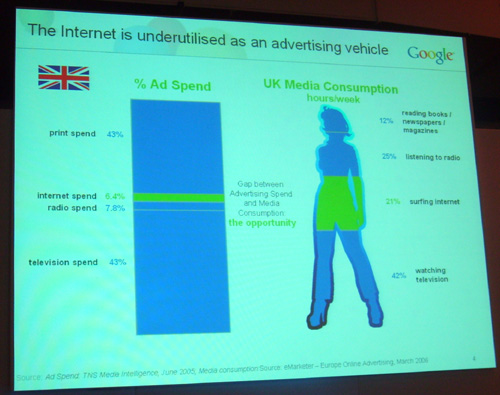


Friday, September 29, 2006

Here is a photo of the stand on next year's dates for AdTech London, outside Pizza Express. Notice the 'Revolution' logo bottom right. My question remains why Haymarket have not decided to promote Brand Republic instead. A website could be more interesting for this audience than a printed magazine. In my opinion it is highly likely something will change in time for the next AdTech.
Wednesday, September 27, 2006
Off to AdTech tomorrow. Like a direct mail show, but online.
Haymarket are a media partner and last year were in the basement with a hospitality area. Strangely they promoted their print magazines - Marketing etc. Revolution got included - covering online - but I don't remember much about Brand Republic - the website version of their advertising media publishing. Not sure why this should be. the Haymarket policy may be to recognise the web but it is not coming over in their promotion. At least that was what I thought last year.
Still no news on a Lawrence Wallis blog. Maybe Brand Republic could offer him some space.
To comment, please switch to commentrequest.
Haymarket are a media partner and last year were in the basement with a hospitality area. Strangely they promoted their print magazines - Marketing etc. Revolution got included - covering online - but I don't remember much about Brand Republic - the website version of their advertising media publishing. Not sure why this should be. the Haymarket policy may be to recognise the web but it is not coming over in their promotion. At least that was what I thought last year.
Still no news on a Lawrence Wallis blog. Maybe Brand Republic could offer him some space.
To comment, please switch to commentrequest.
Saturday, September 23, 2006
I have now started another blog, comments allowed
http://commentrequest.blogspot.com/
So please go to item on Lawrence Wallis if you know where his adventures on the blogosphere may be found.
This new blog may have a wider scope. I have tended to start a new blog when in doubt so this one could be a way to integrate some ideas, even if only just as questions.
http://commentrequest.blogspot.com/
So please go to item on Lawrence Wallis if you know where his adventures on the blogosphere may be found.
This new blog may have a wider scope. I have tended to start a new blog when in doubt so this one could be a way to integrate some ideas, even if only just as questions.
I have now visited Life Bytes , opposite the Odeon in Sidwell Street Exeter, for a full discussion on this Breeze as Acrobat situation. I am told that "it may not be a bad thing".
So ok, I am trying to get my head round it. Starting with my own experience that I don't find Flash content as 'engaging' as PDF or text. It is like being hit over the head with a Powerpoint presentation as designed sometime ago. There is no record of it, it cannot be edited or combined with other sources. I think Powerpoint has become much better or at least I have got used to it enough to copy out the bits I need.
Acrobat Connect may be improved on the current Breeze or maybe things will improve later. I would like an option to save the presentations as PDF and also to save the chat as PDF or text. These can be posted later apparently but the people in the audience have no option to do it for themselves. Maybe this is the attraction of Flash, that it is easier to keep control of content, but this is not the same as an engaging platform. Before the recent presentation of Acrobat 8, Adobe used to offer video plus PDF download. I found that much easier to follow or study later. The crazed load of Flash touring Acrobat 8 is impossible to follow if you want to get past the supposed benefits towards the actual features. What I want is a PDF file with a carefully structured set of bookmarks on the left.
I have not found any reference to improvements in PDF as a container for Flash, Quicktime or other media. Acrobat 7 is able to capture web pages with Flash, but it tends to come and go. You have to reload occasionally. I don't understand why and maybe this is not a problem for everyone but I notice PDF is rarely used for multimedia. Is it a technical limitation, or has Adobe just stopped explaining the option? At LifeBytes I was told there is another problem in controlling how Quicktime is displayed when designing a PDF from scratch. Apparently it pops out of the page and finds a new size. Maybe this is ok with a screen culture and some people I know are just hanging on to the idea of a page.
Meanwhile I am enjoying the video on Youtube so I don't mind Flash as such. The next couple of months could be a time for revision on PDF so far and maybe for looking at Breeze potential.
So ok, I am trying to get my head round it. Starting with my own experience that I don't find Flash content as 'engaging' as PDF or text. It is like being hit over the head with a Powerpoint presentation as designed sometime ago. There is no record of it, it cannot be edited or combined with other sources. I think Powerpoint has become much better or at least I have got used to it enough to copy out the bits I need.
Acrobat Connect may be improved on the current Breeze or maybe things will improve later. I would like an option to save the presentations as PDF and also to save the chat as PDF or text. These can be posted later apparently but the people in the audience have no option to do it for themselves. Maybe this is the attraction of Flash, that it is easier to keep control of content, but this is not the same as an engaging platform. Before the recent presentation of Acrobat 8, Adobe used to offer video plus PDF download. I found that much easier to follow or study later. The crazed load of Flash touring Acrobat 8 is impossible to follow if you want to get past the supposed benefits towards the actual features. What I want is a PDF file with a carefully structured set of bookmarks on the left.
I have not found any reference to improvements in PDF as a container for Flash, Quicktime or other media. Acrobat 7 is able to capture web pages with Flash, but it tends to come and go. You have to reload occasionally. I don't understand why and maybe this is not a problem for everyone but I notice PDF is rarely used for multimedia. Is it a technical limitation, or has Adobe just stopped explaining the option? At LifeBytes I was told there is another problem in controlling how Quicktime is displayed when designing a PDF from scratch. Apparently it pops out of the page and finds a new size. Maybe this is ok with a screen culture and some people I know are just hanging on to the idea of a page.
Meanwhile I am enjoying the video on Youtube so I don't mind Flash as such. The next couple of months could be a time for revision on PDF so far and maybe for looking at Breeze potential.
It is possible that Lawrence Wallis has joined in with the blogging scene. His words in Printweek are about the 'blook'. Surprisingly for me he makes no objection to the word 'blook' although he sometimes has a problem with variations on established language. His major complaint this week is about the standardised and restricted stock of most bookshops. Maybe he is finding that the web offers the variety and serendipity that browsing in bookshops offered in days gone by.
Mysteriously, he adds that "loyal readers ( rumour suggests one might exist ) may have noticed that I spent some time in the blogosphere to escape the bleak scene in bookselling". Well, sadly I can find no trace of this. Try the link, things may have been updated,
Please let me know if a link to a Lawrence Wallios blog turns up. Sorry, I can't find a way to turn on comments.
By the way, he is crestfallen that the Blooker Prize has been won by yet another cookery book. You know what? He has got a point.
Mysteriously, he adds that "loyal readers ( rumour suggests one might exist ) may have noticed that I spent some time in the blogosphere to escape the bleak scene in bookselling". Well, sadly I can find no trace of this. Try the link, things may have been updated,
Please let me know if a link to a Lawrence Wallios blog turns up. Sorry, I can't find a way to turn on comments.
By the way, he is crestfallen that the Blooker Prize has been won by yet another cookery book. You know what? He has got a point.
Subscribe to:
Posts (Atom)