Scope for websites. The blogs started to take over around or after 2002 when they got so much easier to update. The websites became stuck as claims of some possibility or other. Forget the homepage said Jeff Jarvis at some point but I kept updating it to hang on to credibility. There should have been a database of stories, not just a constant rewrite. Still, they all exist somewhere so an archive should be possible. Stuff comes around. Next month Personal Computer World is promising a guide to databases.
The Total Print event has confirmed in my mind that print is now part of a digital scene. I tried to make litho interesting as news but this only worked to an extent. The editors of OhmyNews have switched the headlines on my story so that the e-book aspect is the priority. Seems reasonable for their audience.
So let us assume that WWWatford has arrived. It was intended as a destination for the UK print industry, like Cairo for Windows. The Heidelberg presentation was as good as this could get. Prinect and computer to plate. Litho could not be much more available. Web-to-print was all over the show. What the speed is for the UK industry to implement this sort of thing, that is another question. There may be more consolidation before there is much investment. Recent Printweek editorials have been frank about the level of investment that would make much sense, for example in capacity for magazines. The WWWatford site will continue to look at UK print with the global context getting easier to link in as attention turns to IPEX. Assume next year's Total Print much the same as this. The LCC conference was mostly about games and the Web so there is a discussion possible about how this fits with the display area.
The Acrobat Services sites are complicated by the Adobe introduction to Acrobat of all things Flash. It is no longer just about PDF. On balance I think most people are still mostly interested in PDF when they think about Acrobat but this is not the marketing view from Adobe. They seem to be giving up on Adobe Classic as if it is getting too easy for others to supply Postscript clones or PDF creation. Adobe Max is expected to be much more future proof. I think the UK is not really ready for much of this, partly because of bandwidth. So I intend to keep the UK site pretty much to Adobe Classic in themes, - flat pages, hard copy, documents as organisations are used to them. Also the Digital Editions Reader and ePUB. The PDFXML approach will be included but there is almost no support from Adobe in promoting this. At least with ePUB there is a group of people with an interest in reaching a wider audience.
The dotcom site is best thought of "in a cloud". That is where Adobe seem to be heading. It already includes some news about Google. Docs can save PDF and I also like Scribd. Their design makes good use of Flash but they seem to be interested in text as well. there may even be mention of Microsoft. The cloud beckons.
Remaining aspects of Flash will turn up as part of animX, a site about digital animation. I am interested in such content, just slow to believe it is a priority for people who are used to PDF.
Tuesday, October 07, 2008
"Earls Court in Outer Space", possible title for a future episode of Dr Who. I have been thinking about forms of fiction as a way to make more sense of things. Also time travel is unavoidable. This blog is about 2002 after all and the issues for UK print and publishing seem not to have changed very much. Also travel in actual space would be interesting as the Frankfurt bookfair is the same week as Total Print! So my first plot premise is that in the future there will be an integrated kind of show in London, "total communication" perhaps when the LCC gets used to not being LCP. This is some way off of course.


Diagrams show Earl's Court with a print and publishing event at the same time. Ground floor for anything heavy, print kit in Earl's Court 2 but connected to the books in Earl's Court 1. Upstairs for the agents near the Conference Centre, and pre-media, software any equipment that is fairly light. The LCC Futures Conference is in some other space at the back. Yes, there had to be a point to all this. the escalator will go straight to the LCC conference with a direct walking route from Earl's Court 2. Think about it. Next week you may find yourself walking all the way round Earl's Court to go up a level and walk back almost as far as where you started.
Anyway, back to the fiction. UK authors have started to vanish, but then reappear. Terry Pratchett is back again but still no sign of Doris Lessing. Then new texts appear on the Web in similar styles such as they may have written. The website is traced to Canada and there appears to be a connection with a Toronto agent played by Dan Ackroyd. Believe me, he will take the part. All he has to do is to explain that he is in contact with aliens and they have a method of producing books. Terry Pratchett was easy to clone but Doris Lessing is a bit more difficult.
Enter Doctor Who, played by Christopher Eccleston. He manages to negotiate a deal with Dan Ackroyd so that Doris Lessing returns to the UK and several authors agree to let the aliens have all digital rights while they keep hard copy rights for the UK. Also the entire building of Earl's Court and anyone in it during the show gets a trip round the planet earth. Only Christopher Eccleston can manage the confident grin as he hurries off to the next adventure. There could be a sequel depending on how the deal turns out.
Link to Doctor Who show and gif (animated)


Diagrams show Earl's Court with a print and publishing event at the same time. Ground floor for anything heavy, print kit in Earl's Court 2 but connected to the books in Earl's Court 1. Upstairs for the agents near the Conference Centre, and pre-media, software any equipment that is fairly light. The LCC Futures Conference is in some other space at the back. Yes, there had to be a point to all this. the escalator will go straight to the LCC conference with a direct walking route from Earl's Court 2. Think about it. Next week you may find yourself walking all the way round Earl's Court to go up a level and walk back almost as far as where you started.
Anyway, back to the fiction. UK authors have started to vanish, but then reappear. Terry Pratchett is back again but still no sign of Doris Lessing. Then new texts appear on the Web in similar styles such as they may have written. The website is traced to Canada and there appears to be a connection with a Toronto agent played by Dan Ackroyd. Believe me, he will take the part. All he has to do is to explain that he is in contact with aliens and they have a method of producing books. Terry Pratchett was easy to clone but Doris Lessing is a bit more difficult.
Enter Doctor Who, played by Christopher Eccleston. He manages to negotiate a deal with Dan Ackroyd so that Doris Lessing returns to the UK and several authors agree to let the aliens have all digital rights while they keep hard copy rights for the UK. Also the entire building of Earl's Court and anyone in it during the show gets a trip round the planet earth. Only Christopher Eccleston can manage the confident grin as he hurries off to the next adventure. There could be a sequel depending on how the deal turns out.
Link to Doctor Who show and gif (animated)

Sunday, March 02, 2008
Not sure about Adobe having reached a new stage with the release of AIR. It could be a significant date but this can only be clear later. I have found some evidence that Postscript is not promoted that often. The webpage still refers to Acrobat 6 so may not have been changed that often. The industry quotes about the PDF Print Engine are from 2006, maybe around the time of IPEX. There could well be an update during drupa but my impression is that most of the time this phase is more or less over.
Wednesday, February 27, 2008
I am just restarting to post to the PDF and print blogs. Yesterday I found out that Adobe have issued AIR as version 1 so it is not just an idea. My impression is that Adobe has actually turned into Macromedia. Adobe Classic is hard to find. Maybe Max is a better word than Macromedia, still used for an event. Acrobat is not just PDF, not even PDF in terms of what they will tell you about.
This blog from 2002 is probably going to be speculative and open to revision, based on guesswork and memory. The drupa2008 blog will appear to be more considered and based on reliable information. Not that Adobe explain much till the products are released. Digital Editions Reader? A complete mystery. That is why Scribd makes a lot of sense. I have done a test page.
The Scribd design gives the impression that they actually like documents. The Adobe site currently has so much animated production numbers that on low bandwidth such as we have in most of the UK everything grinds to a halt. All I want to do is get off the home page to somewhere with some information in a text format I can copy out. The medium is so much the message and always about how engaging Flash is. Enough already.
This blog from 2002 is probably going to be speculative and open to revision, based on guesswork and memory. The drupa2008 blog will appear to be more considered and based on reliable information. Not that Adobe explain much till the products are released. Digital Editions Reader? A complete mystery. That is why Scribd makes a lot of sense. I have done a test page.
The Scribd design gives the impression that they actually like documents. The Adobe site currently has so much animated production numbers that on low bandwidth such as we have in most of the UK everything grinds to a halt. All I want to do is get off the home page to somewhere with some information in a text format I can copy out. The medium is so much the message and always about how engaging Flash is. Enough already.
Tuesday, October 30, 2007
Every so often something happens that suggests 2002 IPEX is still a suitable place for some things. I remember towards the end of IPEX the BT speakers had aday off ill from the presentation theatre and the Adobe people got into a stride. One of their guests spoke about Acrobat for comment and markup. There was some additional programming involved. Later I discovered this was not widely taken up because the costs revolved copies of Acrobat on every desktop. Apparently the architiects found the prices ok when approving a large builing and Pfizer could afford any number of copies to speed up approval by the relevant authorities, but somehow the print industry was mostly left behind.

No sign of Adobe at Digital Print World. Artwork Systems were there though, with a Web based approval system. They charge for the server software but the browser level requires nothing but Java. Maybe 20 or 30 copies of Acrobat could be had for the same sort of price but this model makes a lot more sense if a large number of print customers are involved.
More on Digital Print World in a story for OhmyNews.

No sign of Adobe at Digital Print World. Artwork Systems were there though, with a Web based approval system. They charge for the server software but the browser level requires nothing but Java. Maybe 20 or 30 copies of Acrobat could be had for the same sort of price but this model makes a lot more sense if a large number of print customers are involved.
More on Digital Print World in a story for OhmyNews.
Sunday, August 12, 2007
it has happened again
the swicki is taking over more space
so some padding is needed
these US companies! Who needs them?
they just put themselves forward
install something and something else pops up
we just changed the code so it looks even bigger
that's because it is bigger
still, i'm sure there is a way round it
the swicki is taking over more space
so some padding is needed
these US companies! Who needs them?
they just put themselves forward
install something and something else pops up
we just changed the code so it looks even bigger
that's because it is bigger
still, i'm sure there is a way round it
Printweek has reported that NewsTec is cancelled.
This has been for newspapers. My guess is that few expect many new presses to be bought. In December 2005, Jeff Jarvis wrote about "the last presses" in his blog and for the Guardian.
You know what? Maybe he has got a point. There, value added blogging. Not just repeating a link.
So if the newspaper discussion has been moved from 2009 to 2010 it is reasonable to assume technology scope will include blogs, video etc for "news organisations" as Jeff Jarvis describes them.
Printweek has a new and improved website where the comments relate to the news. The previous Printing World site was a bit sketchy as a discussion board. I have added a comment to the report on the latest ABC figures for UK newspaper circulation. The report seems more aware of the issues than some stories in magazines about print. What is the general take on media within Haymarket?, I wonder. They seem still dedicated to hard copy. Only time will tell.
This has been for newspapers. My guess is that few expect many new presses to be bought. In December 2005, Jeff Jarvis wrote about "the last presses" in his blog and for the Guardian.
You know what? Maybe he has got a point. There, value added blogging. Not just repeating a link.
So if the newspaper discussion has been moved from 2009 to 2010 it is reasonable to assume technology scope will include blogs, video etc for "news organisations" as Jeff Jarvis describes them.
Printweek has a new and improved website where the comments relate to the news. The previous Printing World site was a bit sketchy as a discussion board. I have added a comment to the report on the latest ABC figures for UK newspaper circulation. The report seems more aware of the issues than some stories in magazines about print. What is the general take on media within Haymarket?, I wonder. They seem still dedicated to hard copy. Only time will tell.
Thursday, July 19, 2007
A new blog has been started for drupa 2008
http://drupa2008.blogspot.com
Very similar to this one, but convincingly forward looking.
http://drupa2008.blogspot.com
Very similar to this one, but convincingly forward looking.
Friday, November 17, 2006
I have put a new page on the WWWatford website. Since I started blogging the websites have been updated less frequently but they have become more like a blog or sequence of opinion. The page added is a draft for drupa in 2008 and quotes an article in Printing World about JDF being accepted over the next couple of years.
This kind of time travel is a way to try to keep up with the Adobe approach to pushing Acrobat online and towards Flash. the UK print industry is not going quite as quickly and this may also be true in other places.
This kind of time travel is a way to try to keep up with the Adobe approach to pushing Acrobat online and towards Flash. the UK print industry is not going quite as quickly and this may also be true in other places.
Tuesday, November 07, 2006
A relevant comment from 'Good Morning Silicon Valley', on the news that Google will now be selling small ads for US newspapers-
For the newspaper industry, which failed to understand where its future lay back before Craigslist had a CEO and Google was still run out of a Stanford dorm room, and has been suffering miserably for it ever since, the program is a way to make some money off inventory that would typically be filled with worthless house ads. But it also proffers a dubious bargain: it will bolster the newspapers' flagging advertising revenues, but it may undercut their existing advertising relationships and, more importantly, rates in the process. Says Publishing 2.0: "Handing the reins over to Google’s efficient direct response advertising machine will only hasten the realization that the Web is much more efficient than print at driving action and response."
Will this sort of thing work in the UK? Probably sometime soon. Though the official moment will only be recognised when you read it in a newspaper.
For the newspaper industry, which failed to understand where its future lay back before Craigslist had a CEO and Google was still run out of a Stanford dorm room, and has been suffering miserably for it ever since, the program is a way to make some money off inventory that would typically be filled with worthless house ads. But it also proffers a dubious bargain: it will bolster the newspapers' flagging advertising revenues, but it may undercut their existing advertising relationships and, more importantly, rates in the process. Says Publishing 2.0: "Handing the reins over to Google’s efficient direct response advertising machine will only hasten the realization that the Web is much more efficient than print at driving action and response."
Will this sort of thing work in the UK? Probably sometime soon. Though the official moment will only be recognised when you read it in a newspaper.
The Guardian Review on Saturday included a few paragraphs from the Bookseller on the inside back cover about the prospects for e-books, or an 'e-reading device'. Joel Rickett remembers the mistaken hopes for the CD-Rom in the '90s and suggests that publishers are now very cautious. There is no mention of Google or Google Books as such but news that Random House and Harper Collins are investing in digital versions of their titles. This may be to ensure the text can be found by search engines in a manner the publisher controls. Probably Joel Rickett reflects industry opinion in suggesting that although all publishers "are frantically planning for the tipping point when an e-reading device really takes off, predictions for the book's trade's 'iPod moment' range from two to five years."
In my view the process has already gone some way. Many people find text online that may or may not be regarded as a book equivalent. Last week I had a look at the new version of Acrobat from Adobe. Most of their presentation is about the benefits of Acrobat Connect for collaboration beyond the limits of the document. This conferencing suite used to be known as Breeze from Macromedia and is mostly based on Flash. Lots of video and animated Powerpoint etc. I am still in shock about this as I am used to editing text or adding comments to a fixed page. Maybe this is something I will get used to eventually but it is a point of departure for Acrobat as a PDF product. Over the last ten years or so PDF has represented on screen the layout of a printed page. Adobe seem to think we should be moving away from this. I will try to keep an open mind but the arrival of Acrobat 8 is for me a defining moment in realising what I liked about all the previous versions. Apparently the new version of a Reader will be in Flash but can accept PDF as an input. I have had a look at the beta. Maybe some people will prefer this. A small download if you already have Flash, but there is no way to copy out text to combine with something else. An engagement platform? I don't think so.
Have a look at this ad c/o YouTube
This strikes me as mostly an ad for Flash. The type is all over the place. With previous versions of Adobe there was often a White Paper or something similar in a PDF format. This sort of thing is now harder to find.
Enough on where Adobe might be going. The main point is that an 'iPod moment' for books has already happened.
In my view the process has already gone some way. Many people find text online that may or may not be regarded as a book equivalent. Last week I had a look at the new version of Acrobat from Adobe. Most of their presentation is about the benefits of Acrobat Connect for collaboration beyond the limits of the document. This conferencing suite used to be known as Breeze from Macromedia and is mostly based on Flash. Lots of video and animated Powerpoint etc. I am still in shock about this as I am used to editing text or adding comments to a fixed page. Maybe this is something I will get used to eventually but it is a point of departure for Acrobat as a PDF product. Over the last ten years or so PDF has represented on screen the layout of a printed page. Adobe seem to think we should be moving away from this. I will try to keep an open mind but the arrival of Acrobat 8 is for me a defining moment in realising what I liked about all the previous versions. Apparently the new version of a Reader will be in Flash but can accept PDF as an input. I have had a look at the beta. Maybe some people will prefer this. A small download if you already have Flash, but there is no way to copy out text to combine with something else. An engagement platform? I don't think so.
Have a look at this ad c/o YouTube
This strikes me as mostly an ad for Flash. The type is all over the place. With previous versions of Adobe there was often a White Paper or something similar in a PDF format. This sort of thing is now harder to find.
Enough on where Adobe might be going. The main point is that an 'iPod moment' for books has already happened.
Monday, October 30, 2006
I have now done a Google custom search engine for JDF, the Job Definition Format.
I thought about changing the current balance, PDF-ISO9000-quality-learning , but I don't think JDF is yet as interesting in terms of people looking for it. So the JDF one will stay as a side project for a while. The stats show at least 10 time as many searches on PDF as JDF.
I thought about changing the current balance, PDF-ISO9000-quality-learning , but I don't think JDF is yet as interesting in terms of people looking for it. So the JDF one will stay as a side project for a while. The stats show at least 10 time as many searches on PDF as JDF.
Thursday, October 26, 2006
Google have started a sort of social software version of a search engine. I am not sure it is as networked as the Eurekster Swicki idea. I have tried to start with it and it seems to me intended to have a fairly sharp focus. There is no word cloud for example. These are great to show that there are different aspects to a collection and the relative sizes show how much each is used. I will still work on the Eurekster Swickis and I expect the Google move to strengthen this concept. There is a page showing mine at Learn9.net, Hello Spiders.
The 'learn9' one is important for me as it shows links between quality and learning. I don't find this much in academic sources where learning is studied.
The Google ones are focused just on PDF, ISO 9000, quality and learning. You can put the same query into each if you like. The ISO 9000 one assumes an 'objective' model is possible for any system. The 'quality' one includes 'critique' and all other options. That's the design intention anyway.
And now a graphic for the PDF Search Engine. The Google idea of a graphic is not very flash, but it probably loads fairly quickly.

The 'learn9' one is important for me as it shows links between quality and learning. I don't find this much in academic sources where learning is studied.
The Google ones are focused just on PDF, ISO 9000, quality and learning. You can put the same query into each if you like. The ISO 9000 one assumes an 'objective' model is possible for any system. The 'quality' one includes 'critique' and all other options. That's the design intention anyway.
And now a graphic for the PDF Search Engine. The Google idea of a graphic is not very flash, but it probably loads fairly quickly.

OhmyNews have published my story about last week's Digital Print World and the Acrobat 8 launch in the UK.
Maybe I lack a bit of balance, but I still think the main news about Digital Print World was that Adobe were not there. Maybe they are right if they think print is more or less over. It certainly needs to change fairly rapidly to keep up with the web as an option.
Maybe I lack a bit of balance, but I still think the main news about Digital Print World was that Adobe were not there. Maybe they are right if they think print is more or less over. It certainly needs to change fairly rapidly to keep up with the web as an option.
Tuesday, October 24, 2006
A lot happened last week but I did not update this blog. For one thing the last entry more or less stands. At the three dome Regent's Park two hour special on Acrobat 8 there was no time at all for JDF. This was a special version intended for 'creatives'. Not general knowledge workers or engineers or some other group that might not need print. I honestly got the impression that Adobe now believe that 'creatives' are only interested in video for mobile phones or whatever else is interesting at the moment. Press and magazine advertising is in decline but is probably still at least half of what London agencies are turning over. Just a bit about JDF would not have been out of place.
Reviewing Acrobat 8 for Digital Printer, Nessan Cleary wrote that there is more on JDF "though none of the Adobe staff at the press launch seemed to be too clued up on JDF, and Adobe doesn't appear to have tested its JDF with any of the MIS or workflow systems that one would expect it to be used with." Later he writes that PDF1.7 supports PDFX/-4 and native transparency. "We will now start to see workflow vendors upgrading their RIPs with the new PDF Print Engine." Now this may be based on some guidance from the press launch. My impression as a blogger is that there is an absolute disconnect between the press release out of Chicago and the experience in the UK and other places. Unless the JDF aspect is explained the benefits of the PDF Print Engine will not result in a rush to upgrade current RIPs.
Explained that is from end to end. Desktop to RIP as a consistent story.
By the way, most executives in enormous companies realise that they face a cost in a print bill. Even today the web cannot cope with all communication. The assumed Adobe target audience for Acrobat 8 might be slightly interested in the benefits of JDF for costs and schedules.
The reality as, however, that Adobe probably think they did enough for print at IPEX and will do something else at drupa in 2008. I have done a slideshow from previous photos and the official drupa song. About 12 meg. Other video etc. will appear later.
The slideshow PDF was created in Adobe Album. This never seems to heve been developed much in Acrobat. I got the impression that there was not much emphasis on any of the multimedia features in the presentation of Acrobat 8. Web capture of pages with Flash has always been a bit dodgy and there is no news of any improvement. Perhaps corporates don't like external files that may contain a virus. Or maybe they don't like Flash anyway. So what will they make of Breeze?
Reviewing Acrobat 8 for Digital Printer, Nessan Cleary wrote that there is more on JDF "though none of the Adobe staff at the press launch seemed to be too clued up on JDF, and Adobe doesn't appear to have tested its JDF with any of the MIS or workflow systems that one would expect it to be used with." Later he writes that PDF1.7 supports PDFX/-4 and native transparency. "We will now start to see workflow vendors upgrading their RIPs with the new PDF Print Engine." Now this may be based on some guidance from the press launch. My impression as a blogger is that there is an absolute disconnect between the press release out of Chicago and the experience in the UK and other places. Unless the JDF aspect is explained the benefits of the PDF Print Engine will not result in a rush to upgrade current RIPs.
Explained that is from end to end. Desktop to RIP as a consistent story.
By the way, most executives in enormous companies realise that they face a cost in a print bill. Even today the web cannot cope with all communication. The assumed Adobe target audience for Acrobat 8 might be slightly interested in the benefits of JDF for costs and schedules.
The reality as, however, that Adobe probably think they did enough for print at IPEX and will do something else at drupa in 2008. I have done a slideshow from previous photos and the official drupa song. About 12 meg. Other video etc. will appear later.
The slideshow PDF was created in Adobe Album. This never seems to heve been developed much in Acrobat. I got the impression that there was not much emphasis on any of the multimedia features in the presentation of Acrobat 8. Web capture of pages with Flash has always been a bit dodgy and there is no news of any improvement. Perhaps corporates don't like external files that may contain a virus. Or maybe they don't like Flash anyway. So what will they make of Breeze?
Monday, October 16, 2006
Adobe have announced a "1.1" version of the PDF Print Engine as it now works with PDF 1.7 and Mac OSX.
I still think an "end-to-end" workflow will not happen unless the JDF creation in Acrobat is explained just a little.
I still think an "end-to-end" workflow will not happen unless the JDF creation in Acrobat is explained just a little.
Tuesday, October 10, 2006
I have set up two topics on the 'Comment Requested' blog.
It is not an invention that I can't get the comments to work on this IPEX 2002 blog.
One is about the urgency of the print industry getting momentum for JDF as a marketing opportunity. Print customers could be aware that JDF is useful for them.
I have set up a poll on a JDF lens at Squidoo. Keep scrolling down.
The second topic is about the way Adobe is moving away from PDF, at least just for hard copy. Acrobat 8 is a further move into the office. Connect is Flash, not PDF. I am still in shock about this. I may get used to it by the time 8 is released. It still should be a concern for printers though. Maybe PDF will depend on a wider range of support.
It is not an invention that I can't get the comments to work on this IPEX 2002 blog.
One is about the urgency of the print industry getting momentum for JDF as a marketing opportunity. Print customers could be aware that JDF is useful for them.
I have set up a poll on a JDF lens at Squidoo. Keep scrolling down.
The second topic is about the way Adobe is moving away from PDF, at least just for hard copy. Acrobat 8 is a further move into the office. Connect is Flash, not PDF. I am still in shock about this. I may get used to it by the time 8 is released. It still should be a concern for printers though. Maybe PDF will depend on a wider range of support.
Saturday, September 30, 2006
I am now even more convinced that AdTech marked a new phase for the acceptance of online publishing in the UK. Maybe it had happened already and I missed it. I have now had a look at the new Haymarket directory site - BlueBoomerang. This is comprehensive in market sectors including print and direct mail. The focus is shifting towards digital, however slowly in some cases. At Digital Print World there will be software that could be used for direct mail in hard copy or email. Printweek covers this to some extent.
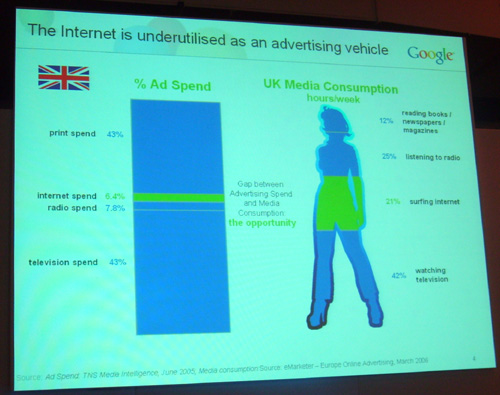
Meanwhile here are some photos of slides from Google University. Other numbers are available but the overall picture seems clear enough. This is based on current UK, so the growth of broadband will move it further. A stand for Brand Republic at a future AdTech is a strong probability.


Meanwhile here are some photos of slides from Google University. Other numbers are available but the overall picture seems clear enough. This is based on current UK, so the growth of broadband will move it further. A stand for Brand Republic at a future AdTech is a strong probability.


Friday, September 29, 2006

Here is a photo of the stand on next year's dates for AdTech London, outside Pizza Express. Notice the 'Revolution' logo bottom right. My question remains why Haymarket have not decided to promote Brand Republic instead. A website could be more interesting for this audience than a printed magazine. In my opinion it is highly likely something will change in time for the next AdTech.
Wednesday, September 27, 2006
Off to AdTech tomorrow. Like a direct mail show, but online.
Haymarket are a media partner and last year were in the basement with a hospitality area. Strangely they promoted their print magazines - Marketing etc. Revolution got included - covering online - but I don't remember much about Brand Republic - the website version of their advertising media publishing. Not sure why this should be. the Haymarket policy may be to recognise the web but it is not coming over in their promotion. At least that was what I thought last year.
Still no news on a Lawrence Wallis blog. Maybe Brand Republic could offer him some space.
To comment, please switch to commentrequest.
Haymarket are a media partner and last year were in the basement with a hospitality area. Strangely they promoted their print magazines - Marketing etc. Revolution got included - covering online - but I don't remember much about Brand Republic - the website version of their advertising media publishing. Not sure why this should be. the Haymarket policy may be to recognise the web but it is not coming over in their promotion. At least that was what I thought last year.
Still no news on a Lawrence Wallis blog. Maybe Brand Republic could offer him some space.
To comment, please switch to commentrequest.
Subscribe to:
Posts (Atom)