Starting with IPEX 2002, this blog covers events relevant for UK print, including Seybold and DRUPA. See also website at www.atford.co.uk

Thursday, October 26, 2006

Google have started a sort of social software version of a search engine. I am not sure it is as networked as the Eurekster Swicki idea. I have tried to start with it and it seems to me intended to have a fairly sharp focus. There is no word cloud for example. These are great to show that there are different aspects to a collection and the relative sizes show how much each is used. I will still work on the Eurekster Swickis and I expect the Google move to strengthen this concept. There is a page showing mine at Learn9.net, Hello Spiders.

The 'learn9' one is important for me as it shows links between quality and learning. I don't find this much in academic sources where learning is studied.

The Google ones are focused just on PDF, ISO 9000, quality and learning. You can put the same query into each if you like. The ISO 9000 one assumes an 'objective' model is possible for any system. The 'quality' one includes 'critique' and all other options. That's the design intention anyway.

And now a graphic for the PDF Search Engine. The Google idea of a graphic is not very flash, but it probably loads fairly quickly.

OhmyNews have published my story about last week's Digital Print World and the Acrobat 8 launch in the UK.

Maybe I lack a bit of balance, but I still think the main news about Digital Print World was that Adobe were not there. Maybe they are right if they think print is more or less over. It certainly needs to change fairly rapidly to keep up with the web as an option.

Tuesday, October 24, 2006

A lot happened last week but I did not update this blog. For one thing the last entry more or less stands. At the three dome Regent's Park two hour special on Acrobat 8 there was no time at all for JDF. This was a special version intended for 'creatives'. Not general knowledge workers or engineers or some other group that might not need print. I honestly got the impression that Adobe now believe that 'creatives' are only interested in video for mobile phones or whatever else is interesting at the moment. Press and magazine advertising is in decline but is probably still at least half of what London agencies are turning over. Just a bit about JDF would not have been out of place.

Reviewing Acrobat 8 for Digital Printer, Nessan Cleary wrote that there is more on JDF "though none of the Adobe staff at the press launch seemed to be too clued up on JDF, and Adobe doesn't appear to have tested its JDF with any of the MIS or workflow systems that one would expect it to be used with." Later he writes that PDF1.7 supports PDFX/-4 and native transparency. "We will now start to see workflow vendors upgrading their RIPs with the new PDF Print Engine." Now this may be based on some guidance from the press launch. My impression as a blogger is that there is an absolute disconnect between the press release out of Chicago and the experience in the UK and other places. Unless the JDF aspect is explained the benefits of the PDF Print Engine will not result in a rush to upgrade current RIPs.

Explained that is from end to end. Desktop to RIP as a consistent story.

By the way, most executives in enormous companies realise that they face a cost in a print bill. Even today the web cannot cope with all communication. The assumed Adobe target audience for Acrobat 8 might be slightly interested in the benefits of JDF for costs and schedules.

The reality as, however, that Adobe probably think they did enough for print at IPEX and will do something else at drupa in 2008. I have done a slideshow from previous photos and the official drupa song. About 12 meg. Other video etc. will appear later.

The slideshow PDF was created in Adobe Album. This never seems to heve been developed much in Acrobat. I got the impression that there was not much emphasis on any of the multimedia features in the presentation of Acrobat 8. Web capture of pages with Flash has always been a bit dodgy and there is no news of any improvement. Perhaps corporates don't like external files that may contain a virus. Or maybe they don't like Flash anyway. So what will they make of Breeze?

Monday, October 16, 2006

Adobe have announced a "1.1" version of the PDF Print Engine as it now works with PDF 1.7 and Mac OSX.

I still think an "end-to-end" workflow will not happen unless the JDF creation in Acrobat is explained just a little.

Tuesday, October 10, 2006

I have set up two topics on the 'Comment Requested' blog.

It is not an invention that I can't get the comments to work on this IPEX 2002 blog.

One is about the urgency of the print industry getting momentum for JDF as a marketing opportunity. Print customers could be aware that JDF is useful for them.

I have set up a poll on a JDF lens at Squidoo. Keep scrolling down.

The second topic is about the way Adobe is moving away from PDF, at least just for hard copy. Acrobat 8 is a further move into the office. Connect is Flash, not PDF. I am still in shock about this. I may get used to it by the time 8 is released. It still should be a concern for printers though. Maybe PDF will depend on a wider range of support.

Saturday, September 30, 2006

I am now even more convinced that AdTech marked a new phase for the acceptance of online publishing in the UK. Maybe it had happened already and I missed it. I have now had a look at the new Haymarket directory site - BlueBoomerang. This is comprehensive in market sectors including print and direct mail. The focus is shifting towards digital, however slowly in some cases. At Digital Print World there will be software that could be used for direct mail in hard copy or email. Printweek covers this to some extent.

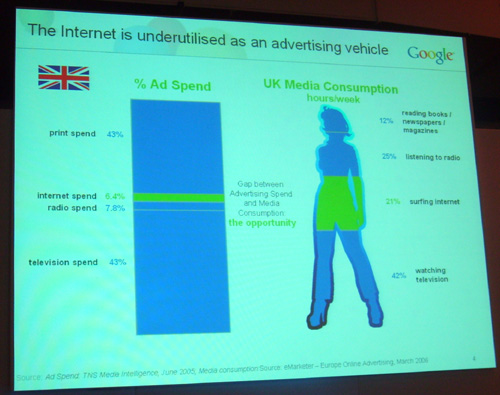
Meanwhile here are some photos of slides from Google University. Other numbers are available but the overall picture seems clear enough. This is based on current UK, so the growth of broadband will move it further. A stand for Brand Republic at a future AdTech is a strong probability.


Friday, September 29, 2006


Here is a photo of the stand on next year's dates for AdTech London, outside Pizza Express. Notice the 'Revolution' logo bottom right. My question remains why Haymarket have not decided to promote Brand Republic instead. A website could be more interesting for this audience than a printed magazine. In my opinion it is highly likely something will change in time for the next AdTech.

Wednesday, September 27, 2006

Off to AdTech tomorrow. Like a direct mail show, but online.

Haymarket are a media partner and last year were in the basement with a hospitality area. Strangely they promoted their print magazines - Marketing etc. Revolution got included - covering online - but I don't remember much about Brand Republic - the website version of their advertising media publishing. Not sure why this should be. the Haymarket policy may be to recognise the web but it is not coming over in their promotion. At least that was what I thought last year.

Still no news on a Lawrence Wallis blog. Maybe Brand Republic could offer him some space.

To comment, please switch to commentrequest.

Saturday, September 23, 2006

I have now started another blog, comments allowed

http://commentrequest.blogspot.com/

So please go to item on Lawrence Wallis if you know where his adventures on the blogosphere may be found.

This new blog may have a wider scope. I have tended to start a new blog when in doubt so this one could be a way to integrate some ideas, even if only just as questions.
I have now visited Life Bytes , opposite the Odeon in Sidwell Street Exeter, for a full discussion on this Breeze as Acrobat situation. I am told that "it may not be a bad thing".

So ok, I am trying to get my head round it. Starting with my own experience that I don't find Flash content as 'engaging' as PDF or text. It is like being hit over the head with a Powerpoint presentation as designed sometime ago. There is no record of it, it cannot be edited or combined with other sources. I think Powerpoint has become much better or at least I have got used to it enough to copy out the bits I need.

Acrobat Connect may be improved on the current Breeze or maybe things will improve later. I would like an option to save the presentations as PDF and also to save the chat as PDF or text. These can be posted later apparently but the people in the audience have no option to do it for themselves. Maybe this is the attraction of Flash, that it is easier to keep control of content, but this is not the same as an engaging platform. Before the recent presentation of Acrobat 8, Adobe used to offer video plus PDF download. I found that much easier to follow or study later. The crazed load of Flash touring Acrobat 8 is impossible to follow if you want to get past the supposed benefits towards the actual features. What I want is a PDF file with a carefully structured set of bookmarks on the left.

I have not found any reference to improvements in PDF as a container for Flash, Quicktime or other media. Acrobat 7 is able to capture web pages with Flash, but it tends to come and go. You have to reload occasionally. I don't understand why and maybe this is not a problem for everyone but I notice PDF is rarely used for multimedia. Is it a technical limitation, or has Adobe just stopped explaining the option? At LifeBytes I was told there is another problem in controlling how Quicktime is displayed when designing a PDF from scratch. Apparently it pops out of the page and finds a new size. Maybe this is ok with a screen culture and some people I know are just hanging on to the idea of a page.

Meanwhile I am enjoying the video on Youtube so I don't mind Flash as such. The next couple of months could be a time for revision on PDF so far and maybe for looking at Breeze potential.
It is possible that Lawrence Wallis has joined in with the blogging scene. His words in Printweek are about the 'blook'. Surprisingly for me he makes no objection to the word 'blook' although he sometimes has a problem with variations on established language. His major complaint this week is about the standardised and restricted stock of most bookshops. Maybe he is finding that the web offers the variety and serendipity that browsing in bookshops offered in days gone by.

Mysteriously, he adds that "loyal readers ( rumour suggests one might exist ) may have noticed that I spent some time in the blogosphere to escape the bleak scene in bookselling". Well, sadly I can find no trace of this. Try the link, things may have been updated,

Please let me know if a link to a Lawrence Wallios blog turns up. Sorry, I can't find a way to turn on comments.

By the way, he is crestfallen that the Blooker Prize has been won by yet another cookery book. You know what? He has got a point.

Thursday, September 21, 2006

I am still in shock after trying to take in the new information about Acrobat 8. The striking feature is that Acrobat is now based on Flash as well as PDF. What was Breeze is now Acrobat Connect, a conferencing system with a big advert button in the middle of the PDF oriented menu.

Kevin Lynch, previously with Macromedia, is Adobe vice president of product marketing for the Knowledge Worker Business Unit (KWBU) with responsibility for Acrobat and the Flash Media Server. He recently told Kurt Foss - "One of my visions at Macromedia has always been about the combination of asynchronous and synchronous communication. At Macromedia, with Breeze we were heavily involved with the synchronous real time—including the use of persistent meeting rooms. We also realized people want to get information that isn't always in real time. The document format from Acrobat is a perfect fit for that vision. Now we really have documents and people."

So the Breeze approach - a mix of chat, video and Powerpoint - is seen as closer to people than hard copy documents. Previously Adobe has not really promoted the PDF as slideshow option and the collaboration features have required really expensive server support. Acrobat Professional 7 did allow comments to be enabled in a PDF but effectively this was a secret. Flash now is the top priority for collaboration and it looks as if this will be promoted.

The presentation to the Acrobat Users did advertise a section on JDF but this did not happen. All the features are for knowledge workers - combining documents, exchanging comments, making sure text has been deleted (radaction), especially useful for the legal market.

What strikes me is that print is not really in there as a priority or even a mention in the background. More on this later after a look at a recent 'zeitgeist' article in Image Reports. This looks at how to compare Quark and InDesign, one of the big questions of the day. The picture that comes over of the approach to budgets and resources in pre-press or pre-media is a bit disturbing. Apparently many large users known to the editors of Image Reports are still using Xpress 4, introduced in 1998. Recent Mac operating systems may require new equipment. However "old Mac 9 Macs die eventually so even the most skinflint publishers are finally having to upgrade."

The article has a fairly relaxed acceptance of the current state of pre-press integration with data. "Xpress 7 introduces powerful XML/JDF based collaboration support though it is too early to see if real world users will actually take advantage of it." The option of using Job Jackets to ensure customers create PDF as required is explained but on InDesign there is no mention of the Acrobat features to initiate a JDF file.

Two problems. Pre-press is not rushing into new technology. Maybe if designers want to start up a JDF intent file they will form an orderly queue and make a joint request. Secondly Adobe are not going to promote the JDF aspects in Acrobat if they can better spend their time reaching knowledge workers directly. Maybe knowledge workers need print occasionally and would like to specify their requirements, but this has been allocated to a different marketing budget.

Although I am still in shock, the conclusion I'm reaching is that it is time again for people in print to have a close look at what Adobe is doing. The Breeze idea may not work. After the free trials it looks as if a hosted service could cost more than a cable movie subscription for each user. Google Groups is free. But it could be a sound idea to use video and speech as well as text and graphics.

In the same issue of Image Reports Gee Ranasinha writes about AJAX on the web, based on XML and other strange stuff. People wanting to communicate have many options so print may need to move a bit faster on JDF etc. to be part of the mix.

Which was the better record label, Motown or Atlantic?

Wednesday, September 13, 2006

Evidence from Printweek that a new view of print as part of something else is gaining strength. Lauretta Roberts writes in an editorial headlined "newspapers not on the extinction list just yet" that "publishers have to face up to the pesky internet issue." She recognises that online can add to print, with blogs, wikis, and "citizen journalism", ( her quote marks, standard for proper journalists like Emily Bell for example).

There is also a mention for the Google offer of a PDF of out of copyright books. This is seen as a possible challenge for publishers but a great opportunity for printers equipped for short print runs and specialised binding. The conclusion is that "for printers there's a new market opening up."

The London College of Printing became the London College of Communications so maybe "Communications" is a term to cover the expanded world of online and on-off editions. I am still thinking about the 'Knowledge Based Economy' and where print fits. KBE may not be the right term and it may not be that new. A one-off copy on request is back to scribe technology so maybe the KBE started then.

Thursday, August 31, 2006

I am writing a blog from the IAS conference on the Knowledge Based Economy. It is at the learn9 blog.

The connection with print will show up more clearly later. Apparently the knowledge economy started long ago, way before the steam powered printing press. There was industrial espionage on navigation technology involving Portugal and Spain. So I was told over coffee. More detail later.

Friday, August 11, 2006

This report for instance on Trinity Mirror in Printweek has no mention of the Mirror website or how advertising income splits or trends. Haymarket have other marketing titles where such issues do crop up. Surely the print industry need to know a bit more about this?
There it is in a headline.

Young people turn off TV and discard newspapers to surf the net

In black and white, on the business page of a newspaper. I saw it there myself only this morning.

Also on the Guardian award winning website.

At this time a news organisation such as the Guardian is ready to face the facts. In my opinion the yound people are not alone. There are probably others using the web more and print less.

Previously analysis by Roy Greenslade has often skipped over this web trend as an explanation of declining print circulations. There is still not much detail ABCstyle on web and print numbers. Still, at least the business pages are now fairly clear as to what is happening.

Wednesday, August 02, 2006

I think the UK newspapers have definitely switched to an online policy. I have updated the UK Acrobat Services site with news on the Guardian free PDF offer and the FT recovery and web growth. In both cases there is a lack of info on a clear business model. The FT reports advertising growth but no info on what proportion was online. There is circulation info with the UK fully paid only a few thousand more than the web subscribers. So the FT is close to being a news organisation with an online base.

Richard Wray in The Guardian reports

"Pearson's chief executive, Marjorie Scardino, admitted yesterday that the ability of its flagship Financial Times title to take part in the growing online debate was being hampered by the subscription fees charged for access to its FT.com site.
But announcing better-than-expected first-half profits for Pearson, which includes Penguin books and educational publishing, Ms Scardino stopped short of suggesting that the paper's website, which is nearly 11 years old, should dump subscriptions altogether and rely on advertising revenues."

This is pushing the Guardian approach which seems to have more or less given up on subscriptions. There is very little promotion for the 'digital editions' and the new PDF free download is based on the web updates round 24 hours, not a copy of a previous print edition.

Unfortunately most of the potential benefits of PDF have got lost along the way. The new A4 G24 is designed to be printed out apparently. It can be read on screen but there are no links from the content page. The photos are sometimes fairly low res, maybe intended for web a bit smaller. The 'digital edition' has no navigation use of PDF as a document. It is not like a magazine where PDF has been used to offer the complete experience of print.

There may have been a chance that Guardian readers would have paid for a PDF with graphics. But this has not been promoted so the G24 may be the format that will continue. Lots of text but small photos and no illustration.

The FT subscription model has some benefits. It includes some PDF pages complete.

Wednesday, July 12, 2006

I had flu last week so am just catching up with things.

Printweek (6 July) had a news item about the Microsoft response to discussion with Adobe on PDF and XPS. Quite strange this as Jack Schofield for one commented on this news in the Guardian June 8th.

The reason for sudden interest could be a technical comment from Simon Eccles, based around the story. "XPS is designed to allow decent typography and real ICC-based colour management. Hooray. No more ghastly customer-supplied Word docs with bizarrecolour palettes and random line endings."

In brief, any way to get from desktop to plate with mimimum hassle is to be welcomed.

Stangely however, Simon Eccles concludes by stating that although service bureaus may start to receive XPS files in about six months time, "whether they'll be able to output them is another question."

Surely the print industry will see this one coming? When has pre-press held back just because the customers have yet to form an orderly queue and reach agreement amongst themselves on exactly what they are demanding?

Could it be as easy as 'place as XPS' on a menu somewhere? Is there a plug-in company looking at this?

The Simon Eccles article makes no mention of Global Graphics although they developed XPS for Microsoft. Presumably they have some ideas on how to connect with a RIP.

Whatever happens with Adobe and Microsoft, my impression is that for the bulk of documents coming out of Offices it should be more or less an open standard to store a pge edescription and get it printed. Adobe can't expect to sell full Acrobat to everyone just to create PDF. Sometime next year things may be a bit clearer.

Let us hope Printweek reports on a lot more detail. There could be some developments.
There has been a really helpful response on Adobe blogs from Mike Potter.

This is the best explanation I have found so far on how LiveCycle and FLEX compare in the Adobe scheme of things.

However, my conclusion is that LiveCycle is now intended for a very niche approach where document control is mandated or the look or print is a legal requirement. the energy is with FLEX. Comments from Jeff on the blog seem fair enough -

Jeff — 04:45 PM on July 10, 2006
I don't understand the need for pdf forms at all. To me, pdf is good, very good infact, for one thing, and one thing only, output.

It also appears that 'Apollo' is mostly about making offline work possible with Flash applications. It may not have much to do with developments in the PDF format.

So what is new with Acrobat 8 ? Time will tell.

Sunday, July 02, 2006

I am still none the wiser about Flx or apollo as either appear in the Acrobat 8 story.

However I have found some helpful messages from the Flex end of the discussion.

Am I being a bit rude in suggesting that Adobe believes in segmented marketing and targeted messages? Maybe the confusion is just in my own head, but I can't help thinking that some guidance on Flex and LiveCycle would be helpful. If the LiveCycle prices are not adjusted soon there needs to be some good reason not to move along with Flash. OK you used to like paper based design.

Sorry, put that last sentence down to my current confusion. Of course there is a case for server based PDF software. One day Adobe will explain where this fits with Flex.

At Life Bytes (local web access point) on Friday I happened to see an example of an invoice generating webpage using PHP and FPDF. Fairly simple design but it worked really well. A4 PDF from a text file of data. At a time when the Flex SDK is free and I think one CPU is free as well something like that, anything to hold some attention for server PDF is worth promoting. Surprising really that the Adobe blogs don't promote FPDF.